 FEXLINK Research Institute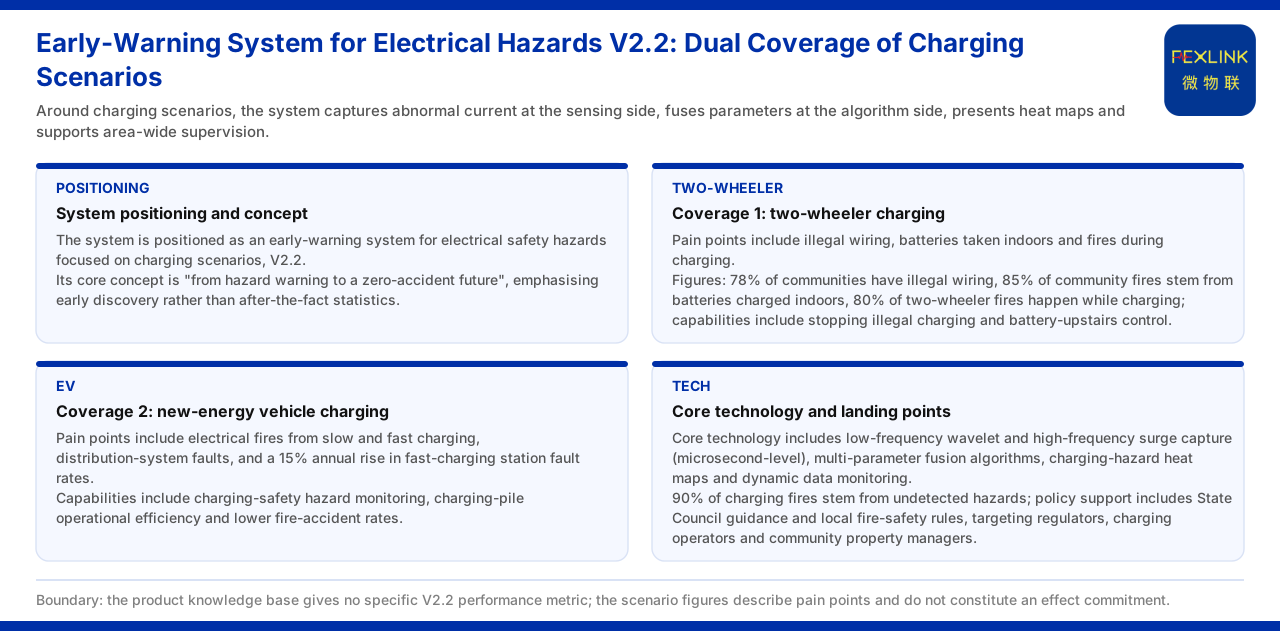
Direct Answer
According to the product knowledge base, the electrical hazard early-warning system is positioned as an electrical-safety hazard early-warning system focused on charging scenarios (V2.2), with the core concept "from hazard warning to a zero-accident future". It adopts dual-system coverage, addressing both two-wheel e-bike charging and new-energy vehicle charging, and provides monitoring and early-warning capability for the pain points of each of the two scenarios. The system takes electrical-quantity acquisition as its basis, combines low-frequency wavelet and high-frequency surge capture, a multi-parameter fusion intelligent algorithm and a charging-hazard heat map, and aims to give a warning before a hazard develops into an accident. It should be noted that the product knowledge base does not give concrete performance indicators of the V2.2 system, such as hazard identification rate, warning lead time or missed-report rate, so this article makes no commitment to those values.
System Positioning and Core Concept
The product knowledge base clearly positions the system in the vertical field of "charging scenarios", with version V2.2 and the core concept expressed as "from hazard warning to a zero-accident future". From this positioning it can be seen that it is not a general electrical monitoring platform but a dedicated system built around the high-frequency, high-risk charging scenario. Narrowing the scenario to charging brings two benefits: first, the acquisition quantities, algorithms and alarm rules can be designed around the characteristics of the charging process; second, the system capability can map directly to the management needs of concrete users such as charging stations and community charging points. The "hazard warning" in the core concept also defines the value boundary of the system — it focuses on finding problems in advance rather than counting accidents afterwards.
Dual-System Coverage One: Two-Wheel E-Bike Charging
The product knowledge base states that the pain points of the two-wheel e-bike charging scenario include illegal fly-line charging, taking batteries into homes, and fire during charging. The concrete figures are: 78 percent of communities have fly-line charging, 85 percent of community fires originate from charging batteries brought indoors, and 80 percent of e-bike fires occur during charging. The corresponding system capabilities include eliminating illegal charging, supervising the charging process, preventing charging fires and governing "batteries going upstairs". The correspondence between this set of figures and capabilities is clear: fly-line charging and bringing batteries indoors are hazards at the behavioural level, and the charging process is a high-risk window at the time level, so the system must manage both "where charging happens" and "whether the charging process is abnormal".
Dual-System Coverage Two: New-Energy Vehicle Charging
The pain points of the new-energy vehicle charging scenario include electrical fires caused by slow and fast charging, distribution-system faults, and an annual increase of 15 percent in the failure rate of fast-charging stations. The corresponding system capabilities include charging-safety hazard monitoring, improvement of charging-pile operating efficiency, and a reduction in the fire accident rate. Unlike the two-wheel scenario, which leans toward behaviour governance, the new-energy vehicle scenario leans more toward the state of the equipment and the distribution system itself: whether the temperature and electrical quantities of the charging pile, the distribution circuit and the connection points are normal directly determines the risk level. The figure of a 15 percent annual increase in the failure rate of fast-charging stations shows that, as fast-charging facilities expand, the pressure of fault and hazard governance is rising, which is precisely the practical reason for the hazard early-warning system to step in.
How the Core Technologies Support Warning
The core technologies listed by the product knowledge base include: low-frequency wavelet and high-frequency surge capture for microsecond-level capture of abnormal current; a multi-parameter fusion intelligent algorithm; a charging-hazard heat map for full-area supervision and precise positioning; and dynamic data monitoring with multi-dimensional intelligent analysis. Taken together, this technology combination addresses the three problems of "capture it, compute it accurately, see it all". Microsecond-level capture means that even an anomaly of very short duration is not easily missed; multi-parameter fusion means the conclusion does not rest on a single indicator; and the heat map lands the conclusion on a spatial distribution so that managers can locate high-risk areas. The product knowledge base also points out that 90 percent of charging fires originate from undetected hazards, which indirectly explains why "finding in advance" is the core goal of this system.
Policy Support and Target Customers
The policy and compliance support listed by the product knowledge base includes the State Council's guiding opinions on a high-quality charging infrastructure system, as well as local management standards for fire safety in new-energy charging sites. The target customers are government regulators, charging operators and community property managers. The cooperation model is a city-partner programme plus channel-partner rights protection. Linking these three points together, the landing path of the system can be understood: policies provide the basis for compliance and governance, regulators, operators and property managers each have different needs, and the cooperation model faces channels wishing to take part in this field. Different customers focus on different things: regulators on the full-area risk situation, operators on equipment reliability and operating efficiency, and property managers on community charging safety.
Boundaries to Note in Use
When using this system, two boundaries must be made clear. First, the product knowledge base gives no concrete performance indicators of V2.2, and performance-type indicators appear only in the related tables of the Taiyi system, so the indicators of the Taiyi system should not be applied to this system. Second, the scenario figures involved in the system (such as 78 percent, 85 percent, 80 percent, 15 percent and 90 percent) are the product knowledge base's description of scenario pain points and should not be read as a commitment to the effect of this system. What is truly verifiable is the monitoring and early-warning capability the system has around these pain points, not result values that are not listed.
The Value of the Heat Map and Full-Area Supervision
The product knowledge base lists the "charging-hazard heat map" as one of the core technologies, whose role is to present hazards by spatial distribution and achieve full-area supervision and precise positioning. For managers, a single alarm can only show "there is a problem somewhere", while the heat map can show "in which areas the problems are concentrated". This shift from point to area changes the governance approach: regulators can judge which districts have more prominent charging hazards, operators can arrange inspection resources accordingly, and property managers can determine the priority of renovation. The value of the heat map lies not in the data itself but in organizing scattered hazard information into a comparable and orderable full-area view.
The Landing Points of System Capability
Collecting the capabilities above, the landing points of the system are relatively clear: capture abnormal current on the perception side, perform multi-parameter fusion on the algorithm side, give a heat map on the presentation side, and support full-area supervision on the management side. The two-wheel e-bike scenario leans toward behaviour and process governance while the new-energy vehicle scenario leans toward equipment and distribution state, and the two share the same technology foundation. Understanding these landing points helps clarify, in scheme communication, what the system can and cannot solve: it can help find hazards earlier and locate risk areas more clearly, but it does not replace the compliance construction and on-site management of the charging facilities themselves.
Applicability and Limits
- The content of this article is limited to the product knowledge base's existing statements on the positioning, dual-system scenarios, core technologies, policy support, target customers and cooperation model of the electrical hazard early-warning system V2.2, and does not extend to algorithm or deployment details not listed.
- The scenario figures in the text (78 percent, 85 percent, 80 percent, 15 percent, 90 percent, etc.) are cited under the listed convention and do not constitute an effect commitment for a specific project.
- The product knowledge base gives no performance indicators of V2.2, and this article makes no inference, nor does it apply indicators of other systems to this system; actual capability is subject to the latest product documents and project scheme.