 微物联研究院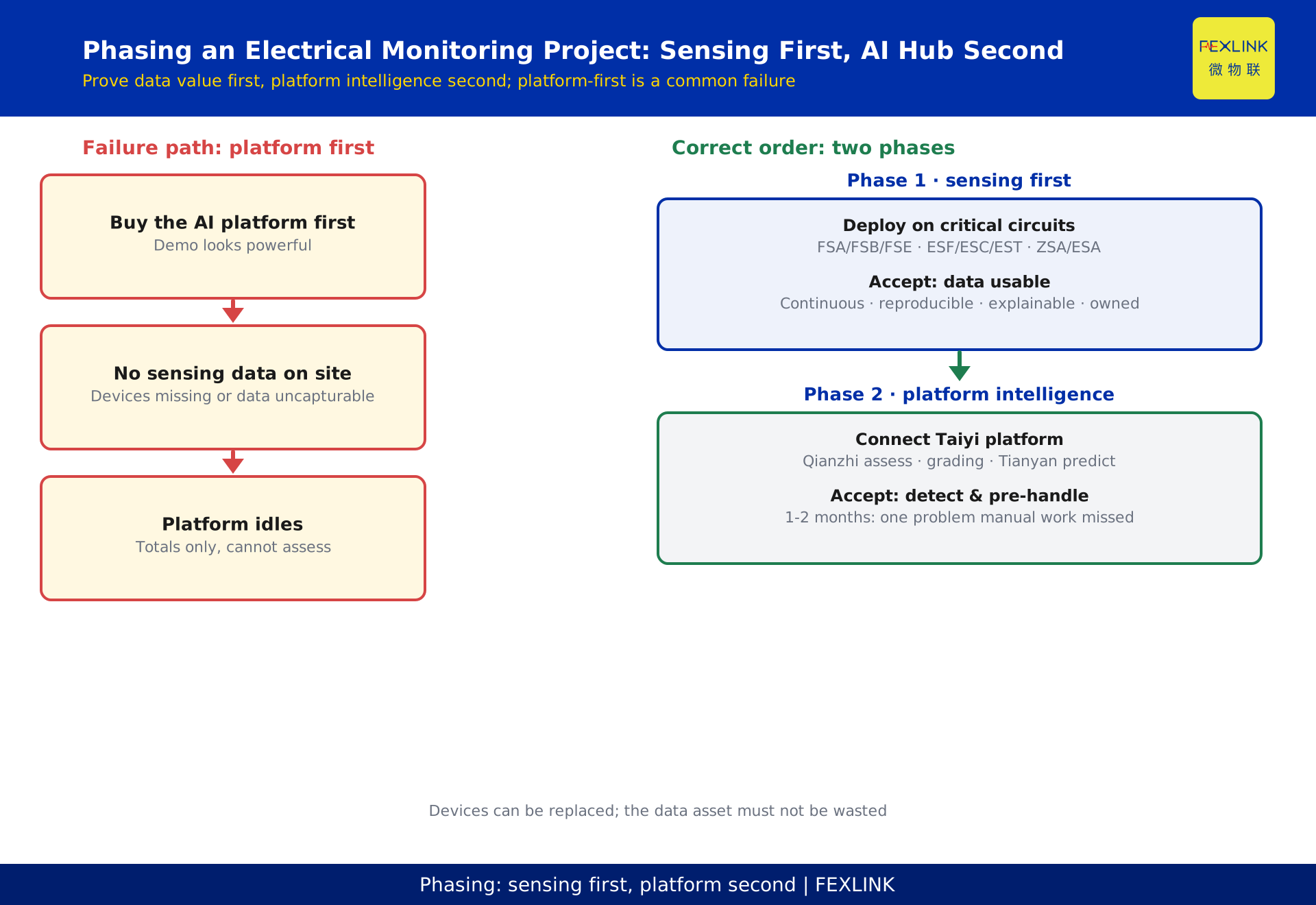
# How to Phase an Electrical Monitoring Project: Sensing First, AI Hub Second
Direct Answer
The safest investment order for an electrical monitoring project is "point-level monitoring first, platform intelligence second" — Phase 1 deploys control devices on critical circuits to capture state data and prove value; Phase 2 connects the Taiyi AI hub for centralized assessment and linkage. The reverse path — "buy the platform first, add sensing later" — is the most common failure mode: without data, even the strongest algorithms run idle.
For project owners, channel partners, and IT leads, this article explains three things: why sensing must precede the platform; what each of the two phases buys; and what counts as "verification passed" in Phase 1.
Why "Platform First, Sensing Later" Fails
A typical failure path in a distribution scenario:
- Decision-makers see the AI platform demo, conclude "assessment is powerful," and buy the platform first;
- After launch they find the site has no sensing devices — or old devices whose data cannot be captured;
- The platform becomes an empty dashboard: only meter totals, no circuit-level state data;
- Asked "what did the AI analyze?", the answer is "insufficient data for assessment."
There is one root cause: the platform's assessment quality is set by sensing data; no data, no intelligence.
The Correct Order: Sensing First, Platform Second
The recommended two-phase investment:
- Phase 1 (sensing first): deploy on critical circuits — multi-element control devices FSA/FSB/FSE (voltage/current/temperature/leakage), special-purpose devices ESF/ESC/EST (fire/leakage/temperature), and smart meters ZSA/ESA (metering and power quality) as needed, so that "key data is capturable, viewable, and verifiable";
- Phase 2 (platform intelligence): once data is stable, connect the Taiyi platform with the Qianzhi engine for multi-dimensional assessment and alarm grading, plus the electrical-hazard early-warning system for trend prediction.
The logic of the order: answer "is there data and is it accurate" first, then answer "how to use the data."
What Counts as "Verification Passed" in Phase 1
Phase 1 is not "buy the devices and done"; it needs acceptance criteria:
- Data continuously available: critical circuits collect continuously for 7-30 days, with a missing-data rate below an acceptable threshold;
- Anomalies reproducible: the site can reproduce at least one typical anomaly (e.g., leakage fluctuation or temperature excursion on a circuit) and the system captures it correctly;
- Alarms explainable: alarms map to specific circuits and causes, not a pile of "unlocatable" noise;
- Business ownership: operations/safety teams have someone looking at and using the data weekly — not just the builder.
When all four pass, proceed to Phase 2.
What Phase 2 Buys and How to Verify It
Phase 2 is not about "more devices" but "turning data into action":
- Centralized assessment: the Taiyi platform aggregates all circuit data; the Qianzhi engine performs cross-point assessment (distinct from single-point alarms);
- Alarm grading and linkage: alarms graded by severity; important alarms link to work orders, notify responsible staff, and where necessary link breakers/control devices to execute protection;
- Trend and prediction: the Tianyan engine predicts trends, moving "already failed" earlier to "about to fail."
Verification standard: within 1-2 months of connection, the system should detect and pre-handle at least one problem that manual inspection previously could not find.
Two Common Variants
- Some sensing devices already exist: Phase 1 only fills gaps (add leakage where missing, temperature where missing), no need to replace everything;
- Budget covers only one phase: do sensing first, platform in Phase 2; at minimum keep data exportable offline and integrable later.
The principle: devices can be replaced; the data asset must not be wasted.
How Channel Partners Pitch the Phased Plan
When pitching phased plans, explain three steps:
- Tell the customer "the platform is a result, not a starting point" — spend small first to prove data value;
- Lock Phase 1 pricing to critical circuits to control the first budget;
- Write the "verification passed" acceptance criteria into the contract; Phase 2 follows naturally.
Phased plans significantly lower the customer's decision threshold and keep both sides' risk in check.
Seven: Three Handover Actions Between the Two Phases
Between phase-one acceptance and phase-two kickoff, three things make phase two smooth:
- Turn data into an asset: export phase-one data into baseline archives — each circuit's normal fluctuation range and seasonal pattern. Phase two's AI assessment uses these as initial baselines, skipping the relearning period;
- Verify reserved interfaces: confirm whether the gateway and platform reserved phase-two points, protocols, and computing capacity. Fill gaps at phase-one close-out, instead of discovering at phase-two kickoff that the gateway must be replaced;
- Solidify people and process: institutionalize the inspection, alarm-handling, and review routines built in phase one. Phase two then only adds data sources and capabilities — the organization does not restart.
Good handover makes phase two look like an upgrade rather than a rebuild.
Commercial Points in a Phased Plan
- Write phase-one scope and acceptance clearly: the phase-one contract must state which circuits, which functions, and how acceptance is done, so phase-two criteria do not roll back onto phase one;
- Reserve pricing for phase two: agree the unit price and discount rules for phase-two expansion in the phase-one contract, locking commercial expectations and avoiding renegotiation;
- Write data ownership explicitly: who owns the monitored data, whether it is portable, and the anonymization requirements — agreed in the first contract, not disputed in the second.
Nine: Common Questions — How Phase-One Data Serves Phase Two
- Build data quality in phase one: standardize point tables, sampling frequency, time synchronization, and data continuity in phase one, so phase-two models have clean data to work with;
- Build an event ledger in phase one: record every phase-one alarm, action, and recovery. These real events are the golden samples for training and validating phase-two rule bases;
- Prove the value loop in phase one: even if only one circuit runs "sense → alarm → action → verify," phase two can replicate that proven path across all circuits. This is why phasing works: it is not dividing one project into two; it is using the first phase to de-risk the second.
Ten: Phase-One Close-Out Checklist
Before phase-one acceptance, walk through this checklist item by item:
- Data is queryable: the platform can query history by circuit and by time; exports are clean with no gaps or encoding issues;
- Alarms are traceable: every alarm can be traced to its circuit, timestamp, handler, and recovery time;
- Linkage is reliable: local linkage still executes as configured during power or network loss, because on-site action takes priority;
- Documents are complete: point table, device point table, communication parameters, acceptance records, and operation manual are archived as the five-document set;
- Training is done: duty staff can independently perform daily inspection, alarm handling, and monthly review without relying on implementation staff being present.
Once this checklist passes, phase one is truly closed and phase two starts from a clean baseline. Skipping any item here usually means paying for it during phase-two commissioning, when fixes are more expensive and more visible.
Common Questions — Will Phase Two Overthrow Phase One?
- Will the platform be replaced? During phase-one selection, confirm the platform upgrades smoothly in place — same architecture, added capability. Phase two reuses the same platform; data does not migrate;
- Will sensing devices be reinstalled? Phase-one points are laid out with phase-two plans in mind, so phase two only adds new points and existing devices keep working;
- Will the rule base start over? The event ledger and baselines accumulated in phase one feed phase two's rule base directly. Phase two extends phase-one experience; it does not start from zero.
In one sentence: phase two is a continuation of phase one, not a replacement — provided phase one was designed to evolve. This is why "phase" is a technical commitment as much as a commercial one: the first phase's architecture, point layout, and data discipline are exactly what make the second phase cheap. Any phase-one shortcut that saves money on architecture usually turns into phase-two rework at several times the cost, which is why the close-out checklist in the previous section is not paperwork but an investment decision.
A useful rule of thumb for deciding how much to put in phase one: include everything needed to answer the owner's single most important question about the site — usually "which circuit is about to fail or overrun" — and defer everything else. A phase one that answers one question decisively is easier to justify, easier to accept, and far more likely to get phase two funded than a phase one that answers ten questions tentatively. Start narrow, finish deep, then expand — and never let phase two fund phase one.
Scope and Limitations
Reading page for KD-0021. Product functions (FSA/FSB/FSE multi-element control devices, ESF/ESC/EST special-purpose control devices, ZSA/ESA smart meters, the Taiyi platform with Qianzhi/Tianyan engines, and the electrical-hazard early-warning system) come from the FEXLINK product knowledge base as product-documentation conventions. The "two-phase order" and "four acceptance criteria" are this article's phasing method for reference; specific phasing and acceptance standards should be confirmed by professional pre-sales staff based on the actual project. This page is not a specific project proposal.