 微物联研究院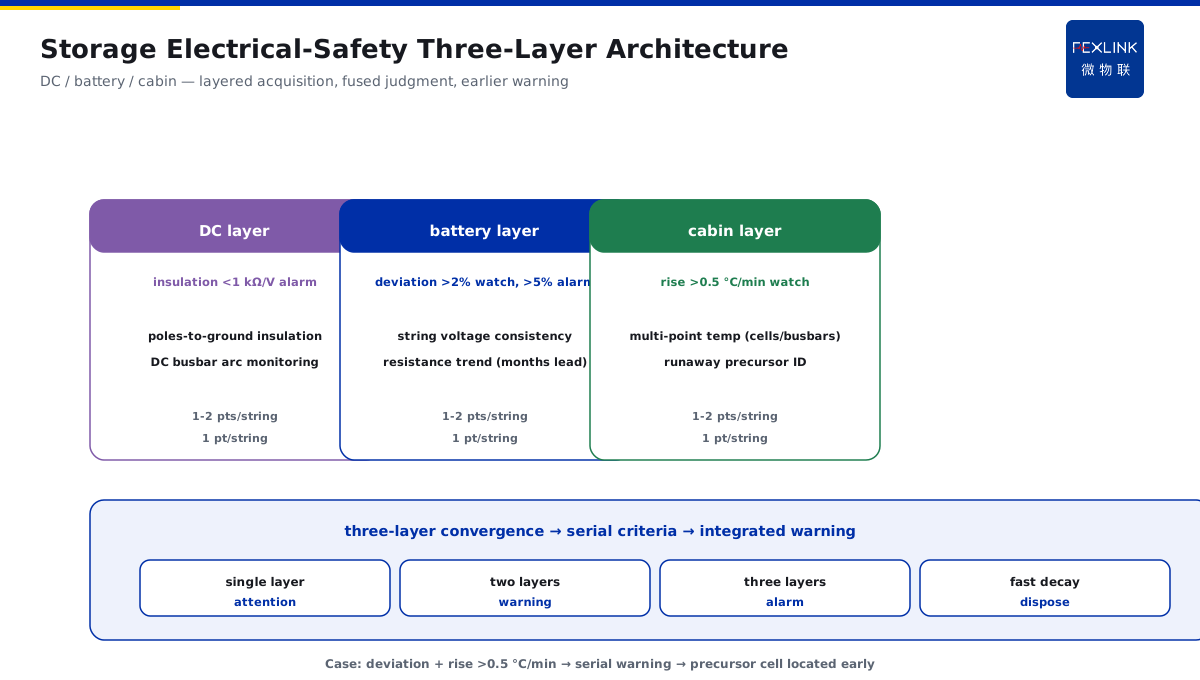
Direct Answer
For a new energy-storage station, the owner requires an electrical-safety monitoring scheme covering all AC/DC risks. How should the scheme be designed? The answer: a three-layer architecture — the DC layer monitors insulation resistance and arcing risk; the battery layer monitors string-level voltage consistency and internal-resistance trends; the cabin layer monitors the temperature field and thermal-runaway precursors; the three layers converge and run serial criteria (consistency deviation + temperature-rise rate), moving the warning earlier.
A 10 MW/20 MWh storage station was built with the three-layer scheme: the DC layer added insulation monitoring on each string's positive/negative poles to ground (alarm below 1 kΩ/V) plus DC arc monitoring; the battery layer monitored per-string voltage consistency (watch at deviation > 2%) plus internal-resistance trends; the cabin layer monitored multiple temperature points per cabin (cells, busbars, PACK enclosures) plus temperature-rise rate. During operation, one battery group in cabin B showed rising voltage deviation and the string's temperature-rise rate exceeded 0.5 °C/min; the serial criterion triggered a warning — the precursor cell was located in advance and handled in time, preventing the incident from expanding. The core of an energy-storage electrical-safety scheme is "three-layer architecture + serial criteria": the DC layer watches insulation and arcing, the battery layer watches consistency and internal resistance, the cabin layer watches the temperature field — with three layers of data fused, the warning can move earlier.
Because:
- Storage risks span AC and DC: DC-side insulation/arcing, battery consistency, cabin thermal runaway — single-layer monitoring loses focus on the rest;
- Thermal runaway has precursors: voltage-consistency deviation plus rising temperature-rise rate precede ignition — catch the precursor to prevent the fire;
- Layer-by-layer acquisition, fused judgment: each layer monitors independently; serial criteria output integrated — no false alarms, no misses;
- Earlier warning is the value: from "extinguish after the fact" to "locate before the event" — dispose at the thermal-runaway precursor.
Key insight: storage electrical safety is a three-layer architecture, not a pile of sensors. DC layer + battery layer + cabin layer + serial criteria — with all four, risk is fully covered.
At one storage station, a string's internal resistance rose slowly for three months; the platform warned by trend that "this string's capacity decay is accelerating" and recommended maintenance; inspection found a loose battery connection in the string; after repair the internal resistance fell — internal-resistance trend is the "lead time" of battery degradation, visible months before voltage anomalies.
1. Three-Layer Monitoring Objects and Points
Step one: what to monitor and where the points go.
DC layer (insulation and arcing):
- Objects: DC busbar, battery-string positive/negative poles to ground;
- Points: each string's poles to ground (insulation monitoring), DC busbar (arcing monitoring);
- Role: early discovery of insulation drop and DC arcing (arc discharge);
- Reference: alarm below 1 kΩ/V insulation resistance; arc-event records.
Battery layer (consistency and internal resistance):
- Objects: string voltage, internal resistance, capacity consistency;
- Points: per-string voltage (inter-string/intra-string deviation), internal resistance (trend);
- Role: early discovery of consistency deviation (cell mismatch) and internal-resistance rise (degradation);
- Reference: watch at deviation > 2%; warn when the resistance-trend slope rises.
Cabin layer (temperature field and thermal runaway):
- Objects: cells, busbars, PACK enclosures, cabin air;
- Points: multiple temperature points per cabin (cells + busbars + enclosures);
- Role: temperature-field distribution, temperature-rise rate (thermal-runaway precursor);
- Reference: watch at > 0.5 °C/min rise rate; warn at > 1 °C/min.
Point density:
- DC layer: 1–2 insulation points per string;
- Battery layer: 1 voltage/resistance point per string (string level);
- Cabin layer: 6–12 temperature points per cabin (per cabin capacity).
Key insight: three-layer points mean full risk coverage. DC insulation/arcing, battery consistency/resistance, cabin temperature field — three-layer points, no risk left uncovered.
2. DC Insulation and Arc Monitoring
Layer one: how the DC side is monitored.
Insulation monitoring:
- Principle: monitor the DC system's positive/negative insulation resistance to ground (bridge/injection method);
- Role: early discovery of insulation drop (moisture, aging, damage);
- Reference: alarm below 1 kΩ/V (system voltage 750 V → below 750 kΩ);
- Positions: each string's poles to ground, DC busbar.
Arc monitoring:
- Principle: monitor DC-circuit arc signatures (current harmonics, arc-flash signals);
- Role: fast discovery of DC arcing (loose connections, insulation-breakdown discharge);
- Reference: arc-event records (count/duration/energy);
- Positions: DC busbar, string connection points.
DC-layer criteria:
- Insulation resistance continuously falling → warning (moisture/aging);
- Insulation resistance suddenly drops → alarm (breakdown risk);
- Arc event → immediate inspection (arc high-temperature risk);
- Insulation + arc together → integrated warning (severe).
DC-layer value:
- DC-side risk independently covered (not dependent on the battery layer);
- Fast discovery of insulation/arcing (prevent arc fire);
- Corroborates with the battery layer (voltage anomaly + insulation drop).
Key insight: the DC layer watches insulation and arcing. Insulation resistance + arc monitoring — DC-side risk independently covered, preventing arc fire.
3. String-Level Consistency and Internal-Resistance Trends
Layer two: how the battery strings are monitored.
Voltage consistency:
- Principle: monitor per-string/per-cell voltage, compute intra-string deviation;
- Role: early discovery of consistency deviation (cell mismatch, connection problems);
- Reference: watch at deviation > 2%, warn at > 3%, alarm at > 5%;
- Trend: deviation continuously widening = mismatch worsening.
Internal-resistance trend:
- Principle: monitor cell internal resistance (computed online during charge/discharge);
- Role: early discovery of resistance rise (degradation, loose connections);
- Reference: warn when the trend slope rises; watch above 1.5× initial;
- Trend: slow rise over months = degradation signal.
Battery-layer criteria:
- Deviation rising + resistance rising → warning (mismatch + degradation);
- Deviation jumps → alarm (single-cell anomaly);
- Resistance step change → inspect (loose connection);
- Consistency + temperature rise in sync → integrated warning (severe).
Battery-layer value:
- String-level state continuously visible (no waiting for a voltage alarm);
- Resistance trend gives months of lead (earlier than voltage anomalies);
- Corroborates with cabin temperature (consistency + temperature rise).
Key insight: the battery layer watches consistency and internal resistance. Voltage deviation + resistance trend — degradation signals visible months early.
4. Cabin Temperature Field and Thermal-Runaway Precursors
Layer three: how the cabin is monitored.
Temperature-field monitoring:
- Principle: multiple temperature points per cabin (cells, busbars, PACK enclosures);
- Role: temperature distribution, hotspot locating, thermal-runaway precursors;
- Reference: watch at > 0.5 °C/min rise rate; warn at > 1 °C/min;
- Positions: 6–12 points per cabin (per cabin capacity).
Thermal-runaway precursor identification:
- Temperature-rise rate (fast rise over a short time = precursor);
- Abnormal temperature distribution (local hotspot = cell anomaly);
- Adjacent-point temperature difference (large inter-cell ΔT = mismatch/connection);
- Gas/smoke (late-stage signal, auxiliary confirmation).
Cabin-layer criteria:
- Rise rate over limit → warning (thermal-runaway precursor);
- Local hotspot → inspect that cell (locate);
- Temperature + gas together → alarm (runaway confirmed);
- Multi-cabin linkage → integrated disposition (isolate/cool).
Cabin-layer value:
- Full temperature-field view (not single-point temperature);
- Precursor captured (rise-rate criterion);
- Hotspot located (fast disposition).
Implementation points:
- Survey/design: cabin structure, cell layout, DC circuits;
- Point placement: per-string insulation points (DC), string-level points (battery), multi-point temperature (cabin);
- Baseline establishment: normal charge/discharge baselines (voltage deviation, temperature rise, insulation);
- Serial configuration: criteria thresholds, time windows, fast-deterioration rules;
- Acceptance trial run: alarm verification, serial verification, false-alarm-rate assessment;
- Linkage testing: thermal-runaway drill (isolation, cooling, fire linkage).
Pre/post comparison reference:
- Before: manual inspection + single-cell voltage monitoring; thermal-runaway precursors hard to find;
- After: three-layer monitoring + serial criteria; precursors warned hours ahead;
- False-alarm rate: single-layer fluctuations no longer alarm after serial criteria (< 20%);
- Disposition efficiency: from "extinguish after the fact" to "precursor locating," disposition time greatly shortened;
- Key takeaway: storage safety shifts from "passive emergency" to "proactive warning."
Key insight: the cabin layer watches the temperature field and thermal runaway. Multi-point temperature + rise rate — precursors captured, disposed before ignition.
5. Three-Layer Data Fusion Criteria
How the three layers fuse: serial criteria are the core.
Serial-criteria design:
- Single-layer anomaly → attention (record and observe by layer);
- Two layers together → warning (e.g., consistency deviation + temperature-rise rate);
- Three layers together → alarm (e.g., insulation drop + consistency + temperature rise);
- Fast deterioration → integrated disposition (immediate isolation/cooling);
- Criteria configured per storage cabin (each cabin judged serially independently).
Typical serial scenarios:
- Deviation rising + rise rate > 0.5 °C/min → warning (mismatched cell heating);
- Insulation drop + voltage anomaly → warning (moisture + cell anomaly);
- Arc + temperature jump → alarm (arc-fire risk);
- Three layers together → integrated warning (thermal-runaway precursor confirmed).
More typical serial scenarios:
- Insulation-resistance drop + that string's temperature rising → warning (moisture-induced heating);
- Resistance continuously rising + deviation widening → warning (accelerating degradation);
- Rise rate over limit + local hotspot → alarm (precursor confirmed);
- Three layers together + gas signal → integrated disposition (immediate isolation + fire linkage).
Fusion-threshold setting:
- Single-layer thresholds: per OEM recommendation + on-site baseline;
- Serial thresholds: triggered when two layers co-occur (loosen single-layer thresholds against false alarms);
- Time window: co-occurrence within the same window counts as serial (not if at different times);
- Fast deterioration: slope over limit in a short time upgrades directly (no waiting for confirmation).
Meaning of fusion:
- Isolated alarms → serial judgment (more accurate);
- Fewer false alarms (single-layer fluctuations do not alarm);
- Earlier warning (dispose at the precursor).
Key insight: serial criteria are the core of fusion. Single layer attention, two layers warning, three layers alarm — three layers serialized, judgment is accurate.
6. Product Landing: Storage Three-Layer Monitoring Scheme
FEXLINK products bring the storage three-layer monitoring scheme to the field:
- ESE Power-Quality Monitor: DC insulation monitoring, arc monitoring, power-quality analysis;
- ESX Edge Computing Gateway: three-layer data convergence, local baselines, serial criteria;
- Electrical Hidden-Risk Early-Warning System: platform integrated alerts, linkage disposition, work-order closure;
- Battery-layer monitoring: string-level voltage/resistance (data connected to the platform for analysis);
- Cabin-layer monitoring: multi-point temperature + rise rate (thermal-runaway precursors).
Design principle in one sentence: turn "single-point monitoring" into "three-layer fusion." DC layer + battery layer + cabin layer + serial criteria — storage risk fully covered, warnings moved earlier.
7. Common Scheme-Design Mistakes
- Battery only, no DC: only cell voltage. Consequence: DC insulation/arcing risk missed. Correct: three-layer full coverage.
- Single-point temperature: only cabin air temperature. Consequence: cell hotspots missed. Correct: multi-point temperature + rise rate.
- No resistance trend: voltage only. Consequence: degradation found late. Correct: voltage consistency + resistance trend.
- Each layer alarming independently: three layers not fused. Consequence: isolated alarms, poor judgment. Correct: serial criteria for integrated judgment.
- Ignoring thermal-runaway precursors: only absolute temperature. Consequence: no warning before fire. Correct: rise-rate criteria (precursor identification).
Scope and Limitations
This article provides an overall framework for electrical-safety monitoring of energy-storage stations (three-layer monitoring objects and points, DC insulation and arcing, string-level consistency and internal resistance, cabin temperature field and thermal-runaway precursors, data-fusion criteria) for electrical-safety monitoring project design on storage stations (including C&I storage cabins). Point density and criteria thresholds should be adjusted to storage scale, cell chemistry (LFP/NCM), and OEM recommendations; DC insulation and arc monitoring involves high-voltage DC safety and must be installed and commissioned per procedures by qualified personnel; thermal-runaway disposition (isolation, cooling, fire-fighting) involves safety operations and must be performed per procedures with approval. Online monitoring data is managed uniformly through the platform to form trend alerts. All cases are anonymized (a certain storage station) and do not refer to any specific customer.