 微物联研究院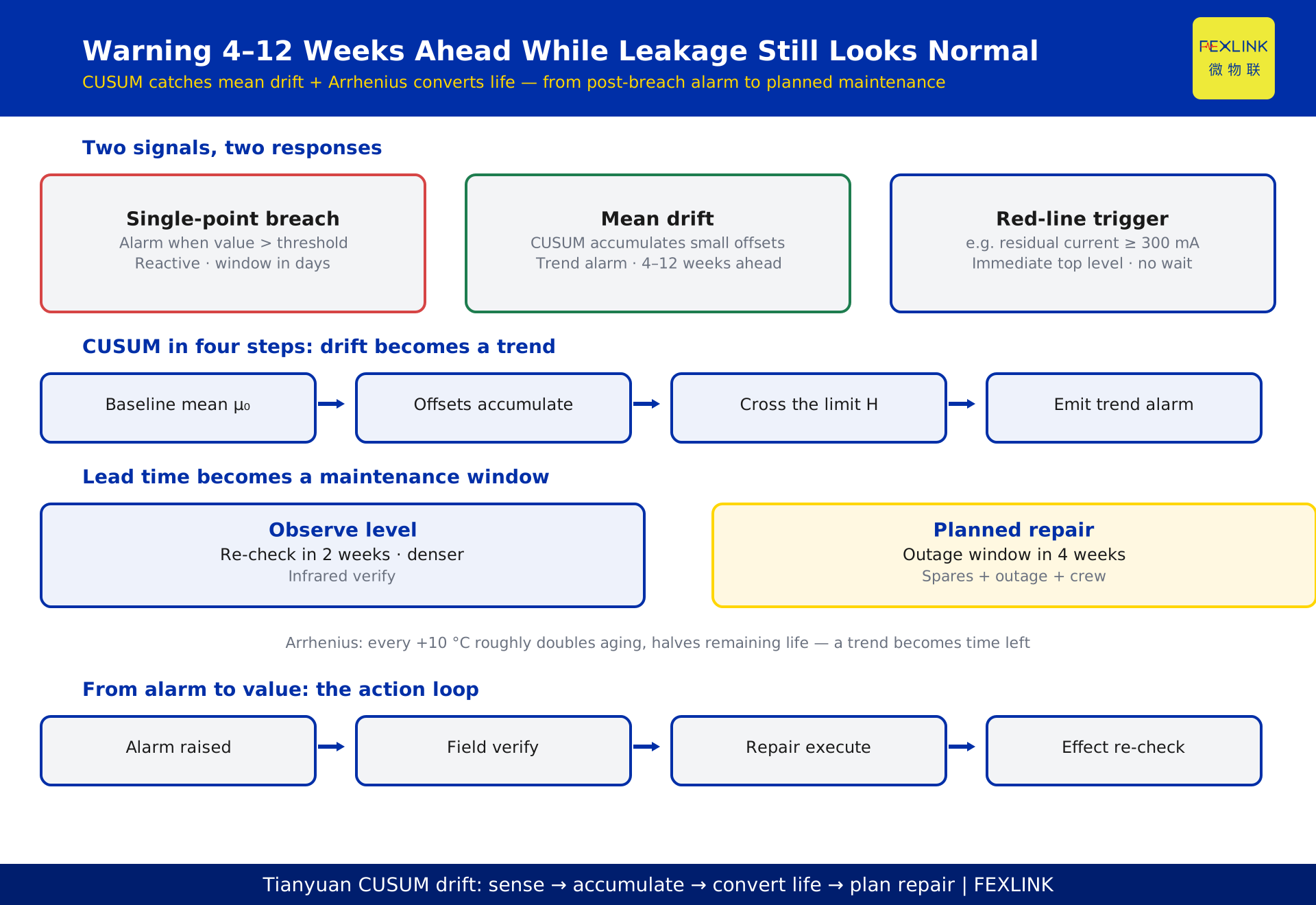
# Warning 4–12 Weeks Ahead While Leakage Still Looks Normal: Tianyuan's CUSUM Drift Detection
Direct Answer
Waiting until leakage current crosses the safety line to alarm is often too late. The Tianyuan engine uses CUSUM (cumulative-sum) change-point detection to track small drift in the mean of residual current — even while the absolute value stays inside the safe band (for example 18 mA), a persistently rising trend can be flagged 4–12 weeks in advance, turning "alarm after threshold breach" into input for planned maintenance. Combined with the Arrhenius equation, which converts temperature rise into insulation-life consumption, the warning tells you not only that a problem is developing but roughly how much time remains — the essential difference between predictive maintenance and traditional threshold alarms.
For operations staff, this article answers three questions: why "compliant but drifting" is the most dangerous state; why CUSUM catches small changes that threshold alarms miss; and what 4–12 weeks of lead time means in a maintenance schedule. The desensitized example of "a campus distribution system" illustrates the logic without referencing any specific project.
Why "Compliant but Drifting" Is More Dangerous than Breaching the Limit
Electrical faults almost never appear as step changes; they develop gradually. In insulation degradation, for example, partial discharge, moisture ingress, and thermal aging all push leakage current upward slowly, over weeks or months. Conventional thinking is "no breach, no problem" — a residual current of 300 mA is the SAR red-line reference (per the GB 13955 framework), and 100 mA has not reached the line, so it seems manageable.
The problem is precisely here: by the time 300 mA triggers action, the insulation may already be in its accelerated-degradation phase, leaving a window measured in days or hours. The drift phase (say, 12 mA climbing slowly to 18 mA) usually still offers a plannable 4–12 week window. This is like a thermometer: a 38 °C alarm matters, but "rising 0.1 °C every day for a week" is more informative — the former is a diagnosis, the latter is an early warning.
So the first mindset shift of predictive maintenance is: replace "is the instantaneous value over the limit?" with "is the mean drifting?" Mean drift is a trend signal; threshold breach is a state signal. Trend signals appear earlier and leave a much larger intervention window.
The Blind Spots of Threshold Alarms: They Only Answer "Are We over the Line Now?"
A threshold alarm is, mathematically, one comparison: current value > threshold → alarm. It has three inherent blind spots:
- Single-point noise masks the trend. Field leakage current carries noise — load swings, temperature changes, harmonic components — so single samples jumping between 12 mA and 18 mA is normal. The threshold either rattles with false alarms or, set higher, lets the real drift pass.
- No time dimension. It does not distinguish "steady at 15 mA" from "climbing from 12 mA to 15 mA" — physically very different situations: the former may be seasonal temperature variation, the latter may be early insulation degradation.
- No lead time. The moment the alarm fires is the moment action must start; the maintenance window collapses to its minimum.
Breaking through these blind spots requires a statistic that "remembers history and measures change." That is where CUSUM comes in.
The Intuition of CUSUM: Accumulating Small Offsets One Step at a Time
The idea behind CUSUM change-point detection is deliberately simple: if the process is not drifting, the signed deviations of each sample from a reference mean should cancel out and hover around zero; if a persistent drift exists, deviations accumulate in one direction, the cumulative sum keeps climbing, and a change of mean is confirmed.
Formally, with reference mean μ₀ and sample xₖ, the cumulative sum is Sₖ = max(0, Sₖ₋₁ + (xₖ − μ₀) − K), where K is the allowable noise band (an insensitivity zone). Noise can nudge Sₖ up only slightly at each step; without a true drift, negative deviations pull it back to zero. Only a sustained one-directional shift keeps pushing Sₖ upward until it crosses the decision threshold H and triggers the alarm.
The elegance: a single 1 mA offset is invisible to anyone, but 30 consecutive samples each offset by 1 mA accumulate past the decision threshold with ease. CUSUM is therefore extremely sensitive to "small but persistent" change and naturally immune to "random but trendless" noise — exactly the properties leakage-current monitoring needs.
Decision Rules and "Better to Over-Alarm than to Miss"
In the product implementation, trend-drift analysis (item S-02 in the knowledge base) adds engineering constraints to CUSUM, with the core parameter philosophy of "better to over-alarm than to miss":
- Adaptive baseline. μ₀ is not chosen arbitrarily; it is established dynamically from the measurement point's history (typically a multi-week window under similar operating conditions) and periodically re-estimated, avoiding mistaking seasonal variation for degradation.
- Sensitive decision threshold. Between false-alarm rate and miss rate, the design explicitly favors the side with lower miss risk — a trend alarm's output is an "observation suggestion"; over-alarming costs one human look, missing costs the maintenance window.
- Decoupled from SAR red lines. CUSUM does not change red-line behavior. A red line (such as residual current ≥ 300 mA) always triggers the highest-level alarm directly; CUSUM provides an earlier signal before the line is reached. The two are complementary, not substitutes.
The result: while leakage is still in the safe band (e.g., 18 mA), the system already reports "residual current trend rising persistently, suspected early insulation degradation" with a warning level. That is where the "ahead" comes from.
Arrhenius: Converting Temperature into Life Consumption
A trend alone is not enough — operations needs "how long do we have." The second building block of the Tianyuan engine is the Arrhenius equation, which quantifies how chemical/physical aging rate relates to temperature. The commonly used engineering rule of thumb: every 10 °C rise roughly doubles the thermal aging rate of insulation and halves its equivalent remaining life.
In the prediction flow, for heat-type faults (terminal contact-resistance degradation, local overload, poor ventilation), the system collects the temperature trend in parallel and uses Arrhenius to estimate how much equivalent life that temperature curve has consumed, then combines the exponential growth pattern of leakage and the nonlinear growth curve of contact resistance to extrapolate remaining usable time. The warning thus upgrades from a directional judgment to a time-based judgment:
- The leakage trend gives the direction: degradation is happening.
- The temperature-life model gives the rate: at the current trend, equivalent life is roughly 5–9 weeks.
- Fused, the output is an actionable conclusion: "schedule maintenance within X weeks."
On the algorithm side, the Tianyuan prediction engine combines CUSUM change-point detection, Prophet (time-series forecasting that can inject Arrhenius electrical knowledge as prior), XGBoost/LightGBM, and Holt-Winters triple exponential smoothing, covering different time scales and data types.
What 4–12 Weeks of Lead Time Means in a Maintenance Schedule
4–12 weeks is not a marketing number; it corresponds to three practical values:
- Planned maintenance instead of emergency response. A window of four weeks or more is enough for spare-part procurement, outage application, crew scheduling, and work-permit approval. Electrical outage windows often must be coordinated with production schedules in advance — managing by weeks versus by days is a completely different administrative cost.
- Expected downtime instead of surprise failures. Planned maintenance can schedule outages at low load (night or production shutdown), so the production loss of one scheduled stop is far below an unscheduled trip — which often adds penalties, data loss, and cascading faults.
- Room for tiered response. With early warning, duty staff can first arrange observation and re-measurement (e.g., denser sampling, on-site infrared verification), then escalate to a maintenance task only after confirmation — instead of triggering the highest response level immediately and exhausting all human resources.
This is why lead time is worth more than alarm accuracy in management terms: lead time directly determines the size of the available decision space.
Turning Trend Alarms into Field Actions
A warning creates value only when it lands on a concrete action chain. A typical closed loop:
- Alarm generation. CUSUM crosses the threshold; the system issues a "residual current trend drift" warning with confidence and four-dimension impact labels (safety/efficiency/life/carbon).
- Tiered response. Graded by trend slope and distance to the red line — early stage gets an "observe" level (denser monitoring, re-evaluation within two weeks); acceleration stage gets a "planned maintenance" level (outage window within four weeks).
- On-site verification. Operations staff verify with an infrared thermometer or clamp meter to confirm insulation degradation rather than a measurement-channel problem; measurement anomalies are closed out directly, and true hazards enter the maintenance queue.
- Maintenance execution. Work is completed in the planned outage window (e.g., replacing aged cable, tightening terminals, treating moisture points).
- Effect re-check. After maintenance, the trend curve falls back and stabilizes; the system confirms alarm clearance and records the full "alarm → verify → repair → re-check" chain as a case to tune that measurement point's baseline and thresholds.
The core of this chain: a trend alarm's value is not at the moment it fires, but in the options it leaves for every step that follows.
Division of Labor: Qianzhi Judges the Present, Tianyuan Judges the Future
Within the same TAI central hub, two engines divide the work: the Qianzhi engine (CERE) answers "is it abnormal now" — sensing and scoring multidimensional parameters with 50 sub-models; the Tianyuan engine answers "when will it fail" — predicting with trend and life models. The former is state estimation, the latter is time prediction; their inputs and outputs are complementary:
| Dimension | Qianzhi engine | Tianyuan engine |
|---|---|---|
| Question | Abnormal now? What is it? | Will it fail? How soon? |
| Method | Parameter sensing, multidimensional scoring | CUSUM, Arrhenius, time-series prediction |
| Output | Risk score, alarm level | Trend warning, remaining-life window |
| Decision value | Whether to act | When to act |
In the pipeline, Qianzhi's scores and Tianyuan's predictions converge at the L6 fusion-decision layer into an overall health score and action recommendation. Field staff do not need engine internals — just remember: the Qianzhi score tells you what to handle today; the Tianyuan lead time tells you what to schedule next. Together they form the complete loop from reactive response to proactive operations.
Scope and Limitations
This is the reading page for KD-0011. CUSUM and the Arrhenius equation are general statistical and engineering methods; this article describes their application within the Tianyuan engine of the TAI central hub. Expressions such as "4–12 weeks ahead" and "better to over-alarm than to miss" reflect product-documentation conventions (knowledge base: S-02 residual-current trend drift); actual lead time depends on field measurement density, data quality, and operating-condition stability and may differ by project. Trend alarms rely on data continuity: with acquisition interruptions, channel faults, or an unestablished baseline, CUSUM cannot work reliably. The "campus distribution system" and the 18 mA example are desensitized illustrations, not specific project data. Trend alarms do not replace mandatory safety protections such as SAR red lines — red-line triggers still demand immediate highest-level handling; any maintenance decision should still follow site procedures and human review. Standard references (e.g., the residual-current red-line reference under the GB 13955 framework) follow the currently effective editions. The algorithm portfolio (CUSUM, Prophet, XGBoost/LightGBM, Holt-Winters) is a product-documentation disclosure; implementation details follow product documentation.