 微物联研究院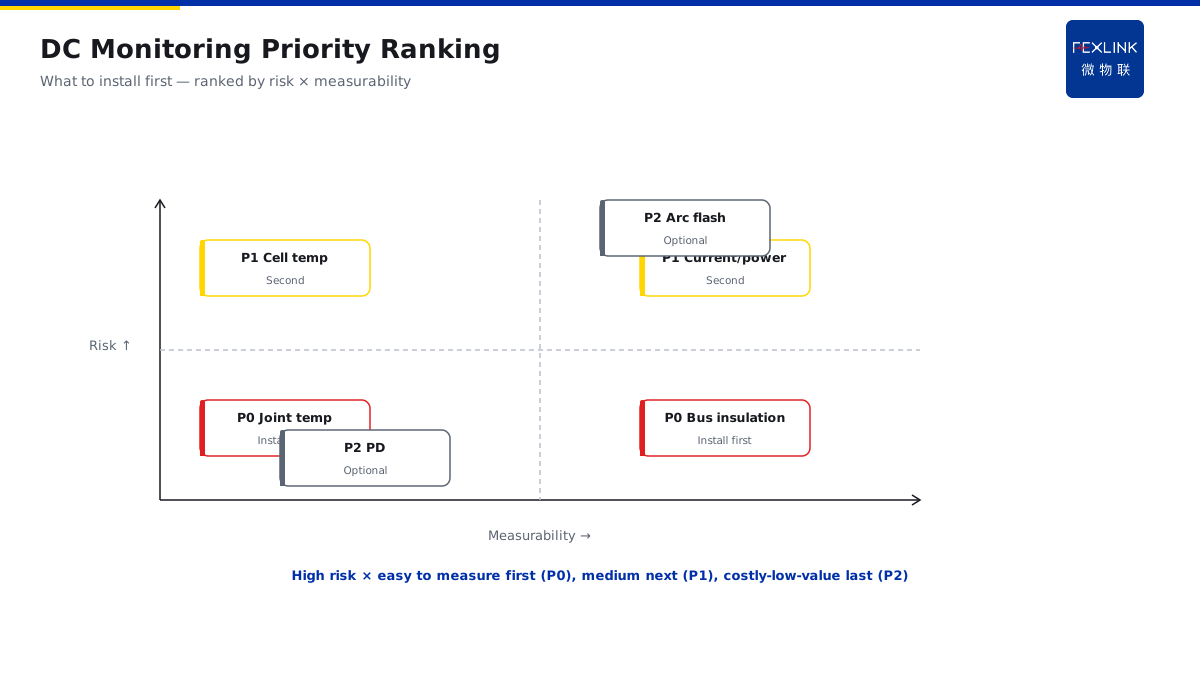
Direct Answer
Energy storage system electrical risk is not "one system's risk," but three completely different zones — DC side, AC side, and battery cabin, each fearing its own thing.
When building a new storage station, the owner asks: where should monitoring money go? Answer:
- DC side: fears insulation failure, arcing, DC arc — insulation monitoring is mandatory;
- AC side: fears harmonics, three-phase unbalance, PCS grid-tie power quality — power quality monitoring;
- Battery cabin: fears thermal runaway, temperature anomaly, combustible gas — temp + gas + smoke multi-factor monitoring.
Key insight: three zones have completely different risk types and monitoring methods, you cannot use one device for all. Which zone to invest first? Battery cabin (human life) → DC side (mandatory compliance) → AC side (power quality).
At one new storage station, the owner wanted to save money and only installed AC side meters. Six months after commissioning, battery cabin thermal runaway early signs were missed, almost caught fire. Later retrofitted temp + gas monitoring to cover the biggest hole. AC side power quality is actually secondary — PCS itself has protection, no need for much extra.
1. Three Zones Risk Comparison
Three zones have completely different risks:
DC side (battery rack → DC combiner → DC/DC → PCS DC side)
- Fears: insulation degradation, DC arcing, connector overheating;
- Feature: DC has no zero crossing, arc once generated never self-extinguishes, very dangerous;
- Mandatory: insulation monitoring (GB/T 42288 requirement).
AC side (PCS AC side → transformer → grid cabinet)
- Fears: harmonic exceedance, three-phase unbalance, voltage deviation, frequency fluctuation;
- Feature: these are power quality issues, do not directly cause fire, but affect grid acceptance and equipment life;
- Monitor: power quality monitor (ESE).
Battery cabin (battery rack + BMS)
- Fears: thermal runaway, temperature anomaly, combustible gas leak, smoke;
- Feature: thermal runaway once occurs, spreads in minutes, must warn early;
- Monitor: temp + gas + smoke multi-factor monitoring.
Key: three zones have different risk levels, battery cabin highest, DC side next, AC side relatively low. Spend money on highest risk first.
2. Why DC Side Insulation Monitoring Is Mandatory
Why is DC side insulation monitoring mandatory? Because DC arc is too dangerous.
AC arc: current crosses zero, arc naturally extinguishes (50Hz crosses zero 100 times per second). DC arc: no zero crossing, arc once generated keeps burning, temperature up to thousands of degrees, until it burns through.
Storage DC side voltage is usually 750V~1500V, once arcing occurs:
- Arc temperature 3000°C+;
- Does not self-extinguish;
- Burns through battery cabin in minutes.
That's why national standard GB/T 42288 "Electrochemical Energy Storage Power Station Safety Code" mandates: storage systems must be equipped with DC insulation monitoring devices.
FEXLINK ESE multi-function smart meter, besides AC side electrical parameters, also supports DC side insulation resistance monitoring — no need for extra device, one device covers both DC and AC.
3. Why Electrical Signs Precede Temperature in Thermal Runaway
Many people think thermal runaway is just "temperature rises then alarm," actually not.
Thermal runaway development path:
- Internal side reaction starts — temperature not yet obviously rising;
- Internal resistance starts changing — electrical parameters change first;
- Temperature starts rising — this is already a bit late;
- Thermal runaway erupts — temperature from 50°C to 500°C in minutes.
Key: before temperature obviously rises, battery internal resistance, voltage, current already show anomalies. If you only measure temperature, you may be 10-30 minutes late detecting the anomaly compared to electrical parameters.
This is why storage monitoring cannot only measure temperature — need electrical + temp + gas multi-factor fusion. FEXLINK Wanxiang engine 18-level scenario tree fuses these dimensions, not just looks at temperature.
4. PCS Grid-Tie Power Quality Parameters
PCS (power conversion system) grid-tie point, what power quality parameters need monitoring?
Mandatory measurements:
- Voltage deviation (within ±7%);
- Frequency deviation (within ±0.2Hz);
- Harmonic distortion THD (≤5%);
- Three-phase unbalance (≤2%).
Optional measurements:
- Voltage fluctuation and flicker;
- Temporary overvoltage;
- DC component.
Why measure these? Because grid company requires storage station grid-tie must meet power quality standards. If not met, either rectify, or fine, or even off-grid.
FEXLINK ESE power quality monitor is built exactly for these — one device covers all power quality indicators, directly outputs national standard compliance reports.
5. Three Zones Monitoring Priority
Budget limited, install where first?
First priority: Battery cabin
- Human life at stake, thermal runaway causes fire;
- Must install: temperature monitoring (EST-22920-R) + combustible gas + smoke;
- This is safety baseline, cannot skimp.
Second priority: DC side
- National standard mandates insulation monitoring;
- Must install: DC insulation monitoring;
- Without it, cannot pass acceptance.
Third priority: AC side
- PCS itself has protection;
- Power quality monitoring is nice to have;
- If budget tight, can skip first, add later.
Key: spend money where it matters — battery safety > DC compliance > AC power quality. Do not reverse it, first spend big money on fancy dashboard, battery cabin monitoring missing.
6. A Real Case
One storage station, 100MWh, owner initially:
- Only installed AC side meter (thought PCS has protection, no extra monitoring needed);
- Battery cabin only installed smoke alarm (thought BMS has temperature, no extra needed);
- Did not install DC insulation monitoring (thought not mandatory).
Six months after operation:
- One time battery cabin temperature anomaly, BMS alarm was 20 minutes late;
- Almost caught fire, luckily duty officer noticed in time;
- Post-incident rectification: retrofitted EST-22920-R multi-channel temperature controller + combustible gas monitoring + DC insulation monitoring;
- Spent extra money, almost had an accident.
Lesson: storage monitoring cannot skimp on battery cabin and DC side, if you skimp you will pay back later.
7. Three Common On-Site Mistakes
Mistake 1: only install dashboard, no sensors. No matter how pretty the dashboard, without sensor data it is empty. Install sensors first, then build dashboard.
Mistake 2: battery cabin only measures smoke, not temp and gas. Smoke is the last line of defense — when you see smoke, it is already burning. Need temp and gas, early warning.
Mistake 3: DC side does not measure insulation. Think PCS has protection so no need to measure insulation. Wrong — DC arcing is beyond PCS protection, must measure separately.
8. One Sentence to Remember
Storage system three zones: DC side fears arcing, AC side fears power quality, battery cabin fears thermal runaway. Spend money first on battery cabin safety and DC side compliance, AC side is nice to have.
Do not reverse it — build pretty dashboard first, critical monitoring missing.
9. Common Questions
Q: Must storage station install DC insulation monitoring? A: Yes. GB/T 42288 "Electrochemical Energy Storage Power Station Safety Code" mandates storage systems must have DC insulation monitoring devices. Without it, cannot pass acceptance.
Q: How many temperature points in battery cabin is enough? A: At least one point per battery rack (module level). Important cabins need multiple points — inlet, outlet, rack middle, rack bottom. EST-22920-R multi-channel temperature controller, one device supports multiple temperature channels.
10. Why This Is Becoming More Important
Storage stations used to be small, few MWh, risk was manageable. Now they are 100MWh+, utility-scale, and a single thermal runaway incident can burn down the whole facility and cost tens of millions.
That is why monitoring investment is not optional anymore — it is insurance against catastrophic loss. A few hundred thousand in monitoring hardware is cheap compared to tens of millions in fire damage.
Stay safe. Stay professional. Stay curious.
11. Quick Checklist
Before you approve your next storage station monitoring budget, run through this checklist:
- Have you allocated budget for battery cabin temperature and gas monitoring first?
- Have you included DC insulation monitoring in the mandatory scope?
- Have you planned for multi-zone monitoring instead of one device for everything?
- Have you thought about electrical signs before temperature in thermal runaway?
- Have you avoided the trap of "pretty dashboard first, sensors later"?
If you answered "no" to most of these, your monitoring budget is probably misallocated. You are paying for looks instead of safety.
The FEXLINK platform helps you allocate smartly. EST-22920-R handles multi-channel temperature. ESE handles power quality and DC insulation. The Wanxiang engine fuses signals across zones. You get the right data in the right place, not just a pretty picture.
12. How to Build a Routine
A good storage station monitoring routine starts with the battery cabin. Install temperature and gas sensors first. Get the DC insulation monitoring in place for compliance. Layer on power quality monitoring for grid-tie compliance. Then build the dashboard.
When temperature starts trending up, you get an alert. When insulation resistance drops, you get an alert. When harmonics exceed the limit, you get an alert. You investigate. You plan maintenance. You avoid the big incident.
This is risk-based storage management. It saves money, reduces risk, and avoids the panic of "battery cabin on fire, why didn't we see it coming."
Start today. Identify your highest-risk zone. Install the right sensors. Build your baseline. Then you can sleep better at night.
Final Thoughts
Storage stations are the future of grid stability. They are also the highest-risk electrical assets we have ever built at scale. A single thermal runaway event can destroy a hundred million yuan facility.
That is why monitoring is not optional. It is the price of admission for safe storage operations.
Do it smart. Do it early. Do it with data.