 FEXLINK Research Institute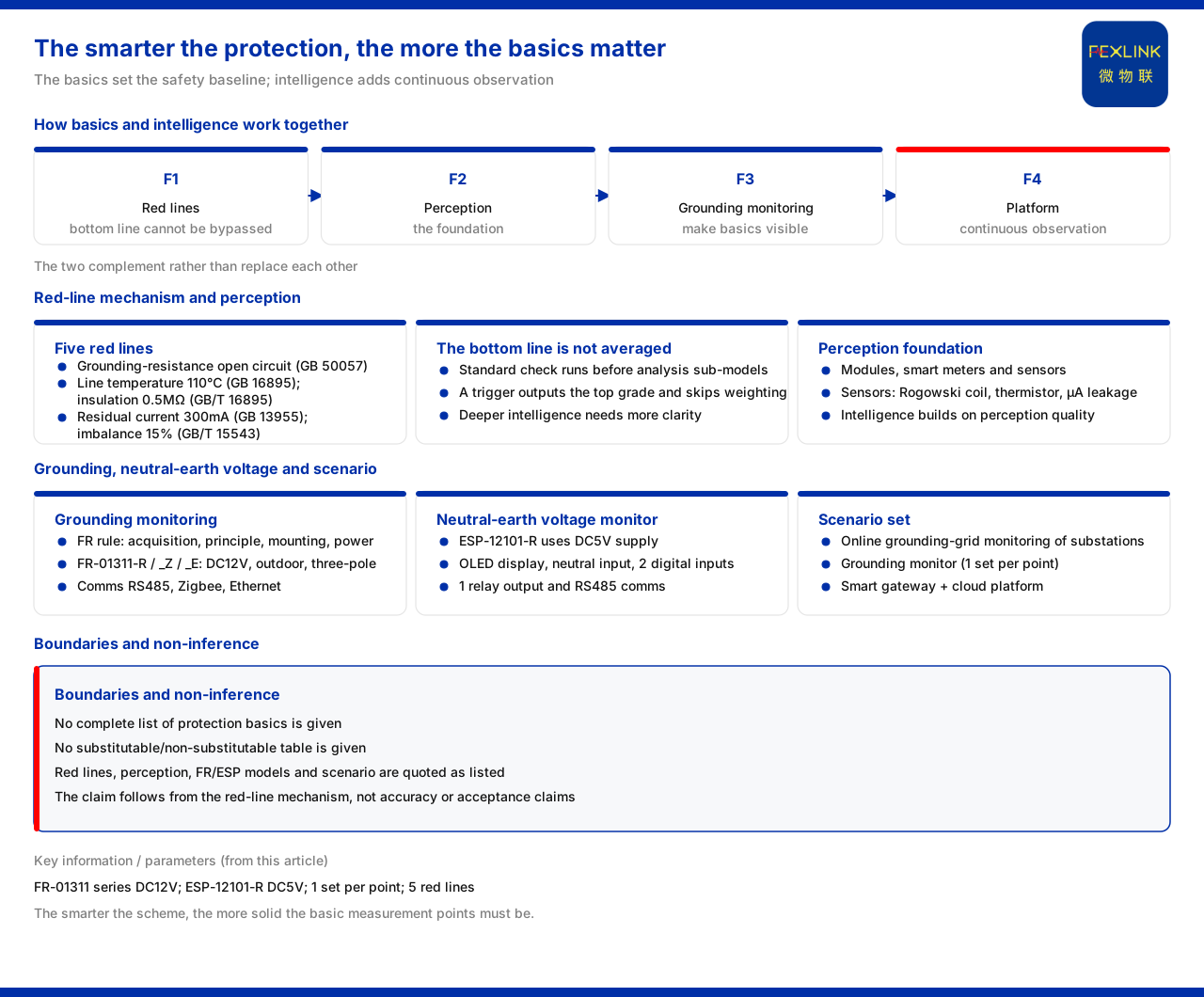
Direct Answer
The smarter lightning protection becomes, the more it must not lose the fundamentals such as grounding and equipotential bonding. The product knowledge base sets "abnormal open circuit of grounding resistance" as one of the safety red-lines that cannot be bypassed, with GB 50057 as the basis, and states that there are five red-lines and that no one can raise the thresholds. This setting itself shows that no matter how strong the upper-layer analysis capability is, the fundamental condition of grounding is still forced into attention and cannot be weakened or skipped for any reason. The role of intelligence is to turn the fundamentals from "invisible" into "continuously visible", not to spare the owner the fundamentals. Only by putting the two in the right relation can intelligent monitoring be used well.
1. Intelligence Cancels No Bottom Line
A common misunderstanding is that, since an intelligent system can analyse comprehensively and warn in advance, basic protection can be relaxed appropriately. The red-line mechanism given by the product knowledge base rejects this idea: standard verification runs before the analysis sub-models are computed, and a triggered red-line outputs the highest-level alarm directly and skips all weighted computation. In other words, bottom-line judgement precedes the composite score and does not take part in averaging. Grounding abnormality is placed in this position because it is the discharge channel; once it fails, no amount of good work elsewhere can safely lead the lightning current into the earth. The deeper intelligence goes, the more clearly this irreplaceable fundamental condition must be kept in view.
2. Red-Lines Turn Fundamentals into Mandatory Items
The five safety red-lines listed by the product knowledge base cover residual current, grounding, three-phase voltage imbalance, line temperature and insulation resistance: the abnormal open circuit of grounding resistance is based on GB 50057; line temperature reaching 110°C is based on GB 16895; insulation resistance below 0.5MΩ is based on GB/T 16895; the other two are residual current reaching 300mA (GB 13955) and three-phase voltage imbalance exceeding 15% (GB/T 15543). These conditions are mostly the basic requirements of conventional lightning protection and electrical safety. Setting them as red-lines that cannot be bypassed is equivalent to using a system mechanism to ensure the fundamentals are carried out continuously. It can be said that the role of intelligence here is not to replace the fundamentals but to fit them with an uninterrupted monitoring line.
3. The Sensing Layer Is Still the Foundation of the Whole System
From the architecture, intelligence also does not bypass the basic monitoring units. The product knowledge base summarises the monitoring system as a four-layer architecture, in which the sensing layer is made up of monitoring modules, smart meters and sensors, and the sensors include Rogowski coils, thermistors and microamp-level leakage sensors. These components are the data starting point of the whole system: without the sensing layer, the later analysis and decision have no data to use. Particularly noteworthy is the microamp-level leakage sensor; it corresponds to tiny leakage changes, showing that the system demands sufficient measurement fineness at the basic layer. The value of intelligence is built on the quality of perception, not above it. If the accuracy or the points of the basic measurement are insufficient, the later analysis, however complex, can only draw conclusions from rough input.
4. Making Grounding Monitoring a Visible Fundamental
Grounding is the most basic link of lightning protection, and the product knowledge base provides a dedicated monitoring landing point for it. The model rule of the grounding resistance monitor combines signal acquisition, detection principle, installation method and power supply, where the detection principle distinguishes the loop method from the three-pole method and the installation distinguishes outdoor from indoor. The in-sale grounding resistance monitor (FR-01311-R) is DC12V, outdoor and three-pole; its variants FR-01311-Z and FR-01311-E differ only in communicating over Zigbee and Ethernet, while the base model uses RS485. The difference among these models lies mainly in communication, showing that the site can choose the access method according to the existing network conditions without changing the grounding practice for monitoring. The significance of grounding monitoring is precisely to turn a fundamental that could only be checked periodically into a continuously visible state.
5. Equipotential Bonding and Neutral-to-Ground Voltage Should Not Be Ignored
Besides grounding resistance, basic quantities such as neutral-to-ground voltage also deserve attention. The product knowledge base records that the neutral-to-ground voltage monitor model ESP-12101-R has a DC5V supply, OLED display, neutral-line input, 2 digital inputs, 1 relay output and RS485 communication. Neutral-to-ground voltage reflects the potential relation between the neutral line and the ground, forming part of the basic state of equipotential bonding and distribution. Bringing it into monitoring shows that intelligence does not focus only on the protective device itself but also covers the basic conditions of the distribution system. Keeping these quantities under observation is the concrete product-level expression of "not losing the fundamentals". Although neutral-to-ground voltage is only one number, it can often reveal basic deviations in a distribution system that are otherwise hard to notice.
6. Fundamentals and Intelligence Are a Partnership
The correct relation should be: the fundamentals provide the safety baseline, and intelligence provides continued observation and advance judgement; the two cooperate rather than replace each other. The red-line mechanism of the product knowledge base ensures the baseline cannot be sacrificed; the sensing layer, trend analysis and prediction capability let the baseline state be continuously mastered. If intelligence is understood as "basic investment can be reduced", the premise on which the system rests is weakened; if the fundamentals are understood as "monitoring is unnecessary", the opportunity to detect degradation early is lost. Only by placing the two in their respective positions can a scheme both hold the bottom line and realise the value of intelligence.
7. The Landing Combination in a Typical Scenario
In a typical scenario this partnership has a clear landing point. The product knowledge base lists the recommended combination for "online monitoring of substation/traction-substation ground grids" as the grounding resistance monitor (1 set per point), the lightning-protection smart gateway and the cloud platform. This combination reflects the link between the fundamentals and intelligence: the grounding resistance monitor digitises the fundamental of grounding, the lightning-protection smart gateway uploads it, and the cloud platform performs continued observation and alarming. The configuration of 1 set per point shows that the landing granularity is the measurement point rather than the whole station, consistent with the requirement that "the fundamentals must reach specific points". It can be seen that the smarter the scheme, the more solidly the basic measurement points must be laid out.
Scope of Application and Limitations
First, this article only explains the relation that intelligent lightning protection cannot replace the fundamentals; the factual boundary is the product knowledge base, and no standard clauses, parameters, certifications or cases not listed there are introduced.
Second, the product knowledge base lists no complete checklist of lightning-protection fundamentals and gives no comparison table of what intelligence can and cannot replace; this article explains only the content related to the red-lines and the sensing layer.
Third, the trigger conditions and basis standards of the five safety red-lines, the composition and sensor types of the sensing layer, the model rule and in-sale models of the grounding resistance monitor, the model and interfaces of the neutral-to-ground voltage monitor, and the typical-scenario recommended combination are cited from the source.
Fourth, this article does not extrapolate the above into an accuracy, effect or acceptance indicator for any site; "the fundamentals cannot be replaced" is a general judgement drawn from the red-line mechanism.
Fifth, the basic protection design and intelligent monitoring configuration of a specific project must be verified against site conditions; this article provides no selection, setting or construction calculation.