 FEXLINK Research Institute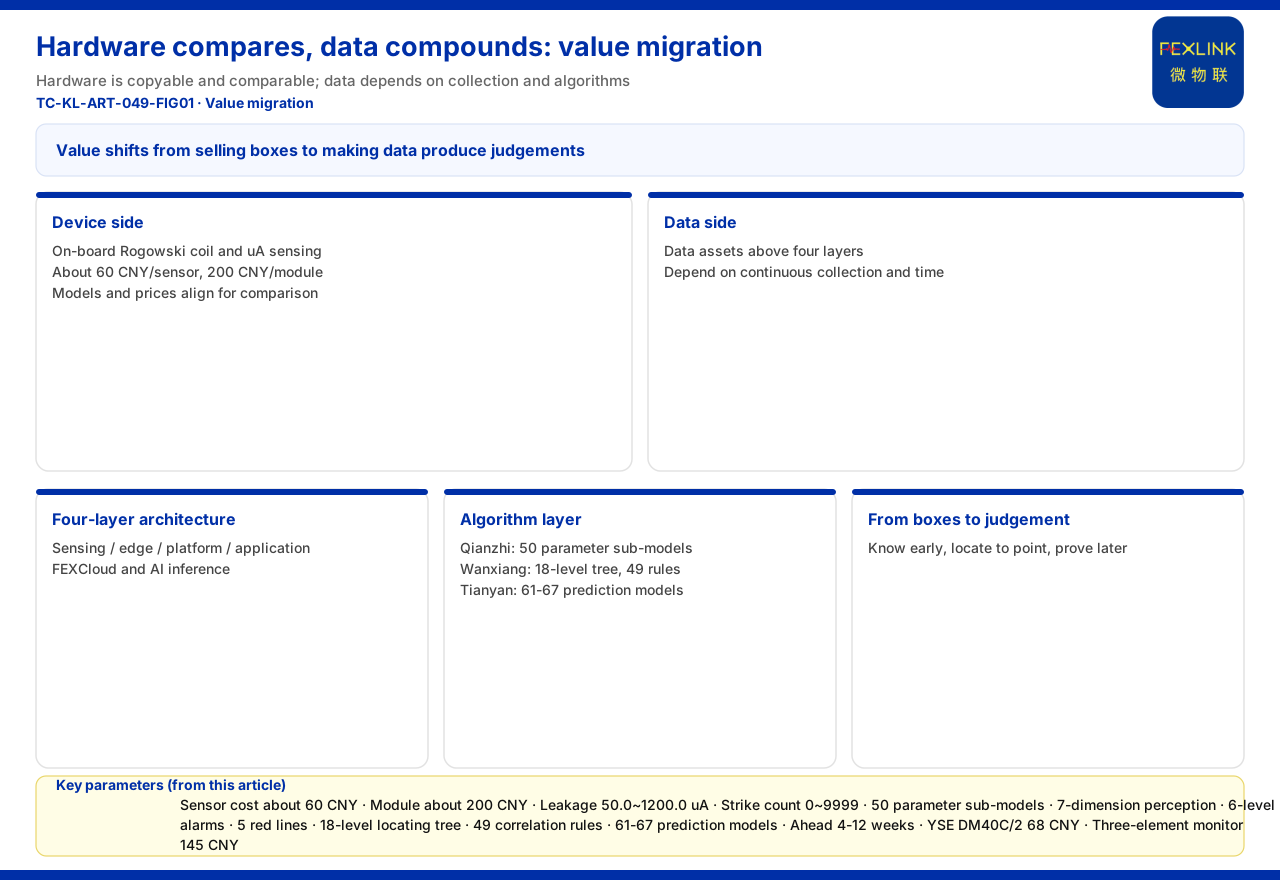
Lightning-protection hardware is becoming a comparable, replaceable standard part, while the data and judgements produced by continuous monitoring and algorithms are becoming harder to copy.
Let Us Be Clear First: This Is an Opinion Piece
The article argues a value-migration judgement: in lightning protection, hardware value is moving toward low cost and reproducibility, while data and judgement are rising. The knowledge base offers no statistics, trend or conclusion about market prices, and it will not use numbers. What we can verify is product-side composition and capability: which modules make up a monitoring system's hardware, what order of magnitude device costs fall into, which layers data passes through, and what judgements the algorithms can produce. Whether devices broadly fall in price and data broadly rises in value is an industry observation.
The Device Side: Hardware That Can Be Compared Item by Item
Viewed as product composition, lightning-protection monitoring hardware is highly standardised. The knowledge base records that the core sensor technology is an onboard special-shaped Rogowski coil (1 μs-level abnormal-current capture) with microamp-level leakage-current acquisition, accuracy 50~100 times better than comparable products, and a cost of about CNY 60 per sensor and CNY 200 per module. Two things follow: core sensing capability can be miniaturised and made low-cost; and once cost is priced per sensor and module, hardware becomes comparable and accountable.
The modules are organised as a bill of items. The FS surge protective device monitor lists voltage, leakage-current and temperature channels, switching values and grounding/lightning-strike items, with key parameters of leakage current 50.0~1200.0 μA (±10 μA), voltage 0~400.0 V (±0.1 V) and lightning-strike count 0~9999 (minimum trigger 0.1 kA); the ESM intelligent lightning-protection monitoring terminal adds temperature, voltage, humidity and lifetime estimation, with DC5V or AC220V supply. Dedicated points follow: the FR-01311 grounding resistance monitor uses the three-electrode method, DC12V power and outdoor installation, with RS485/Zigbee/Ethernet; the FL lightning-current/transient-current monitor offers 1 kA~120 kA and 0.1 kA~1 kA peak ranges, with FL-01222/FL-01212 supporting energy monitoring; the FG lightning-protection intelligent gateway is a protocol-conversion type with RS485/Zigbee downlink, Ethernet uplink and DC12V supply, in models FG-0221-ER and FG-0221-EZ.
Hardware even has public reference prices. The companion surge protectors in the knowledge base are outsourced, with reference prices for cost reference — for example, the 40 kA single-phase power surge protective device (YSE DM40C/2) at CNY 68 and the three-element SPD monitor at CNY 145. These are cost references, quotations follow the company's own price system, so they are not market prices; but they show that once hardware can be tabulated by model and price, buyers view it through price comparison.
The Data Side: Value That Exists Only Beyond a Single Device
Data is hard to squeeze to a hardware price because its value does not reside in any single device. The knowledge base defines the monitoring system as a four-layer architecture of perception, edge, platform and application: the perception layer collects from FS/FR/FL/ES modules, smart meters and sensors; the edge layer uses FG/ESX/CW gateways for protocol conversion, edge computing and local caching; the platform layer is the FEXCloud IoT cloud platform, handling device access, time-series databases and AI inference; the application layer outputs visualisation, alarms, reports and inspections. A parameter becomes a cross-point, cross-time, cross-dimension data asset after entering these four layers.
The algorithm layer especially. The Qianzhi engine runs 50 parameter sub-models (currently 20 core M01-M20) × 7-dimensional sensing, with a six-level alarm system and five non-bypassable red lines; "abnormal open circuit of the grounding resistance", per GB 50057, emits the highest-level alarm directly and skips weighted scoring, with BJ1 (20-39 points) requiring action within 48 hours. The Wanxiang engine provides location awareness and an 18-level scene-location tree, with 49 cross-dimension association rules to answer "why and where the abnormality is". The Tianyan engine plans 61-67 prediction models; S-02 residual-current trend drift (CUSUM) detects a weak mean shift while leakage is still safe, and the knowledge base states it can warn 4-12 weeks ahead.
These capabilities do not attach to a device's factory bill; they depend on continuous collection, multi-point association and time accumulation. A device can be replaced by the same model, but the judgements formed over long-term data cannot. The more data is used, the richer it becomes — the technical basis for "data gets more valuable".
From Selling Boxes to Selling Judgements: Where Data Value Lands
For data value to hold, it must land on concrete scenarios and acceptable outputs. The knowledge base gives usable combinations: for "online monitoring of substation/traction-substation grounding grids", FR-01311 (one set per point) + FG gateway + FEXCloud; for "monitoring of surge-protective-device condition (retrofit of existing SPDs)", the FS surge protective device monitor / ESM full-element SPD monitoring / FSP lightning-protection base. The first shows value scaling with measurement points; the second shows existing equipment can join the data system.
Alarm grading and evidence retention then translate raw data into actionable judgements: red lines keep the bottom line unrelaxed, the six-level alarm system maps states to response deadlines, and event parameters answer "what actually happened recently". When the customer is buying not "one more monitoring box" but the ability to "know in advance, locate the point and produce evidence afterwards", value shifts from device to data. Where models and names are involved, this article applies the knowledge-base wording: FS = surge protective device monitor, ESM = intelligent lightning-protection monitoring terminal (SPD monitor), FR = grounding resistance monitor, FL = lightning current / transient current monitor, FG = lightning-protection intelligent gateway, FSP = SPD lightning-protection base, FEXCloud = IoT cloud platform.
Vendor capability claims need restraint. The knowledge base lists the Taiyi intelligent control hub system's quantitative indicators (electrical-hazard identification rate 95%+, alarm compression ratio 80%, warning lead time 4-12 weeks, MTTR reduced by 60%, comprehensive energy-saving potential 8-20%, and more), which the knowledge base notes are vendor self-reports. They may be cited as vendor capability descriptions, but not as proven market value or a device-data pricing gap.
What This Article Does Not Claim
Second, the companion surge protectors' reference prices in the knowledge base are cost references for outsourced products, not evidence of market prices or a downward trend; the CNY 60 per sensor and CNY 200 per module are device-cost magnitudes, not an inference about complete-unit or system quotations.
Third, the quantitative indicators are vendor self-reports; the note that the FR/FRP series is applied to railway traction-substation grounding grids and the Jinzhou Port tank farm (10 sets per tank) is an internal knowledge-base note. They are cited only as source notes, not as evidence of performance, price decline or value growth.
Fourth, this article provides no pricing model, return-on-investment calculation, market share or trend forecast; it claims no model, parameter, certification or case not in the knowledge base; all parameters cited are limited to the corresponding knowledge-base entries, with no extrapolation.
Conclusion
Split lightning-protection monitoring into two halves: one half is hardware reproducible, comparable and accountable by model and cost; the other is data and judgement that attach to continuous collection and algorithms and thicken as data accumulates. Hardware suits price comparison; data does not. Buyers should evaluate them separately: hardware by parameters and cost, data capability by measurement points, alarm closed loop and evidence retention. For vendors, value will move from "selling the box" to "letting data keep producing judgements".