 微物联研究院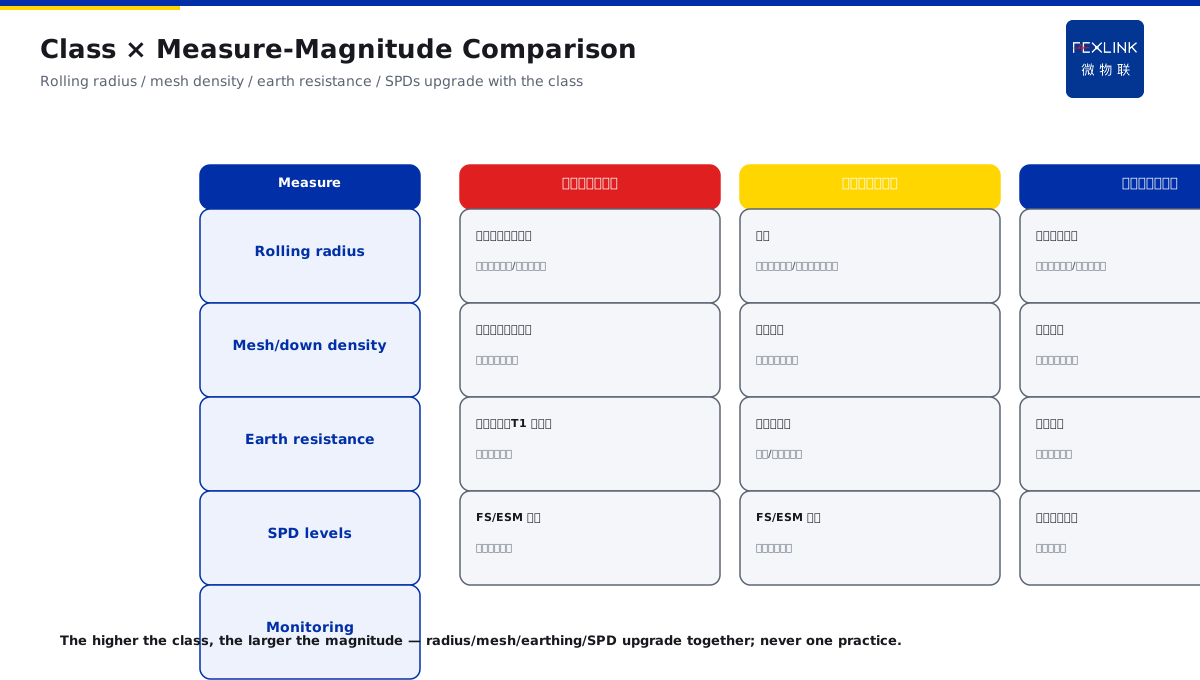
Direct Answer
A drawing says "Class Two lightning-protection building" — how is this class determined, and which measures does it require? The answer: GB 50057 classifies buildings into Class Three, Class Two and Class One lightning protection by the building importance, use nature and the annual expected strike count N; the higher the class, the more severe the consequences; different classes correspond to different rolling-sphere radii, air-termination/down-conductor densities, earth-resistance requirements and SPD configuration levels — the class decides the measure magnitude, not one-size-fits-all practice.
A design drawing marked "Class Two building" was built with Class Three practices — sparser air-termination meshes and lower SPD levels. It was corrected after checking the class basis against the measure magnitude. The key distinction: the class is not "set by feeling" but calculated from the importance, use nature and N — the higher the class, the larger the measure magnitude; the class decides the measures, not one identical practice.
Why:
- The basis: importance, use nature and N;
- The rolling-sphere radius: the higher the class, the smaller the radius and the denser the air termination;
- The measure magnitude: earth resistance and SPD levels upgrade with the class;
- The upgrade rule: flammable/explosive and dense-population buildings take the higher.
Key insight: "The class decides the measure magnitude — GB 50057 sets the class by importance, use nature and N; the rolling-sphere radius/air-termination density/earthing/SPD upgrade with the class; not one identical practice."
A storage project was Class Three by N, but upgraded to Class Two for storing flammable/explosive goods, with the air termination and SPDs completed to Class Two. Lesson: the class is decided by the basis plus the upgrade rule — looking only at N without the nature may set the wrong class, and the measures follow it wrong.
Overview: run "class basis → class → measure magnitude" as a checkable comparison table. The three classes of GB 50057 are not three parallel practices but one ascending chain: Class One the strictest (high-risk like flammable/explosive), Class Two the middle (dense-population/important buildings), Class Three the loosest (ordinary buildings). How the class is set and what it requires come from the same logic — the importance, use nature and N decide the class, and the class decides the rolling-sphere radius, air-termination density, down-conductor density, earth resistance and SPD levels. The five steps below expand: the three-class basis, the class vs rolling-sphere radius/air-termination density, the class vs earth resistance/SPD levels, the upgrade of flammable/explosive and dense-population buildings, and how to check the class against the measures in design review.
The order of N and the nature: in judging the class, the nature and N are not parallel alternatives but "nature first, N as a supplement". The scenarios where the nature directly sets the class: buildings storing flammable/explosive goods or with explosive-hazard environments go Class One directly — this judgment needs no N calculation, because the nature itself says the consequences are extremely severe; dense-population or important-function buildings (hospitals, schools, stadiums, large malls) take the higher, usually starting from Class Two. When the nature cannot set the class, N supplements: ordinary buildings set Class Two or Class Three by N reaching a certain value. The judging rhyme: first ask "is it flammable/explosive or dense-population" — yes, upgrade by the nature; no, then compute N. N and the nature: "nature first, N as a supplement" — flammable/explosive goes Class One directly, dense-population from the higher; what the nature cannot set is computed by N.
1. The Three-Class Basis
Step one: how the class is set.
The three judging dimensions:
- The building importance (important/ordinary);
- The use nature (flammable/explosive/dense-population/general);
- The annual expected strike count N (the risk probability).
The class correspondence:
- Class One: high-risk like flammable/explosive;
- Class Two: dense-population/important buildings;
- Class Three: ordinary buildings (N reaching a value).
The judging order:
- The nature first (flammable/explosive or dense-population?);
- Then N (the strike probability);
- The nature + N set the class together;
- Not just one dimension.
Key insight: "The class is set by three dimensions together — importance, use nature and N; the nature first, then N; flammable/explosive and dense-population upgrade directly; not just one dimension."
2. The Class vs Rolling-Sphere Radius / Air-Termination Density
Step two: how the class decides the air termination.
The rolling-sphere radius:
- Class One the smallest (strictest);
- Class Two the middle;
- Class Three the largest (loosest);
- The radius decides the protected zone.
The air-termination density:
- The higher the class, the denser the mesh;
- The strips/meshes denser;
- The coverage fuller;
- The down-conductor spacing shorter.
The measure meaning:
- The air-termination mode per class;
- The density upgrades with the class;
- The coverage expands with the class;
- The air termination is the first line.
An intuitive view of the air-termination protection: the rolling-sphere radius can be understood as "a ball of a fixed radius rolls along the building surface; where the ball cannot touch is the protection blind zone". The smaller the radius, the fewer places the ball can roll, the stricter the protection — which is why Class One has the smallest radius and the densest mesh. In engineering this corresponds to the mesh size: the higher the class, the smaller the mesh edge length of the strips/meshes (Class One the densest, Class Three the largest); the down conductors likewise — the higher the class, the shorter the spacing and the more the conductors. When checking a drawing, look at three places first: whether the mesh size matches the class, whether the down-conductor spacing matches, and whether the protected zone covers all protruding objects (roof equipment, chimneys, antennas, etc.). The rolling-sphere radius = the strictness — a small radius means strict protection and dense meshes; checking a drawing starts with the mesh size, the down-conductor spacing and the protruding-object coverage matching the class.
Key insight: "The class decides the air-termination magnitude — the radius Class One the smallest and Class Three the largest; the mesh and down-conductor densities upgrade with the class; the coverage fuller."
3. The Class vs Earth Resistance / SPD Levels
Step three: how the class decides the earthing and SPDs.
The earth resistance:
- The higher the class, the stricter the requirement;
- Class One the strictest, Class Three the loosest;
- The electrode arrangement denser with the class;
- The earthing is the discharge end.
The SPD levels:
- The higher the class, the fuller the stages;
- The main inlets T1 stricter;
- The signal paths per interface (relating to KD-0196);
- Capacity/residual per boundary.
The monitoring support:
- The FS/ESM for every stage;
- High-class/important points monitored online;
- Degradation known early (relating to KD-0161);
- The measure magnitude includes monitoring.
Key insight: "The class decides the earthing and SPD magnitude — the resistance Class One the strictest, the SPD stages fuller with the class; FS/ESM online monitoring as the support; the magnitude includes monitoring."
4. The Upgrade of Flammable/Explosive and Dense-Population Buildings
Step four: what goes up.
The flammable/explosive upgrade:
- Storing flammable/explosive goods goes Class One directly;
- Oil depots/gas stations/chemical plants stricter;
- The upgrade ignores N;
- The nature sets the class directly.
The dense-population upgrade:
- Hospitals/schools/stadiums take the higher;
- Important-function buildings upgraded;
- Severe consequences take the higher;
- Personnel safety first.
The meaning of the upgrade:
- The same building may go up a class;
- An upgrade = all measures upgraded;
- The cost is more investment;
- The value is lower risk.
Key insight: "Flammable/explosive goes Class One directly, dense-population from the higher — the upgrade ignores N; the nature sets the class directly; an upgrade = all measures upgraded, cost for lower risk."
5. Checking the Class Against the Measures in Design Review
Step five: how to keep the drawing on track.
The three checks:
- One, the class basis (is the nature + N computed right);
- Two, the measure magnitude (do the air termination/earthing/SPD match the class);
- Three, the monitoring support (important points online).
Common deviations:
- The class set but the measures configured lower;
- N checked but not the nature;
- Upgraded buildings without upgraded measures;
- The drawing detached from the class.
The checking tool:
- The class↔measure comparison table;
- Every measure traceable to the class;
- Review item by item;
- Deviations corrected on the spot.
Key insight: "Review in three steps: the class basis, the measure magnitude, the monitoring support — the class↔measure table checked item by item, deviations corrected on the spot; the drawing stays on track."
6. Product Implementation: Configure to the Class, up to the Monitoring
WeiWuLian products configure the three-class measures in place:
- FS/ESM SPD Monitor: the SPD states of every stage online;
- Per-class configuration: air termination/earthing/SPD strictly matched to the class;
- Closed-loop monitoring: degradation early + event review;
- Review support: the class↔measure comparison.
The design principle in one sentence: "The class is set by the nature + N, the measure magnitude follows the class — air termination/earthing/SPD configured per class, FS/ESM online; review item by item, never off track."
7. Common Understanding Misjudgments
- "The class set by feeling": ignoring the basis. Result: wrong class. Correct: compute the nature + N.
- "Class One practices applied to Class Three": ignoring the magnitude. Result: insufficient protection. Correct: configure per class.
- "N only, not the nature": ignoring the upgrade. Result: flammable/explosive set too low. Correct: the nature first.
- "Air termination enough": ignoring the earthing/SPDs. Result: no discharge place. Correct: configure the whole chain.
- "The drawing detached from the class": ignoring the check. Result: acceptance off track. Correct: review item by item.
Scope and Limitations
This article interprets the basis and required measures of the three lightning-protection classes of GB 50057-2010 (the class basis, the rolling-sphere radius/air-termination density, the earth resistance/SPD levels, the upgrade rules, the review check), applicable to design review and measure checking. The specific clauses follow the original text of GB 50057-2010; this article explains only the classification logic and the comparison method. All cases are anonymized (a storage, a design drawing) and do not refer to any specific customer.