 FEXLINK Research Institute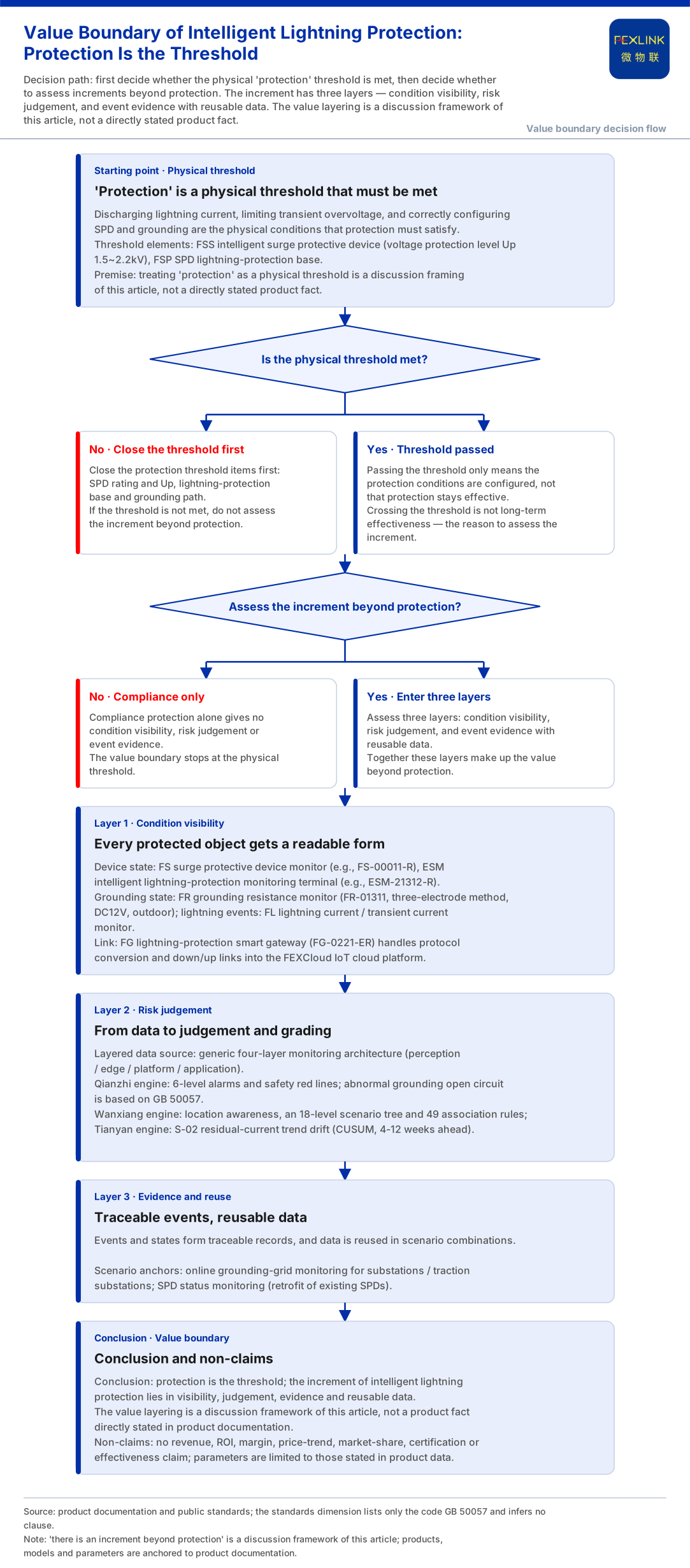
The value of intelligent lightning protection goes beyond "protection" itself. "Protection" here means physical functions — discharging lightning current and limiting transient overvoltage to what equipment can withstand. The increment: it makes the protection system's condition visible, risk judgeable, events documentable, and long-accumulated data reusable. It also avoids existing landing points (hardware-to-data value migration, project profitability, data-producer positioning, which data customers see), answering one boundary question — where the increment beyond protection lies.
1. "Protection" Is a Threshold That Must Be Met, Not the Whole Value
First, what protection itself does. The knowledge base records that the FSS intelligent surge protective device (for example FSS-24100) offers In/Imax class combinations from 10kA/20kA to 40kA/80kA and a voltage protection level (Up) of 1.5~2.2kV, limiting lightning current and switching overvoltage; the SPD lightning-protection base (for example FSP-21100-R) is a monitoring base used with the surge protective device. These products answer "is it installed, and is it enough": required configuration and matching discharge capability. Meet the requirement, and the physical function holds.
A functioning device is not the same as a function that stays effective. Surge protective devices age, backup protection operates, grounding can open through corrosion or installation work — and without monitoring, none of it reveals itself. In other words, "protection" is an entry ticket you must hold, but it guarantees only that the threshold was crossed, not that it still stands every day afterwards. Protective function and protective effectiveness are two things.
2. The First Increment: Making the Protection System's Own Condition Visible
The first increment is visibility, resting on specific monitored elements. The knowledge base records that the FS surge protective device monitor (for example FS-33211-R) can monitor remote signalling, air-switch status, grounding status, strike count, leakage current, temperature, voltage and lifetime estimation, with key parameters of leakage 50.0~1200.0 μA (±10 μA), voltage 0~400.0 V (±0.1 V), temperature -20~100 °C (±1 °C), strike count 0~9999 (minimum trigger 0.1 kA) and lifetime estimation 0~100%. The ESM intelligent lightning-protection monitoring terminal (for example ESM-21312-R) adds temperature, voltage, humidity and lifetime estimation to switching values, grounding and strike counting, with DC5V or AC220V supply.
Dedicated points likewise: the FR grounding resistance monitor (FR-01311) uses the three-electrode method, DC12V supply and outdoor installation, with RS485/Zigbee/Ethernet; the FL lightning-current/transient-current monitor gives two peak ranges, 1kA~120kA and 0.1kA~1kA; the FG lightning-protection smart gateway handles protocol conversion, with RS485 or Zigbee downlink, Ethernet uplink and DC12V supply. The first thing monitoring does is make "is the protection system still normal?" visible — SPD switching status and leakage, grounding continuity, whether a device has already operated. Without sampling, health surfaces only by chance in manual inspection — the first value beyond protection.
3. The Second Increment: From Visible to Judgeable
Visibility alone is not judgement. The knowledge base defines the monitoring system as four layers — perception, edge, platform, application: perception collects through FS/FR/FL/ES series modules, smart meters and sensors; edge uses FG/ESX/CW gateways for protocol conversion, edge computing and local caching; the platform layer is FEXCloud IoT cloud platform for device onboarding, time-series database and AI inference; application outputs visualisation, alarms, reports and inspection. Only after data traverses all four can it become judgement.
The algorithm layer supplies the second increment. The Qianzhi engine runs 50 parameter sub-models (currently 20 core, M01-M20) × 7-dimensional perception, with a six-level alarm scheme and five non-bypassable red lines; "abnormal open circuit of grounding resistance" follows GB 50057, a red-line trigger emits the highest-level alarm directly and skips weighted computation, and BJ1 (20-39) requires action within 48 hours. The Wanxiang engine provides location awareness and an 18-level scenario-location tree and maintains 49 cross-dimensional association rules, answering "why and where the anomaly is". The Tianyan engine plans 61-67 prediction models; S-02 residual-current trend drift (CUSUM) detects a weak mean shift while leakage is still safe, which the knowledge base says warns 4-12 weeks ahead. "Protection" is now no longer merely withstanding strikes, but translating the protection system's condition into actionable risk signals.
4. The Third Increment: Data Becomes a Reusable, Evidentiary Asset
The third increment is data reuse. The scenario comparison gives usable combinations: "online monitoring of substation/traction-substation grounding grids" recommends the FR grounding resistance monitor (FR-01311, one set per point) with the FG lightning-protection smart gateway and FEXCloud; "lightning-arrester condition monitoring (retrofit of existing SPDs)" recommends the FS surge protective device monitor, ESM full-element SPD monitoring and FSP lightning-protection base. The former shows protection data scaling with measurement points; the latter that existing equipment can join the same data system.
Once data reaches the platform layer, its value exceeds "did a device operate": strike counts and event parameters answer "what happened recently", alarm grading and evidence retention answer "was a prompt given at the time", cross-point and cross-time comparison answers "where protection degrades faster". For the owner these outputs feed asset management and maintenance records; for the service provider they are evidentiary deliverables. The knowledge base gives no such causal conclusion.
5. Boundaries: Intelligence Does Not Replace Protection Basics, and Is Not Performance
After the increment, boundaries matter, or "value is more than protection" gets misread as "protection can be dropped".
First, intelligence does not replace protection itself. Grounding, equipotential bonding and correct SPD configuration remain physical preconditions; monitoring makes their state visible, not valid.
Second, vendor capability claims need restraint. The knowledge base lists the Taiyi intelligent-control hub system's quantitative value indicators (hazard identification 95%+, alarm compression 80%, warning lead 4-12 weeks, MTTR reduced 60%, energy savings 8-20%, and so on), which the knowledge base notes are vendor self-reports. Cite them as vendor capability claims only, never as proven returns or proof that intelligence has created performance.
Third, application cases are internal notes. The knowledge base mentions that FR/FRP series grounding resistance monitors have been used in railway traction-substation grounding grids and the Jinzhou Port tank farm (10 sets per tank), marked as internal records. This article cites them only as a source note, not performance evidence.
What This Article Does Not Claim
Second, the monitored elements and parameters in the knowledge base are product facts: they show only "what can be sampled", not that sampling necessarily brings benefit; the four-layer architecture describes the data path, not that data necessarily appreciates.
Third, the quantitative value indicators are vendor self-reports; the records about the railway traction-substation grounding grid and Jinzhou Port tank farm are internal application notes.
Fourth, no pricing model, ROI calculation, market share or trend forecast is given; no model, parameter, certification or case absent from the knowledge base is claimed; parameters are limited to the corresponding knowledge base entry, with no extrapolation.
Conclusion
Split intelligent lightning protection into two layers and the boundary clears. The lower layer is "protection", the physical threshold that must be met: discharge capability, grounding continuity and configuration compliance answer "is it installed". The upper layer is the increment intelligence brings: condition visible, risk judgeable, events documentable, data reusable — answering "is it useful, how will it degrade, can it be explained afterwards". The former is the entry ticket, the latter lasting value. The sensible approach is not to replace protection basics with intelligence, but to treat visibility, judgement and data assets as an independently evaluated layer once protection holds.