 微物联研究院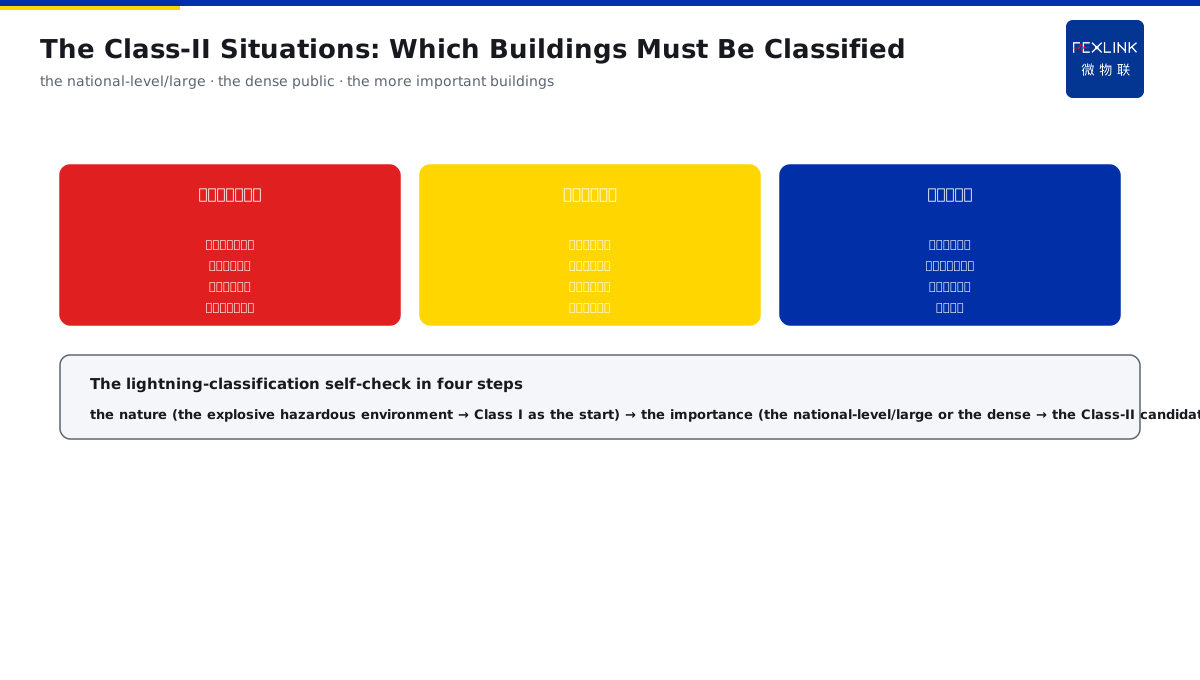
Direct Answer
In the design review, the building lightning-protection classification is often disputed — what exactly does GB 50057 provide for Class II? The answer: GB 50057 provides that the national-level/large important buildings, the dense public buildings, the buildings exceeding a certain height, and the more important buildings whose annual expected lightning-strike number exceeds the threshold should be classified as Class II; Class I targets the explosive/fire hazardous environments; the clauses judge by the three factors of "the nature + the importance + the strike number" comprehensively, not only by the height.
At a large convention center reported as Class III in the design review, the review office raised the objection: the building height exceeds 50 m and it is a dense large public building, so it should be Class II under the GB 50057 Class-II clauses. The designer re-calculated the annual expected strike number and adjusted the lightning measures, then the review passed. The design core: the three-factor comprehensive judgment — the nature (the dense public building), the importance (the national-level/large), and the strike number (exceeding the threshold) — not only by the height, with the review justified.
Why:
- The nature factor: the dense public building;
- The importance factor: the national-level/large important building;
- The strike-number factor: the annual expected strike number exceeding the threshold;
- The comprehensive judgment: the three factors superimposed, not only by the height.
Key insight: "The Class-II three factors — the nature (the dense public), the importance (the national-level/large), and the strike number (exceeding the threshold) — judged comprehensively, not only by the height."
At a multi-story factory designed as Class III, the actual calculated annual expected strike number exceeded the Class-III threshold, and the review required strengthening to Class II; after adding the roof air-termination and the graded SPDs, it passed. Lesson: the classification relies on the calculation and the clauses, not the feeling — when the N value exceeds the threshold, it should be Class II, and the review takes fewer detours.
Overview: run "how the clauses of the three classes are compared → which situations belong to Class II → how the height and the strike number are superimposed → what the review disputes are" as one GB 50057 lightning-classification interpretation. The national standard GB 50057 provides: the national-level/large important buildings, the dense public buildings, the buildings exceeding a certain height, and the more important buildings whose annual expected strike number exceeds the threshold should be classified as Class II. The four layers are unfolded below.
A "personal-insurance tiers" analogy: think of the building lightning classification as buying the personal insurance. The insurance company does not give the highest tier to a person just because he is tall — it looks at the occupational risk (the nature): the underground miner (the explosive hazardous environment) has the highest risk corresponding to Class I, the firefighter and the high-altitude worker (the important/dense) have the second risk corresponding to Class II, and the ordinary office clerk (the general civil) has the lowest risk corresponding to Class III. At the same time, the accident probability (the strike number) is superimposed: for the same occupation, the person active in the thunderstorm-prone area all year round has a higher premium and a higher guarantee tier. The building lightning classification works the same: first look at "what it is used for" (the explosive hazard? the dense? the general civil?), then look at "how important it is" (the national level? the provincial level? the ordinary?), and finally calculate "the probability of being struck" (the annual expected strike number) — the three factors determine the class comprehensively, never only by the height dimension. The insurance analogy: the occupational risk = the building nature (the explosive/dense/general), the occupational importance = the building importance (the national/provincial/ordinary), the accident probability = the annual expected strike number, and the premium tier = the lightning-protection class — the three factors determine the tier comprehensively, not only by the height.
1. The Clause Comparison: How the Three Classes Differ
Step one: first look at the clause-factor comparison of the GB 50057 Class I, Class II and Class III lightning-protection buildings.
Class I:
- The explosive/fire hazardous environment;
- Manufacturing and storing the explosives and the pyrotechnics;
- The electric spark ignites and explodes;
- The highest requirement.
Class II:
- The national-level/large important buildings;
- The dense public buildings;
- The height and the strike number exceeding the limits;
- The second requirement.
Class III:
- The general civil buildings;
- The ordinary industrial plants;
- The strike number lower;
- The basic requirement.
Key insight: "The three-class clause comparison — Class I for the explosive hazardous environment (the highest requirement), Class II for the important and dense buildings (the height/strike number exceeding the limits), and Class III for the general civil (the basic requirement) — the class determines the measure level."
2. The Class-II Situations: Which Buildings Must Be Classified
Step two: which buildings must be classified as Class II under the clauses.
The national-level/large important:
- The national-level key cultural relics;
- The large stadiums;
- The large convention centers;
- The national-level important facilities.
The dense public:
- The large hospitals and schools;
- The large shopping malls and stations;
- The cinemas and the gymnasiums;
- The dense places.
The more important buildings:
- The height exceeding the limit;
- The strike number exceeding the threshold;
- The provincial-level key buildings;
- The comprehensive judgment.
Key insight: "The Class-II situations have three groups — the national-level/large important (the key relics/the large venues/the convention centers), the dense public (the hospitals and schools/the malls and stations/the cinemas), and the more important buildings (the height exceeding/the strike number exceeding the threshold/the provincial-level key) — the hit means Class II."
3. The Superimposed Judgment: How the Height and the Strike Number Are Calculated
Step three: the superimposed judgment of the height and the annual expected strike number.
The height threshold:
- Exceeding a certain height;
- The strike probability rising;
- The protection level upgrading;
- Not only by the use.
The N-value threshold:
- The annual expected strike number;
- Calculated by the local thunderstorm days;
- Exceeding the threshold upgrading;
- The numbers speaking.
The superimposed judgment:
- The height and the N value superimposed;
- Any exceeding upgrading;
- The nature judged comprehensively;
- The conclusion unique.
Key insight: "The superimposed judgment has three things — the height threshold (exceeding the limit upgrading the protection level), the N-value threshold (calculated by the thunderstorm days and upgrading when exceeded), and the superimposed judgment (any exceeding upgrading and the nature judged comprehensively) — the conclusion unique without the dispute."
4. The Review Disputes: What the Common Blockers Are
Step four: the common review disputes.
Dispute one, the height:
- Classified only by the height;
- Ignoring the dense public;
- The nature factor missed;
- The class lower.
Dispute two, the N value:
- The N-value calculation caliber;
- The thunderstorm-day value;
- The building-area caliber;
- The calculation with the basis.
Dispute three, the importance:
- The important-building recognition;
- The national/provincial difference;
- The function-attribute judgment;
- The review materials complete.
Key insight: "The review disputes have three points — the height only judges half (ignoring the dense public), the N-value calculation caliber (the thunderstorm days/the building area with the basis), and the importance recognition (the national/provincial difference/the materials complete) — with the clauses and the calculation, the review is not blocked."
5. Product Implementation: The Classification and Monitoring Closed Loop
WeiWuLian makes the lightning-classification implementation "the class justified and the state visible":
- The classification self-check: the nature/importance/strike number checked against the clauses;
- The measures landed: the air-termination and the graded SPDs configured by the class;
- The online monitoring: the lightning events and the SPD states continuously recorded;
- The data closed loop: the classification and the monitoring data mutually verified.
The design principle in one sentence: "The class is set by the clauses, the measures are configured by the class, and the state is watched by the monitoring — the three factors judged comprehensively, and the lightning classification is not by the feeling."
6. Common Understanding Misjudgments
- "The class is judged only by the height": wrong. The nature, the importance and the strike number are judged comprehensively.
- "Class I is the strictest, so all the buildings should be Class I": wrong. Class I targets only the explosive hazardous environment.
- "The N value is estimated casually": wrong. It is calculated by the local thunderstorm days and the building parameters, and the review needs the basis.
- "The classification is decided once for all": wrong. The reconstruction and the function changes require the re-check.
- "The classification has nothing to do with the monitoring": wrong. The monitoring data verifies the measure effectiveness, mutually verified.
Scope and Limitations
This article interprets the GB 50057 lightning-protection classification clauses (the Class I/II/III comparison, the Class-II situations, the superimposed judgment and the review disputes), applicable to the building lightning-protection design review. The specific design follows GB 50057-2010; this article explains only the clause logic. All cases are anonymized (a large convention center/a multi-story factory) and do not refer to any specific customer.