 FEXLINK Research Institute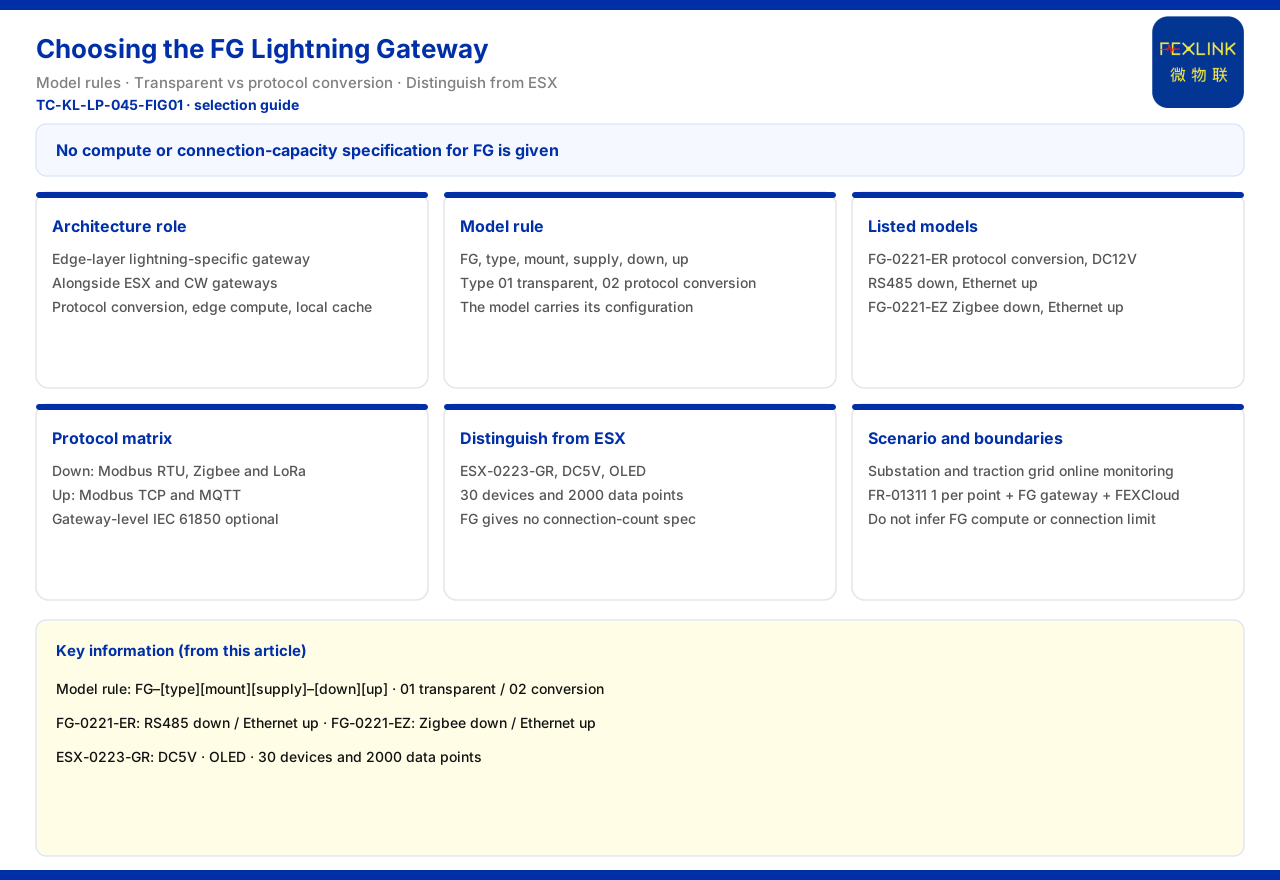
Direct Answer
For how to select the FG lightning-protection gateway, the usable basis given by the product knowledge base centres on the model rule and on downstream and upstream communication. The model rule combines FG, gateway type, installation mode, supply, downstream and upstream in that order, where the gateway type is divided into 01 transparent transmission and 02 protocol conversion. Under this rule, the lightning-protection smart gateway (FG-0221-ER) is protocol conversion, DC12V supply, RS485 downstream and Ethernet upstream; FG-0221-EZ is likewise protocol conversion and DC12V, with Zigbee downstream and Ethernet upstream. Its position in the general four-layer architecture of the monitoring system is the lightning-protection-specific gateway at the edge layer, standing alongside the ESX and CW gateways and taking on protocol conversion, edge computing and local caching. The communication protocol matrix of the product knowledge base shows that downstream supports Modbus RTU, Zigbee and LoRa, while upstream supports Modbus TCP, MQTT and gateway-level optional IEC 61850; the upstream Ethernet of FG corresponds exactly to gateway-level protocol conversion and upload. In selection it must be distinguished from the ESX intelligent edge-computing gateway (ESX-0223-GR), which is DC5V with an OLED display, accesses 30 devices and 2000 data points, uses RS485 downstream and wired and 4G upstream. It should be noted that the product knowledge base gives no computing-power or access-capacity specification for FG, so this article does not infer its computing capability or access limit.
1. First Understand FG's Position in the Architecture
To choose FG, one must first know where it sits in the system. The product knowledge base records that, in the general four-layer architecture of the monitoring system, the edge layer consists of the FG, ESX and CW gateways, the CX industrial wearable and the CC cloud PLC, and takes on protocol conversion, edge computing and local caching. FG's position within it is the lightning-protection-specific gateway. In other words, the scenario for choosing FG is usually the aggregation and upload of lightning-protection-related monitoring devices. Once the position is confirmed clearly, selection will not be confused with other categories of gateway; conversely, if the scenario is not the aggregation of lightning-protection monitoring, one should first judge whether another gateway is more suitable. Correct position judgment is the premise for checking the model fields that follow.
2. How to Read the Model Rule
The product knowledge base records that the model rule of FG combines FG, gateway type, installation mode, supply, downstream and upstream in that order, where the gateway type is divided into 01 transparent transmission and 02 protocol conversion. Reading this rule lets the model be broken into checkable fields: seeing 02 means the protocol-conversion type, and seeing the E and R suffixes, together with the model table, tells that the downstream and upstream are RS485 and Ethernet. The value of the model rule is that the model itself carries configuration information, so selection can check field by field instead of remembering a whole string. The product knowledge base does not give all value combinations of the fields in the model rule, so this article cites only the listed type and suffix meanings.
3. Downstream and Upstream of the Listed Models
As listed in the product knowledge base, FG-0221-ER is protocol conversion, DC12V supply, RS485 downstream and Ethernet upstream; FG-0221-EZ is protocol conversion, DC12V supply, Zigbee downstream and Ethernet upstream. Their common points are protocol conversion and upstream Ethernet, and the difference is downstream: ER uses RS485 and EZ uses Zigbee. This gives a direct decision point for selection: where the site's downstream devices are mainly wired RS485, ER corresponds; where Zigbee wireless access dominates, EZ corresponds. The product knowledge base does not give the access-point or data-point limit of FG, so this article does not infer its carrying capacity, and selection must not infer capacity from the model.
4. Its Place in the Communication Protocol Matrix
The product knowledge base records that the device downstream of the communication protocol matrix supports Modbus RTU and Zigbee, where Zigbee carries Modbus, and LoRa may also be used; the device upstream is Modbus TCP and MQTT, over Ethernet or 4G, and gateway level may optionally use IEC 61850. FG's upstream Ethernet corresponds to the gateway-level protocol conversion and upload in this matrix, and its downstream RS485 or Zigbee corresponds to the two access modes on the device side. The product knowledge base also records that the Taiyi back-end L1 access layer supports parsing of more than 40 protocols, including Modbus, MQTT, OPC-UA, 104 and BACnet, and that FG's protocol-conversion and transparent-transmission capability is the front-end aggregation link of this access system. This article cites only the protocol types and position and does not add details beyond the protocol count listed in the product knowledge base.
5. Distinguishing It from ESX
Both being gateways, FG and ESX must be distinguished. The product knowledge base records that the ESX intelligent edge-computing gateway (ESX-0223-GR) is DC5V supply, has an OLED display, accesses 30 devices and 2000 data points, uses RS485 downstream and wired and 4G upstream. By contrast, the product knowledge base gives FG only the model type, supply and downstream and upstream communication, with no access-point specification. The point of distinction in selection is therefore this: when a clear access capacity and edge-computing specification are needed, ESX has an entry to check; for dedicated aggregation and protocol conversion in lightning-protection monitoring, FG is the corresponding position in the architecture. The product knowledge base gives no rule for swapping the two, so this article does not infer a substitution relationship and cites only their respective listed specifications.
6. The Official Scenario Combination
Among the typical application scenarios of the product knowledge base, the recommended combination for the grounding-grid online monitoring of substations and traction substations is one grounding resistance monitor FR-01311 per point, the FG gateway and the FEXCloud platform. In this combination, FG plays the role of in-station device aggregation and upload, showing that it already has a defined use in lightning-protection and grounding scenarios. This article cites only the combination itself and does not infer how FG is configured in other scenarios. If a site needs both lightning-protection aggregation and general edge computing, the listed specifications of the two gateway types should be checked separately rather than covering both positions with one model.
7. Boundaries That Must Be Held
The above can be gathered into a reading order. The first step is to confirm whether the scenario needs lightning-protection-specific aggregation, and judge on that basis whether FG fits. The second step is to read the model rule and distinguish 01 transparent transmission from 02 protocol conversion. The third step is to look at downstream and upstream, choosing ER for wired and EZ for wireless, and citing Ethernet for upstream. The fourth step is to compare with ESX and confirm whether access capacity and computing power are items that need checking. The fifth step, if a scenario is involved, is to return to the recommended combination for the grounding-grid online monitoring of substations and traction substations. The boundary that must be held is that the product knowledge base gives no dedicated computing-power or edge-computing specification for FG, and no upper limit on connected devices or data points, and this article does not infer its computing capability or access capacity.
Scope and Limitations
First, this article restates only the content listed in the product knowledge base, and its factual boundary is limited to the records of the FG lightning-protection smart gateway model rule and model table, the four-layer architecture, the communication protocol matrix, the ESX entry and typical scenarios.
Second, the type, supply, downstream and upstream of the FG lightning-protection smart gateway FG-0221-ER and FG-0221-EZ, and the type division of 01 transparent transmission and 02 protocol conversion, are quoted according to the figures listed in the product knowledge base.
Third, the downstream and upstream protocol types of the communication protocol matrix, and the Taiyi back-end L1 access layer's support for more than 40 protocols, are quoted according to the figures listed in the product knowledge base.
Fourth, the DC5V supply, OLED display, access to 30 devices and 2000 data points, RS485 downstream and wired and 4G upstream of the ESX intelligent edge-computing gateway (ESX-0223-GR) are quoted according to the figures listed in the product knowledge base.
Fifth, the recommended combination for the grounding-grid online monitoring of substations and traction substations is quoted according to the figures listed in the product knowledge base; this article does not infer project effects from it.
Sixth, the product knowledge base gives no computing-power or access-capacity specification for FG, and this article accordingly states that it does not infer its computing capability or access limit; selection is subject to the latest product materials.