 FEXLINK Research Institute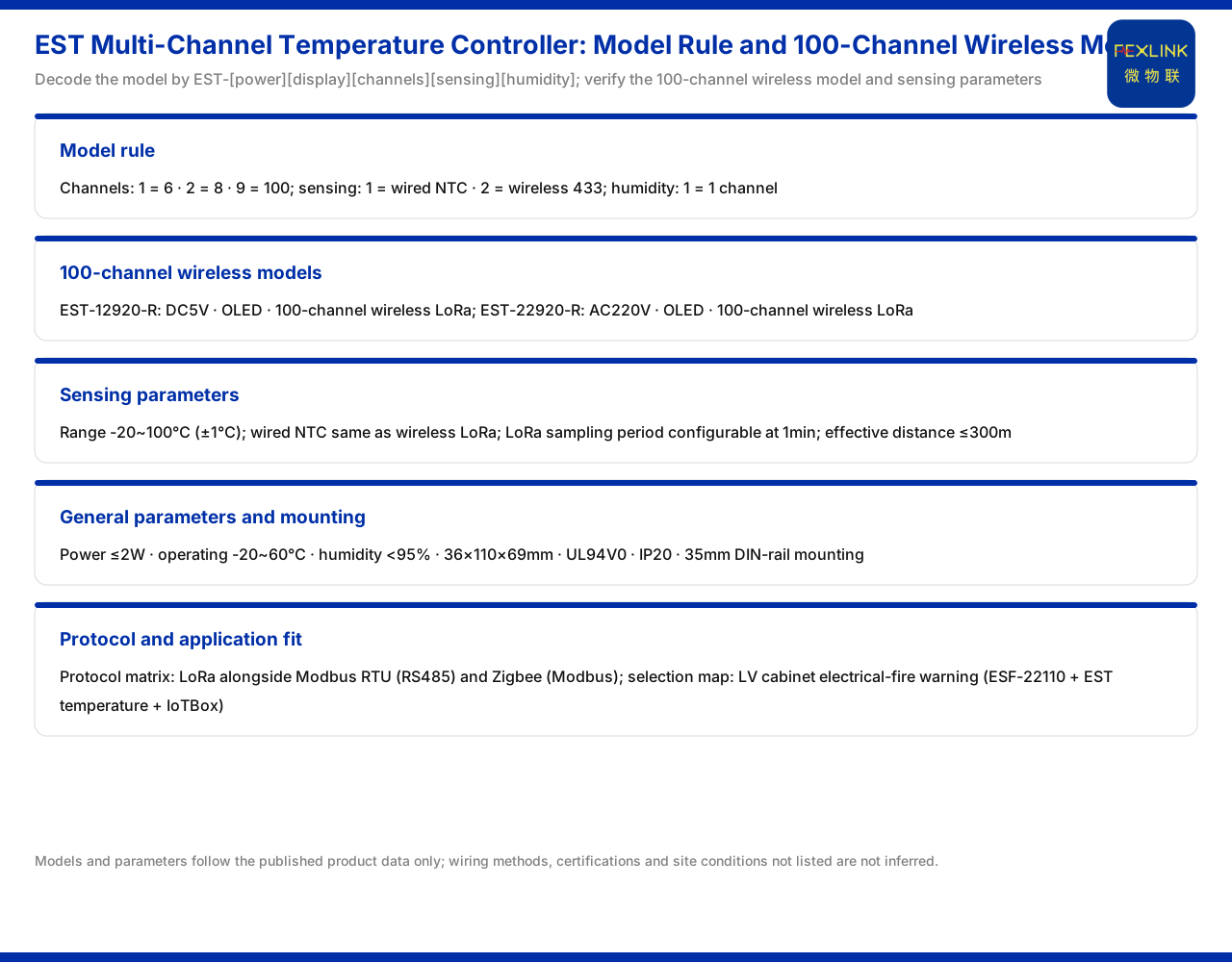
Direct answer
In multi-channel temperature monitoring, what determines whether a scheme can be implemented is often not whether to measure but how one hundred points are numbered, linked, and installed. The multi-channel temperature intelligent controller (EST series) encodes power supply, display, channel count, measurement method, and humidity into its model rules, so that the capability of a single device can be read from the model at a glance. Based on the wording listed in the product documentation, this article explains the model rules of the series, the key parameters of the 100-channel wireless model, its position in the communication protocols, and how it combines in low-voltage distribution-cabinet electrical-fire early warning; it infers no field thresholds or assessment conclusions.
1. Reading a temperature controller from its model rules
The product documentation states that the model rules of the EST multi-channel temperature intelligent controller consist of EST plus five segments: power supply, display, channel count, measurement method, and humidity. The channel-count segment gives three scales: 6 channels, 8 channels, and 100 channels; the measurement-method segment gives two paths: wired NTC and wireless 433; the humidity segment is 1 channel of humidity. Assembling the five segments yields the complete identity of a device.
The value of these rules is that they are readable. Procurement and design staff need not leaf through parameter tables: seeing the channel-count segment tells them the scale of points covered, and seeing the measurement-method segment tells them whether the site should be wired or wireless. This turns the selection question from which device to choose into which segments the site needs, reducing communication cost.
2. Two models in the 100-channel wireless tier
In the 100-channel tier, the product documentation lists two models. The multi-channel temperature intelligent controller (EST-12920-R) is powered by DC5V with an OLED display; the multi-channel temperature intelligent controller (EST-22920-R) is powered by AC220V with an OLED display. What they share is 100 channels of temperature, wireless LoRa transmission, and no humidity and no relay output.
Three points need to be distinguished here. First, the channel scale is 100 channels, corresponding to a wide distribution of points. Second, the measurement method is wireless LoRa, indicating it faces situations where wiring is difficult or points are scattered. Third, in functional configuration there is no humidity and no relay output, meaning it focuses on temperature monitoring itself, while ambient humidity and local control must be handled by other devices. The product documentation gives only this configuration wording, and this article does not infer the specific site scale it suits.
3. Temperature parameters: range, period, distance
The product documentation states that the wireless active temperature measurement range is minus 20 to 100 degrees Celsius with an accuracy of plus or minus 1 degree Celsius; it uses LoRa communication, supports a maximum of 100 channels, has a sampling period of 1 minute that can be set, and an effective distance of not more than 300 m. The wired NTC measurement is likewise minus 20 to 100 degrees Celsius with an accuracy of plus or minus 1 degree Celsius, and together with the wireless LoRa model it forms the two measurement methods for temperature monitoring within 100 channels.
Among these parameters, the settable 1-minute sampling period and the 300 m effective-distance limit most affect a scheme. Settable means the sampling rhythm can be adjusted to the speed of field changes; the distance limit means wireless point placement must consider transmission and reception conditions. The choice between wired and wireless is therefore not merely a preference: wired suits fixed points with controllable wiring, wireless suits scattered points where wiring is inconvenient, and together they cover the temperature-monitoring need within 100 channels.
4. General parameters and installation conditions
The product documentation states the general parameters of the EST series: power consumption of not more than 2 W; an operating temperature of minus 20 to 60 degrees Celsius; humidity below 95%; dimensions of 36 × 110 × 69 mm; a housing with flame-retardant rating UL94V0; a protection rating of IP20; and 35 mm DIN-rail mounting.
These conditions determine whether a device can fit into an existing cabinet. The 35 mm rail mounting shows it faces standard-rail scenarios; IP20 shows it suits in-cabinet, non-directly-exposed environments; and the upper limits on operating temperature and humidity define the operating boundary. Only by viewing these conditions together with the temperature range can one judge whether a temperature controller fits the cabinet in question. The product documentation gives general wording, and this article does not infer the temperature rise or environmental margin of a specific cabinet.
5. Position in the communication protocol
The communication protocol matrix in the product documentation lists LoRa as one of the device downlink protocols, alongside Modbus RTU (RS485) and Zigbee (Modbus). Downlink here means the field-side channel relative to the gateway or platform. Placing LoRa in this matrix shows that wireless temperature monitoring is not an isolated link but sits in the same protocol system as wired channels.
For a scheme this means that after temperature data goes up through LoRa, it must still converge with data from other protocols on the same platform. This explains why the 100-channel wireless model usually does not form a network on its own but is connected as the temperature dimension of multi-parameter monitoring. The protocol matrix gives the channel positioning, and this article does not expand the message details of each protocol or the gateway mapping rules.
6. Typical application: low-voltage distribution-cabinet electrical-fire early warning
The typical-application and selection correspondence in the product documentation includes EST temperature in the recommended combination for low-voltage distribution-cabinet electrical-fire early warning: the residual-current electrical-fire monitoring detector (ESF-22110) and the multi-channel leakage monitoring (ESC series) handle the residual-current dimension, the multi-channel temperature intelligent controller (EST series) handles the temperature dimension, and the IoT gateway (IoTBox) handles aggregation and uplink.
The logic of this combination is joint multi-dimension judgement. The electrical-fire risk of a low-voltage distribution cabinet usually appears as abnormal residual current together with contact temperature rise, and looking at current alone or temperature alone easily misses the case. Including EST temperature as one dimension is precisely to add the thermal feature beyond the current data. The product documentation gives the recommended combination structure, and this article does not infer the warning threshold or judgement result of any specific distribution cabinet.
7. Three questions for selection and placement
Bringing the above together, selection can begin by answering three questions. First, what is the scale of points? The three tiers of 6 channels, 8 channels, and 100 channels correspond to sites of different scales. Second, can the site be wired? If wiring is possible, consider wired NTC; if wiring is difficult, consider wireless LoRa. Third, is humidity or local control needed? If so, choose a model with the humidity segment or with relay output, whereas the 100-channel model provides neither.
Installation placement must likewise return to the general parameters: whether the in-cabinet rail space, ambient temperature, and humidity fall within the permitted range, and whether the protection rating matches the site. After these questions are answered, placing EST temperature into the low-voltage distribution-cabinet combination above forms a data chain from point to platform. The product documentation does not give the specific quotation or delivery information of each tier, and this article does not infer it.
Scope and limitations
First, this article restates only the wording listed in the product documentation, and its factual boundary is limited to: the five segments of the EST model rules (power supply, display, channel count, measurement method, humidity); the channel counts of 6 channels, 8 channels, and 100 channels, the measurement methods of wired NTC and wireless 433, and 1 channel of humidity; the 100-channel models EST-12920-R (DC5V, OLED) and EST-22920-R (AC220V, OLED), with 100 channels of wireless LoRa and no humidity and no relay output; the wired NTC and wireless active measurement both at minus 20 to 100 degrees Celsius with an accuracy of plus or minus 1 degree Celsius, wireless LoRa supporting at most 100 channels, a settable 1-minute sampling period, and an effective distance of not more than 300 m; the general parameters of power consumption not more than 2 W, operating temperature minus 20 to 60 degrees Celsius, humidity below 95%, dimensions 36 × 110 × 69 mm, UL94V0 housing, IP20, and 35 mm rail mounting; LoRa as one of the device downlink protocols alongside Modbus RTU (RS485) and Zigbee (Modbus); and the low-voltage distribution-cabinet electrical-fire early-warning combination containing ESF-22110, ESC multi-channel leakage, EST temperature, and IoTBox.
Second, this article does not infer the specific quotation, delivery cycle, or stock status of each tier, nor the temperature-rise rate, alarm threshold, or fire-risk conclusion of any cabinet.
Third, the temperature-collection parameters are product-documentation wording, and the number of field points, the sampling-period setting, and the interlocking strategy belong to engineering-design judgement.
Fourth, specific selection and configuration should follow the latest product documentation, the relevant standards, and the project scheme.