 微物联研究院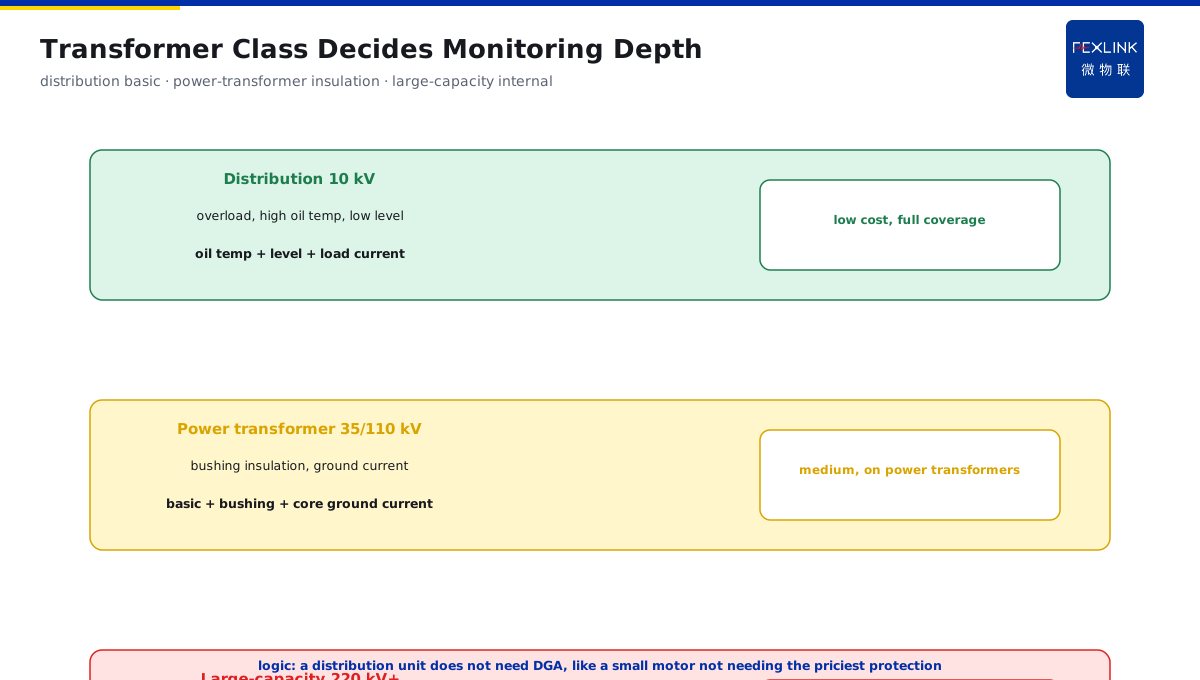
Direct Answer
A substation retrofit wants transformer online monitoring — is an online DGA (dissolved-gas analysis) device worth it? The answer: tier by voltage class and importance — distribution transformers first get oil-temperature, oil-level, and load-current monitoring; important power transformers add bushing and core-ground-current monitoring; HV large-capacity transformers then consider online DGA. Online DGA suits transformers with high failure cost; routine offline testing is usually enough for ordinary distribution transformers.
At a campus substation with two 110 kV power transformers and eight 10 kV distribution transformers, the retrofit budget was limited and the vendor suggested "online DGA on everything" — but one 110 kV online DGA unit costs about 5–10× the whole online-monitoring package of a distribution transformer, so blanket deployment made no sense. Tiered configuration: the eight 10 kV units got oil temperature + oil level + load current (covers common faults, low cost, best value); the two 110 kV units (supply hubs, high fault cost) added bushing/core-ground-current monitoring (early insulation defects); online DGA went on only one — the transformer with the worst failure consequences — while the other used offline testing + online oil-temperature linkage. Over two years, oil temperature flagged one distribution transformer overloaded above 90% and ground current found slight bushing-insulation degradation — the tiered approach covered the main risks at reasonable cost without burdening distribution units with expensive DGA.
Because:
- Monitoring items must match transformer class: common distribution faults (overload, high oil temperature) are covered by oil temperature/level/load current; insulation defects on power transformers need deeper means;
- Online DGA vs offline testing is an arithmetic problem: online DGA is expensive; small transformers with low fault cost are usually served well by offline testing (periodic sampling);
- Cost magnitude sets the pace: oil temperature/level/load current are cheapest and go everywhere; bushing/ground current are medium and go on power transformers; online DGA is the most expensive and goes only on the highest-fault-cost transformers;
- Data upload and alarm linkage share one platform: all tier data finally enters the Digital Electrical Intelligent Supervision System with unified trends, alerts, and health.
Key insight: transformer online monitoring is tiered by class, not "the more the better." Distribution units get basic monitoring first; power transformers go deeper — online DGA only for the highest-fault-cost transformers.
At an airport substation with two 35 kV power transformers, the vendor quoted online DGA and O&M hesitated. The arithmetic: one supply interruption affects flights, so fault cost is high — online DGA was worth it; but only on one unit (the core transformer carrying the station load), the other used offline testing + online oil-temperature linkage. Later, online DGA found acetylene creeping 3 months early (early internal discharge); a planned outage prevented fault escalation. The value of online DGA = fault cost ÷ price — worthwhile only on high-fault-cost transformers.
1. Monitoring Items vs Transformer Class
First clarify what each transformer class should get:
Distribution transformers (10 kV/0.4 kV):
- Common faults: overload, high oil temperature, low oil level, hot joints;
- Monitoring: oil temperature, oil level, load current, low-side joint temperature;
- Purpose: cover common faults at the lowest cost.
Important power transformers (35/110 kV, hub units):
- Common faults: bushing insulation defects, abnormal core/clamp ground current, internal discharge;
- Monitoring: oil temperature + oil level + load current + bushing dielectric/PD + core ground current;
- Purpose: cover early insulation defects; high fault cost justifies going deeper.
HV large-capacity transformers (220 kV and above, critical hubs):
- Common faults: internal discharge (DGA gases), winding deformation, insulation aging;
- Monitoring: all of the above + online DGA + winding temperature (fiber or thermal model);
- Purpose: early warning of internal faults; extremely high fault cost justifies the most expensive means.
Class-matching logic:
- Distribution: basic monitoring (oil temperature/level/load);
- Power transformer: + insulation monitoring (bushing/core ground);
- Large capacity: + online DGA (internal discharge).
Key insight: transformer class decides monitoring depth. A distribution transformer does not need online DGA, just as a small motor does not need the most expensive protection — match the class, do not waste.
2. Online DGA vs Offline Testing
DGA is the "most expensive and most sensitive" transformer tool — but do the arithmetic:
Online DGA device:
- Pros: real-time continuous monitoring; characteristic-gas trends (H₂, CH₄, C₂H₂, C₂H₄, CO, CO₂) never break; catches sudden discharge;
- Cons: high price (one unit equals several distribution-monitoring packages), needs maintenance, possible false alarms requiring re-test;
- Applies: high-fault-cost power transformers (hubs, airports, data centers, hospitals).
Offline testing (periodic oil samples to the lab):
- Pros: low cost (per sample), high lab accuracy, mature standards;
- Cons: periodic sampling — fast-developing discharge can be missed between samples;
- Applies: ordinary distribution transformers, low-fault-cost equipment.
Trade-off criteria:
- High fault cost (one interruption is costly) + high voltage class → online;
- Low fault cost + distribution class → offline testing + online oil-temperature linkage;
- Compromise: power transformer online oil temperature + periodic offline DGA + denser sampling when oil temperature is abnormal.
Engineering intuition:
- Online DGA is not a "standard item"; it is a "config for important power transformers";
- Offline testing is not "backward"; it is the "reasonable choice for distribution transformers";
- Compromise: oil temperature online (real time) + DGA offline (periodic) — cost and coverage balanced.
Key insight: online vs offline is the arithmetic of fault cost ÷ price. High cost goes online; low cost is served offline — the compromise is the most common.
3. Cost Magnitude of Each Item
Configuration costs money; first see the cost tiers:
Low-cost tier (distribution full coverage):
- Oil temperature: sensor + acquisition, low cost;
- Oil level: level gauge + alarm, low cost;
- Load current: CT + acquisition, low cost;
- Verdict: distribution transformers get these three; controllable cost, common faults covered.
Medium-cost tier (power-transformer insulation):
- Bushing: dielectric/PD sensors, medium cost;
- Core ground current: ground CT + acquisition, medium cost;
- Verdict: added on power transformers; covers early insulation defects.
High-cost tier (large-capacity internal monitoring):
- Online DGA: gas-sensor array + online analysis, high cost (one unit equals several distribution packages);
- Winding temperature (fiber): fiber sensors embedded in windings, high cost;
- Verdict: only on the highest-fault-cost transformers.
Cost and pace:
- Limited budget: low tier everywhere first (oil temperature/level/load), then deepen by importance;
- Sufficient budget: power transformers add medium tier (bushing/core), large-capacity add high tier (DGA);
- Principle: spend first on the tier that covers the most transformers, then on the deepest/most expensive tier.
Key insight: the cost tier sets the pace — cheap full coverage first, then expensive and deep. Online DGA is the most expensive tier; give it only to the most important transformers.
4. Data Upload and Alarm Linkage
Tiered data must close the loop on one platform:
Upload requirements:
- All tier data integrates into a supervision system/gateway (e.g., ESX Edge Computing Gateway aggregating; Digital Electrical Intelligent Supervision System displaying);
- Distribution: oil temperature/level/load-current trends;
- Power transformer: + bushing/core-ground-current trends;
- Large capacity: + DGA gas trends.
Alarm linkage:
- High oil temperature → check load/cooling;
- Low oil level → check leaks;
- Core-ground-current over-limit → check core insulation/clamps;
- DGA abnormal (fast-rising acetylene/total hydrocarbons) → immediate outage inspection;
- Multi-signal linkage: oil temperature + load + DGA abnormal together = high internal-fault probability.
Health linkage:
- Oil temperature, load, ground current, DGA data become transformer health deduction items;
- Worsening trends auto-escalate alerts; maintenance orders generate by deduction item.
Key insight: without unified platform data, tiering is wasted. Oil temperature, load, bushing, DGA — all tiers on one platform so trends and alerts can link.
5. Typical Tiered Configuration Examples
Three scenarios show how to configure:
Scenario 1: campus distribution transformers (eight 10 kV):
- Configuration: oil temperature + oil level + load current;
- Purpose: cover overload/high-oil-temperature common faults;
- DGA: no (offline testing suffices).
Scenario 2: substation power transformers (two 110 kV):
- Configuration: oil temperature + oil level + load + bushing monitoring + core ground current;
- Purpose: cover early insulation defects;
- DGA: one unit (highest fault cost); the other offline + linkage.
Scenario 3: critical-hub power transformers (airport/data-center 220 kV):
- Configuration: oil temperature + oil level + load + bushing + core ground + online DGA + winding temperature;
- Purpose: full-dimensional coverage, early internal-discharge warning;
- DGA: must-have (extremely high fault cost).
Common tier logic:
- Oil temperature/level/load = always the first layer (full coverage);
- Bushing/core = power-transformer second layer;
- DGA = large-capacity/hub third layer;
- Each higher layer requires a higher transformer class and fault cost.
Key insight: the tier is "full coverage first, then deepen by class." Oil temperature/level/load for everyone, bushing/core for power transformers, DGA only for the most important.
6. Product Landing: Tiered Transformer Monitoring
FEXLINK's Digital Electrical Intelligent Supervision System brings tiered transformer monitoring to practice:
- EST Multi-Channel Temperature Controller: oil-temperature and winding-temperature acquisition (low-tier full coverage + high-tier winding sensing);
- Oil-level/load monitoring: level gauge + CT input (low tier);
- Bushing/core-ground-current monitoring: sensors + acquisition (medium-tier power-transformer config);
- Online DGA: characteristic-gas online analysis (high-tier large-capacity config);
- ESX Edge Computing Gateway: unified aggregation of all tiers, edge computing, alarm linkage;
- The platform shows oil temperature/level/load/bushing/core/DGA six-line trends; health scores auto-link deduction items.
Design principle in one sentence: turn "whether to buy online DGA" into "tier by class." Distribution basic, power-transformer insulation deeper, large-capacity internal warning — cost matched to risk.
7. Common On-Site Mistakes
- Online DGA on everything: distribution transformers included. Consequence: cost out of control, most functions idle. Correct: tier by class; distribution gets basic monitoring.
- Treating offline testing as "backward": forcing online on distribution units. Consequence: waste. Correct: distribution = offline testing + online oil-temperature linkage.
- Only the cheap items: power transformers without bushing/core. Consequence: early insulation defects missed. Correct: power transformers add the medium insulation tier.
- Installing DGA and ignoring it: nobody watches gas trends. Consequence: the online unit becomes a decoration. Correct: trend monitoring + abnormal linkage; install means use.
- Data islands: each tier on its own software. Consequence: trends fragmented, alerts missed. Correct: unified platform integration, multi-signal linkage.
Scope and Limitations
This article discusses tiered transformer online-monitoring configuration (oil temperature/oil level/load current/bushing/core-ground-current/online DGA) for distribution transformers and substation power transformers. Cost magnitudes and tiering are engineering experience references; actual choices follow voltage class, fault cost, vendor proposals, and budget. Online DGA should be selected by transformer importance; offline testing is the reasonable choice for distribution transformers. All tier data needs unified platform integration to form trend warnings and alarm linkage. All cases are anonymized (a certain campus / airport) and do not refer to any specific customer.