 FEXLINK Research Institute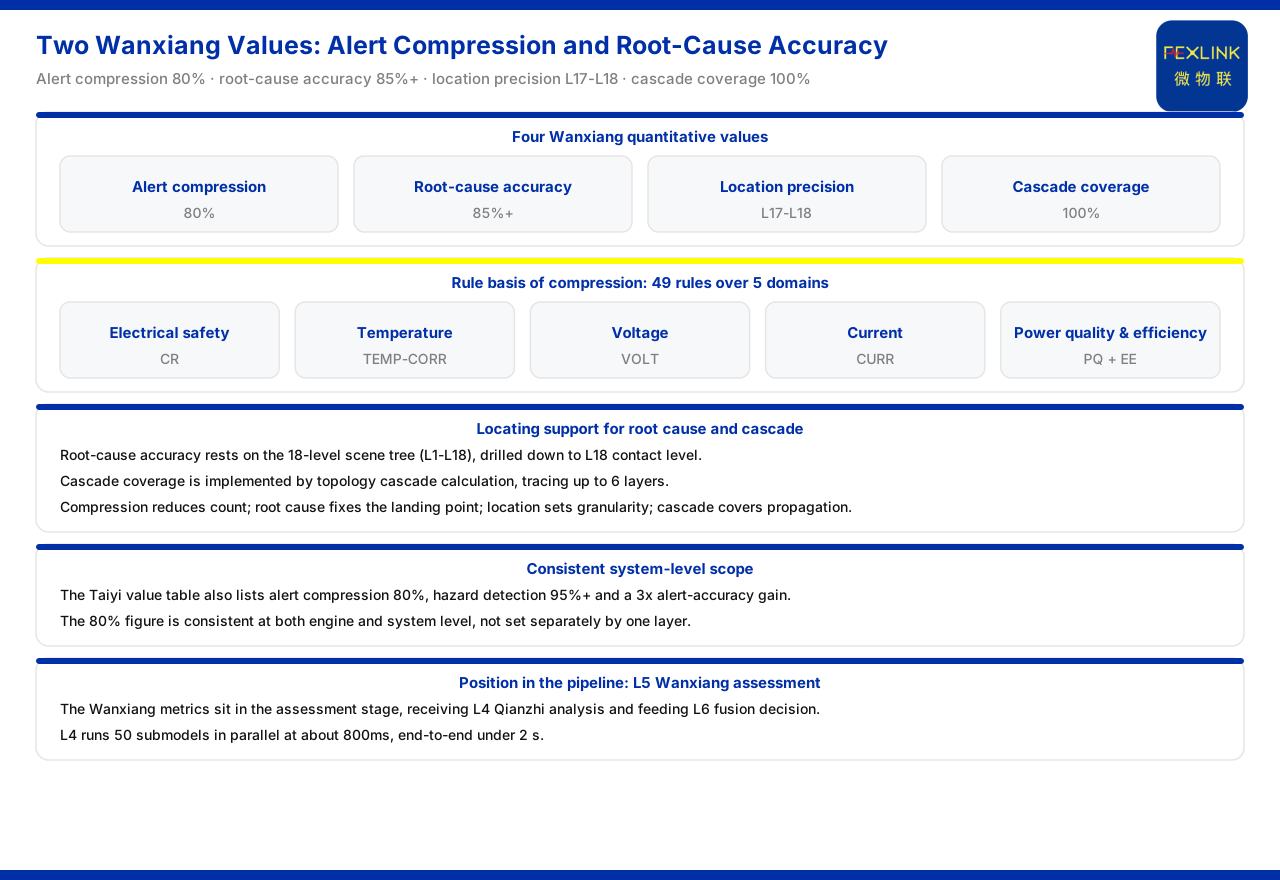
Direct answer
Among the quantified values of the Wanxiang engine (Shijing, V4.0), two are cited most often: 80% alarm compression and root-cause accuracy of 85% or above. The product knowledge base lists them together with a scene-positioning accuracy of L17 to L18 and 100% cascading-risk coverage as the engine's four quantified values. They are not isolated numbers: the basis of alarm compression is 49 cross-dimensional association rules, the structural support of root-cause accuracy is the 18-level scene-positioning tree, and 100% cascading-risk coverage is achieved through topological cascading-impact computation tracing up to 6 layers. At the system level, the Taiyi quantified value indicator table in the knowledge base also lists an 80% alarm compression ratio, plus an electrical-hazard identification rate of 95% or above and a 3-fold improvement in alarm accuracy, which shows that the 80% figure is consistent at both the engine level and the system level. This article only restates the specifications above.
The scope and source of the two indicators
The source should be stated first. The knowledge base records that the quantified values of the Wanxiang engine are four: 80% alarm compression, root-cause accuracy of 85% or above, scene-positioning accuracy of L17 to L18, and 100% cascading-risk coverage. Two things need attention here. First, the four are one group of value indicators, which shows that alarm compression and root-cause accuracy are not independent promotional figures but different facets of one capability set. Second, they also have counterparts at the system level: the Taiyi quantified value indicator table likewise lists an 80% alarm compression ratio, plus an electrical-hazard identification rate of 95% or above and a 3-fold improvement in alarm accuracy. That the two places agree shows the 80% figure runs through the engine level and the system level, rather than being a parameter set separately at one layer.
The rule basis of the 80% alarm compression
Alarm compression means converging a large number of raw alarms into a small number of effective conclusions. The knowledge base records that Wanxiang provides 49 cross-dimensional association rules divided into 5 domains: electrical safety 7, temperature-related 7, voltage-related 15, current-related 14, and power quality and energy efficiency 3 each. These rules relate readings from different dimensions to one another, so as to judge which alarms point to the same problem and which can be merged. The rule basis decides the reliability of compression: without a systematic set of association rules, compression is only a simple reduction in quantity and may discard important signals together. Understanding the 80% figure should therefore place it together with the 49 association rules, rather than viewing the proportion alone.
The positioning support for root-cause accuracy of 85% or above
Root-cause accuracy describes the ability to find the fundamental cause of a problem, and its structural support is positioning accuracy. The knowledge base records that the scene-positioning accuracy of Wanxiang is L17 to L18, arising from the 18-level scene-positioning tree: the tree drills down from the L1 park level to the L18 contact level, and an alarm can be located precisely to "the outgoing terminal of circuit 5 in the power cabinet of workshop 3". The finer the level, the clearer the root-cause landing point. In other words, root-cause accuracy is not an isolated algorithmic indicator but is bound to positioning granularity: only when positioning reaches the wiring-terminal level or even the contact level does root-cause judgement have a sufficiently fine object. This article does not interpret 85% or above as a guarantee for any site; it explains only the supporting relationship with the positioning tree.
The implementation support for 100% cascading-risk coverage
Cascading risk is the risk that an anomaly at one point propagates along the distribution topology to adjacent positions. The knowledge base records that the dedicated analysis engines of Wanxiang include topological cascading-impact computation, which supports topological cascading-impact computation and traces up to 6 layers. This provides the implementation support for 100% cascading-risk coverage: to cover cascading along the topology, it must be possible to trace several levels upward and downward along the supply path. The number of traced layers decides the depth of coverage, and 6 layers is the specification listed in the knowledge base. Placing this item beside the other three shows that the quantified values of Wanxiang form a set: compression handles the number of alarms, root cause handles the landing point, positioning handles granularity, and cascading handles the spread.
The assessment stage in the pipeline
It must be clear where these indicators sit in the seven-stage pipeline of Taiyi. The knowledge base records that stage four of the pipeline is Qianzhi analysis (50 sub-models in parallel, about 800 milliseconds), stage five is Wanxiang assessment, and stage six is fusion decision (forming a comprehensive health score by weighting the Qianzhi and Wanxiang results), with an end-to-end latency of less than 2 seconds. The indicators of Wanxiang sit in the assessment link of this pipeline: Qianzhi handles the analysis, and Wanxiang handles the assessment and gives "why" and "where", after which the fusion decision follows. Understanding this position helps avoid confusing the quantified values of Wanxiang with the value of the whole pipeline: they are the capability expression of one link in the pipeline, and the final value appears at the fusion decision and the system level.
Division of labour with Qianzhi and Tianyan
The family overview in the knowledge base positions the Wanxiang engine as the "Shijing brain · assessment layer", version V4.0, and notes that V5.0 is evolving towards related capabilities; its responsibility is to "know why and where the anomaly is", with a clear division of labour from Qianzhi (the recognition layer) and Tianyan (the decision layer). This division explains why alarm compression and root-cause accuracy are borne by Wanxiang: discovery and recognition are done by Qianzhi, prediction and decision by Tianyan, and converging readings into conclusions with root causes is the job of the assessment layer. Only by setting out the three roles clearly can one understand that the two indicators of Wanxiang are a definite link in the whole intelligence chain, not the whole of it.
Checking sequence when applying the two indicators
Setting this out as a sequence makes item-by-item checking easier. First, confirm that the indicator scope comes from the four quantified values of the Wanxiang engine, not from extracting one of them alone. Second, match 80% alarm compression with the 49 cross-dimensional association rules, understanding that compression comes from association rather than simple deletion. Third, match root-cause accuracy of 85% or above with the L17 to L18 accuracy of the 18-level scene-positioning tree, understanding that accuracy depends on positioning granularity. Fourth, match 100% cascading-risk coverage with topological cascading-impact tracing up to 6 layers. Fifth, confirm within the Taiyi seven-stage pipeline that these indicators sit in the Wanxiang assessment link, and distinguish them from the roles of Qianzhi and Tianyan. This sequence separates "recognise the scope, see the rules, see the positioning, see the topology, see the link", avoiding a direct reading of engine-level indicators as system-level promises. The checked result should be confirmed together with project conditions; this article does not replace on-site verification.
Applicability and limits
First, the content of this article is limited to the product knowledge base's existing statements about the Wanxiang engine's quantified values, cross-dimensional association rules, scene-positioning tree, dedicated analysis engines, and the Taiyi pipeline and family division of labour.
Second, 80% alarm compression, root-cause accuracy of 85% or above, scene-positioning accuracy of L17 to L18 and 100% cascading-risk coverage are all specifications listed in the knowledge base; this article does not constitute a promise about the result of a specific project.
Third, the counts of the 5 domains of the 49 association rules, the topological cascading-impact tracing up to 6 layers, and the about 800 milliseconds of pipeline stage four and the end-to-end latency of less than 2 seconds are all restated according to the knowledge base.
Fourth, the 80% alarm compression ratio, the electrical-hazard identification rate of 95% or above and the 3-fold improvement in alarm accuracy in the Taiyi quantified value indicator table are limited to the knowledge base; this article does not infer unlisted indicators.
Fifth, the V5.0 evolution of Wanxiang is a state listed in the knowledge base; this article does not infer its specific capabilities or timetable, and actual performance follows the latest product materials and project plans.