 微物联研究院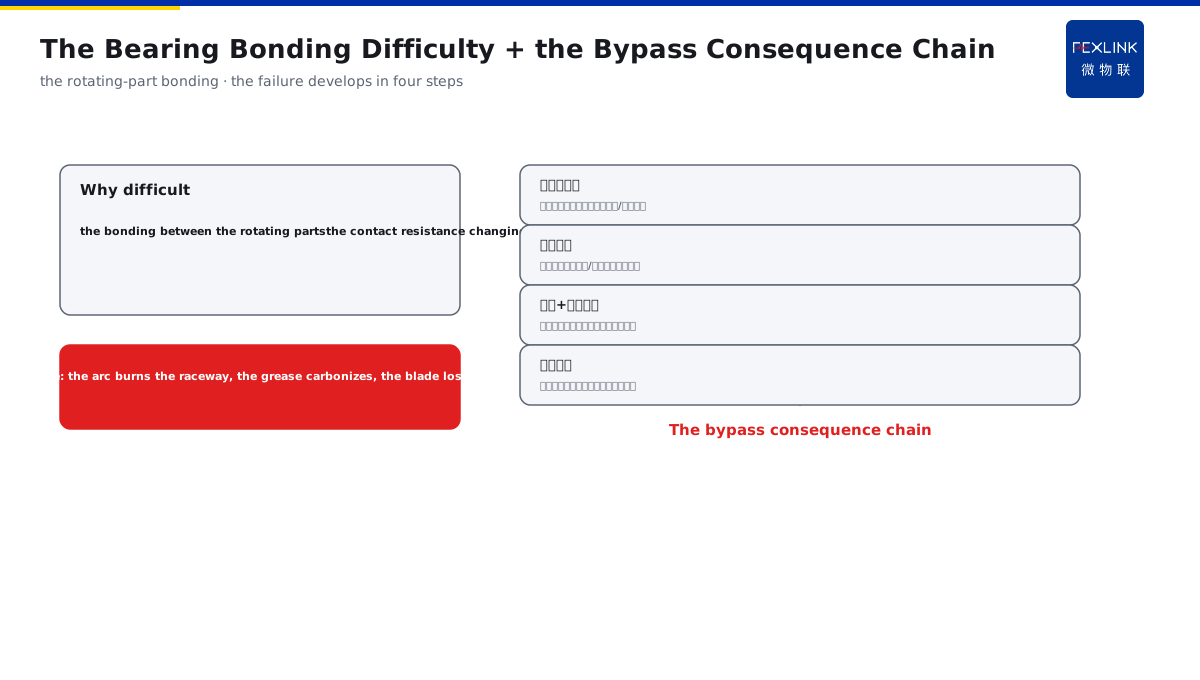
Direct Answer
With the blade a hundred meters high on an isolated hilltop, how is the lightning current led down inside the blade and the tower? The answer: the wind turbine relies on the blade air-termination devices (the metal receptor at the tip / the receiving mesh in the blade) to capture the lightning, and leads it down through the embedded down conductor in the blade, the hub and the pitch bearing, the grounding trunk inside the tower wall, to the foundation grounding grid into the earth; at any place of this path where the contact resistance increases (the bearing carbon-brush aging, the loose connection bolts), the lightning current may jump the arc and burn the blade or the electrical insulation.
At a wind farm, after a strike, a turbine showed a through-burn at the blade root; the shutdown investigation found that the carbon brush at the pitch bearing was worn and the contact resistance had jumped, and the lightning current jumped the arc at the bearing. After the brush was replaced and the bonding cleaned, the same kind of strike left the blade intact. The key distinction: the air-termination path is a "series chain" — the blade receptor → the down conductor → the hub/pitch bearing → the tower trunk → the foundation grounding grid; at any link where the contact resistance increases, the lightning current jumps the arc and burns the blade or the insulation; every link of the path needs the monitoring and the maintenance.
Why:
- The blade air termination: the metal receptor at the tip / the receiving mesh captures the lightning;
- The down-conductor path: the embedded down conductor transmits the lightning current;
- The bonding difficulty: the hub and the pitch bearing need the reliable bonding;
- The earthing link: the tower trunk → the foundation grounding grid into the earth.
Key insight: "The air-termination path is a series chain — the blade receptor captures the lightning, the embedded down conductor transmits it, the pitch bearing bonds it, the tower trunk leads it down and the foundation grid earths it; at any link where the contact resistance increases, the lightning current jumps the arc and burns the blade or the insulation."
At a turbine, after a strike, the blade looked intact but the converter in the nacelle was punctured; the investigation found that the tower-flange bolts were loose, and part of the lightning current bypassed through the nacelle metal path and flashed over to the electrical equipment. After the flange bonding was tightened, the lightning current returned to the trunk to the earth. Lesson: the "intact appearance" of the path does not equal the electrical continuity — the loose bolts/worn carbon brushes make the lightning current bypass and flash over to burn the electrical equipment; the bonding and the tightening are the key to keeping the path.
Overview: run "how the blade air-terminates → how the down-conductor path goes → why the bearing bonding is difficult → how the tower to the foundation earths" as one path disassembly. The blade a hundred meters high on an isolated hilltop is the high-frequency strike point; the lightning current must be led down through a complete path: the blade receptor captures the lightning, and through the embedded down conductor, the hub and the pitch bearing, the grounding trunk inside the tower wall, to the foundation grounding grid into the earth. At any place of this path where the contact resistance increases, the lightning current may jump the arc and burn the blade or the electrical insulation. The four layers are unfolded below.
A "water pipe" analogy: think of the air-termination path as a water pipe from the blade tip to the underground. The lightning current is the "water", the blade receptor is the "inlet", the down conductor/bearing bonding/tower trunk are the "pipe", and the foundation grounding grid is the "outlet". When any place of the pipe is "blocked" (the contact resistance increases), the water (the current) overflows from the side (the arc jump) — overflowing to the blade composite burns the blade, and overflowing to the electrical equipment flashes over and punctures it. To make the lightning current enter the earth smoothly, every section of the pipe (the bonding/flange/carbon brush) must be open. The water-pipe analogy: the air-termination path = a pipe from the blade tip to the underground, the current = the water, and the increased contact resistance = the pipe blockage — the blocked point jumps the arc to burn the blade or flashes over to burn the equipment, and every section of the pipe must stay open.
1. The Blade Air Termination: How to Capture the Lightning
Step one: first look at how the air-termination devices on the blade capture the lightning.
The blade-tip receptor:
- The metal tip protruding beyond the blade tip;
- Actively guiding the leader discharge;
- Protecting the blade body;
- The strike point fixed at the receptor.
The receiving mesh in the blade:
- The metal mesh laid on the blade surface;
- Covering the large area to capture the strike;
- Dispersing the lightning-current density;
- Protecting the composite structure.
The receptor state:
- Falling off/burning out means failure;
- The strike point moves to the blade body;
- The composite material is punctured;
- The regular inspection is the key.
Key insight: "The blade air termination relies on the metal devices — the tip receptor protrudes to guide the leader and the receiving mesh covers the large area to disperse the current; when the receptor falls off/burns out, it fails, the strike point moves to the blade body and the composite material is punctured."
2. The Down-Conductor Path: How the Current Is Transmitted
Step two: after the blade captures the lightning, along what path does the current go down.
The embedded down conductor:
- The down copper cable laid inside the blade;
- Going down from the blade-tip receptor;
- Bonding with the hub;
- Transmitting the main lightning current.
The connection points:
- The blade root bonding with the hub;
- The bolt connection reliable;
- The contact resistance small;
- The loosening is the arc-jump point.
The transmission principle:
- The main path with the low impedance;
- The current not bypassing the electrical path;
- The metal path under control;
- Avoiding the flashover to the equipment.
Key insight: "The down-conductor path is the main line — the copper cable embedded in the blade goes down from the tip and the blade root bonds reliably with the hub; the main path is low-impedance, the current does not bypass the electrical path, and the bolt loosening is the arc-jump point."
3. The Bearing Bonding: Why It Is Difficult
Step three: the pitch bearing is the "bonding difficulty" of the path.
Why difficult:
- The bearing is a rotating part;
- The bonding between the static and the rotating;
- The contact resistance changing dynamically;
- The carbon brush/carbon film easily aging.
The bonding ways:
- The carbon brush/carbon film bonding;
- The metal braid bonding strip;
- The wear inspected regularly;
- The contact resistance monitored.
The failure consequences:
- The arc jump at the bearing;
- The raceway burned;
- The grease carbonized;
- The blade out of control.
Key insight: "The pitch bearing is the bonding difficulty — the rotating parts bond through the carbon brush/carbon film/braid, the contact resistance changes dynamically and ages easily; when it fails, the arc jumps at the bearing, the raceway is burned, the grease is carbonized and the blade loses control."
A three-step way to "verify the path in the maintenance": after the thunderstorm season, verify the turbine path in three steps. Step one, look at the receptor — whether the blade-tip receptor falls off/burns out and whether the receiving mesh is damaged; step two, measure the bonding — the carbon-brush wear of the pitch bearing, whether the tower-flange bonding wire is tightened, and measure the contact resistance with a micro-ohmmeter; step three, check the earthing — re-measure the foundation ground resistance and whether the equipotential connection is intact. After the three steps, which link of the path has the hidden danger is clear at a glance. The three-step maintenance check: look at the receptor (the fall-off/burn-out) → measure the bonding (the brush wear/flange tightening/contact resistance) → check the earthing (the ground resistance/equipotential) — after the three steps, the path hidden danger is clear at a glance.
The typical consequence chain of the "bypass" of the lightning current: after the contact resistance of one link increases, the fault develops along a chain. Step one, the current finds the shortcut — with the main path resistance high, the lightning current changes to the nacelle/tower metal structure; step two, the flashover punctures — the bypass path passes through the electrical equipment (the converter/slip ring) and the insulation is punctured; step three, the equipment is damaged and the blade is also damaged — the flashover burns the equipment, while the arc jump at the main path continues to burn the blade; step four, the shutdown loss — the fault is found only after it expands, and the shutdown maintenance is costly. These four steps show that the path hidden danger is invisible at ordinary times and exposed by one strike. The bypass consequence chain: the current finds the shortcut → the flashover punctures the equipment → the equipment is damaged and the blade is also damaged → the shutdown loss — the path hidden danger is invisible at ordinary times and exposed by one strike.
4. The Tower to the Foundation: How to Earth
Step four: the lightning current goes down the tower trunk to the foundation grounding grid into the earth.
The tower grounding trunk:
- The trunk laid inside the tower wall;
- The flanges bonded reliably;
- The current going down the trunk;
- Not through the electrical path.
The flange bonding:
- The tower segmented flanges connecting;
- The bolt loosening increasing the resistance;
- The bonding wire parallel and reliable;
- The tightening and the inspection regular.
The foundation grounding grid:
- The foundation ring/pile grounding;
- The ground resistance under control;
- The lightning current dispersing into the soil;
- Connected with the equipotential bonding.
Key insight: "The earthing link is at the foundation — the trunk inside the tower wall leads the current down, the flanges bond reliably, and the foundation grounding grid disperses the current into the soil; the loose flange bolts make the current bypass, and the foundation grid with the equipotential bonding discharges the current safely."
The "double check inside and outside the blade" after the strike: the blade is the hardest-hit area of the lightning damage, and after the strike, the double check inside and outside must be done. The outside checks three points — whether the tip receptor falls off/burns out, whether the blade-surface metal mesh is damaged, and whether the blade root has a through-burn trace; the inside checks two points — whether the down copper cable connection is tightened and whether the blade-root/hub bonding is good. The common landing point of the inside and outside is the "path continuity": the outside checks the capture end and the inside checks the transmission end, and any abnormality at either end must be handled before the operation resumes. The double check inside and outside the blade: the outside checks the receptor/mesh/root burn, and the inside checks the down-cable tightening/hub bonding — the common landing point is the path continuity, and the operation resumes after the abnormality is handled.
5. Product Implementation: The Air-Termination Path Made Monitorable
WeiWuLian products bring the air-termination path to the verifiable level:
- FL lightning-current monitor: the strike current of each blade online;
- The strike location: the actual strike points compared with the path;
- The data review: the arc-jump/bypass traces located;
- The loop improvement: the targeted path maintenance.
The design principle in one sentence: "The path monitored and the fault located — the FL records the strike current of each blade, the arc-jump/bypass is located against the path after the strike, and the maintenance changes from 'checking the whole machine' to 'checking one point'."
6. Common Understanding Misjudgments
- "The intact blade appearance means no problem": wrong. The contact resistance inside the path increases, and the arc jump burns the blade at the strike.
- "The receptor is a decoration": wrong. When the receptor falls off/burns out, the strike point moves to the blade body.
- "The bearing bonding needs no care": wrong. The carbon-brush aging is one of the root causes of the frequent wind-turbine lightning damage.
- "The flange bolts do not matter": wrong. The loose bolts make the lightning current bypass and flash over to the electrical equipment.
- "The foundation grounding is measured once": wrong. The ground resistance and the equipotential must be continuously monitored, and every link of the path must be verified.
Scope and Limitations
This article disassembles the lightning air-termination path of the wind turbine (the blade air termination, the down-conductor path, the bearing bonding, and the tower earthing), applicable to the wind-turbine lightning-protection design and the operation-and-maintenance judgment. The specific bonding and earthing requirements follow GB/T 21714 and IEC 62305-3; this article explains only the path mechanism. All cases are anonymized (a wind farm/a turbine) and do not refer to any specific customer.