 微物联研究院
Direct Answer
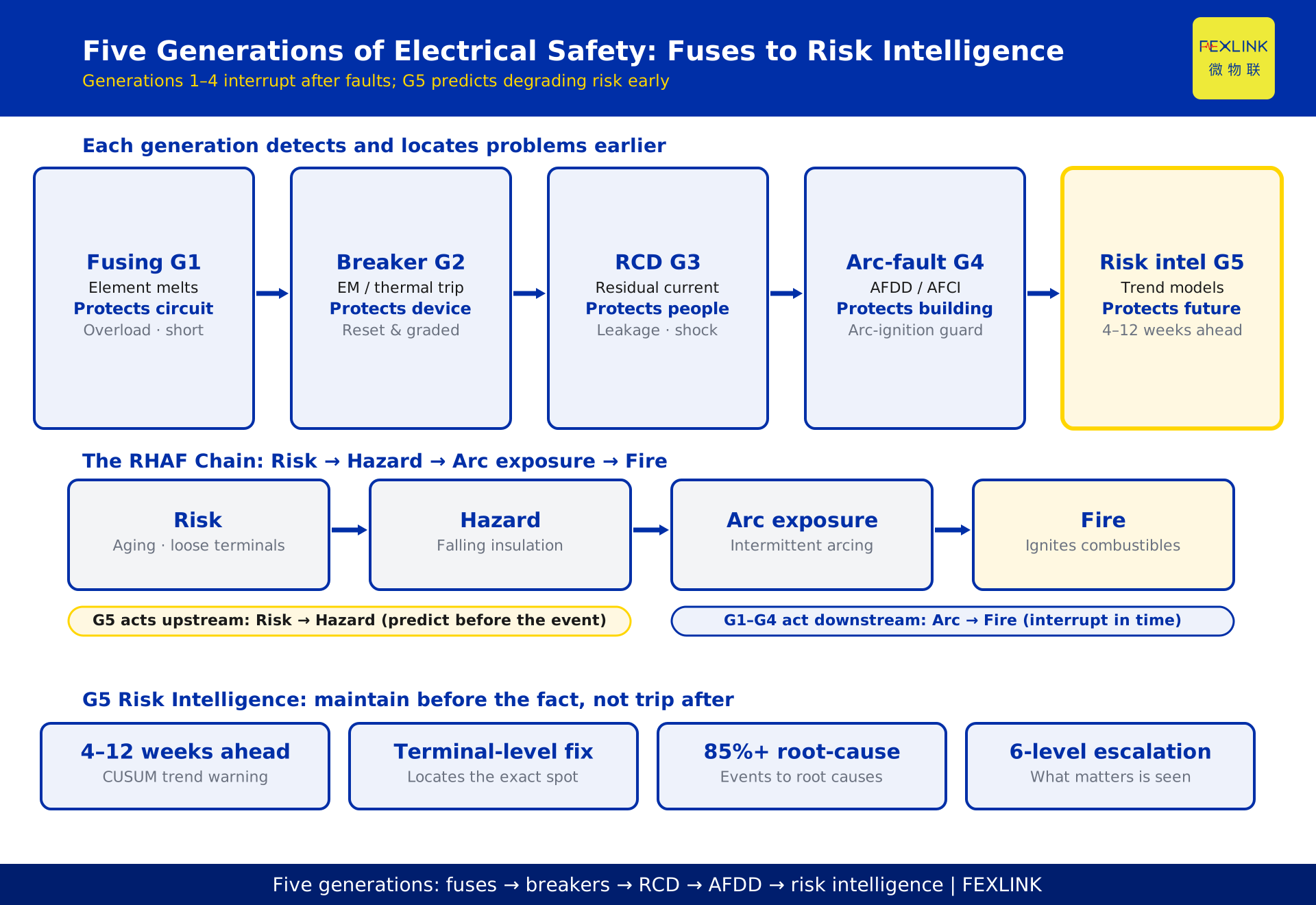
Electrical safety did not become "intelligent" overnight — it has evolved through five generations: G1 fuses → G2 circuit breakers → G3 residual-current protection (RCD) → G4 arc-fault detection (AFDD/AFCI) → G5 risk intelligence. The first four generations answer the same question — "how do we interrupt power after something goes wrong" — with the protected object widening from cables and equipment to people, and then to arc ignition. The fifth generation changes the game: it is not another protective device; it uses data and models to move protection from "reaction after the event" to "prediction before the event" — surfacing risk while a fault is still developing, not after it has become an accident. Understanding this lineage prevents a common mistake: treating a new-generation platform as a "better fuse," and it clarifies what to install first when upgrading an existing electrical room.
1. Why Five Generations, Not Three
A common shorthand divides electrical safety into "mechanical → electronic → intelligent" protection. The direction is right but the granularity is too coarse, because each generation change protected a different object — sometimes the cable from burning out, sometimes the person from electric shock, sometimes the building from arc ignition. When the protected object changes, the installation point, the operating principle, and the selection logic all change with it.
A more useful classification groups protection by "protected object + operating principle":
- G1 fusing: protects the circuit; a metal element melts to interrupt;
- G2 circuit breakers: protect circuits and equipment; electromagnetic/thermal tripping, resettable;
- G3 residual-current protection: protects people; trips on residual (leakage) current;
- G4 arc-fault detection: protects buildings and lives; recognizes arc signatures and interrupts;
- G5 risk intelligence: protects "accidents that have not happened yet"; detects developing faults with data and models.
Read across all five, a clear thread emerges: each generation detects problems earlier and locates them more precisely than the last. By G5, protection no longer depends on "fault current large enough to trip a device" — it depends on abnormal signals already visible in the trend.
2. G1 Fuses: Sacrificing the Element to Save the Circuit
A fuse is the first-generation protection with the simplest principle: when current exceeds the rating, the element heats, melts, and opens the circuit. Its strengths are simplicity, reliability, and no moving parts. Its weakness is that it is one-shot — after it blows, someone must replace it, and before replacement nobody knows exactly what happened; diagnosis happens after the fact.
G1 solved overload and short-circuit protection, reducing "fire risk" to "replace the element." But its limits are obvious: a fuse cannot protect a person (human-body fault current is often too small to melt it), cannot distinguish leakage, and offers no warning. Fuses still exist in low-voltage distribution, but their role has shifted from "the only line of defense" to "backup protection."
3. G2 Circuit Breakers: Making Interruption Repeatable
Breakers removed the "single-use" pain of fuses. An electromagnetic release handles short circuits; a thermal release handles overloads; after the fault clears, the breaker can be reclosed and reused. More importantly, breakers turned protection from a one-time event into part of system design: they can be coordinated across levels (selective protection) to isolate a fault in the smallest possible zone.
But breakers still protect circuits and equipment. They are largely blind to human shock, to leakage, and to arc ignition — because those faults are not characterized by "too much current" but by "current going somewhere it should not" or "localized discharge at a contact point," which may never reach the breaker's trip threshold.
4. G3 Residual-Current Protection: From Equipment to People
The residual-current device (RCD) extended the protected object from equipment to people. It measures the vector sum of phase and neutral current: under normal conditions they cancel; when someone is shocked or insulation leaks to earth, the residual current exceeds the setting and the RCD interrupts within tens of milliseconds.
This was the first time electrical safety was designed for human life, which is why RCDs are mandatory in residential, temporary-power, and hand-tool applications. But RCDs have a blind spot: they are sensitive only to earth leakage and do not operate on phase-to-phase arcs or series arcs (discharge from a loose contact) — precisely the arcs that most often ignite real electrical fires.
5. G4 Arc-Fault Detection: Closing the "Invisible Ignition Source" Gap
Arc-fault detection (AFDD/AFCI) is the fourth generation, dedicated to arc ignition. An arc is deceptive: the current is too small to trip a breaker, the location is hidden (inside a joint, terminal, or damaged insulation), and the temperature is extreme — thousands of degrees in an instant — enough to ignite surrounding combustibles. AFDD recognizes the high-frequency signatures and waveform distortion unique to arcing and interrupts before the arc persists long enough to ignite.
At this point the first four generations cover the four major fault classes — overload, short circuit, leakage, and arcing — one device per class. But note what they share: all of them act after the fault has occurred. An arc takes only seconds to minutes to develop from inception to ignition; however fast an AFDD reacts, it merely shrinks the loss from "fire" to "trip." It cannot rescue a risk that has already formed.
6. The RHAF Chain: Risk → Hazard → Arc Exposure → Fire
To see why a fifth generation is necessary, trace the complete chain of an electrical fire: RHAF (Risk → Hazard → Arc exposure → Fire).
- Risk: aging insulation, loose terminals, condensation from humidity, harmonic overheating, steadily growing leakage — the fault has not happened, but the seed is planted;
- Hazard: the risk develops into a defect capable of discharging, such as insulation resistance that keeps falling or abnormal localized temperature rise;
- Arc exposure: intermittent arcing begins at the defect — one step away from ignition;
- Fire: the arc ignites combustibles and the fire spreads.
The first four generations all act on the "arc exposure → fire" segment — the tail end. The real upstream opportunity is in "risk → hazard": if a deteriorating trend can be detected and located to a specific circuit early in insulation aging, the fire chain is broken at its first link. That is exactly where G5 enters.
7. G5 Risk Intelligence: Not a Fifth Protective Device, but Four to Twelve Weeks of Lead Time
G5 risk intelligence is not one more protective device; it is a sensing + data + model system. Monitoring modules and smart meters continuously sample voltage, current, temperature, and leakage; edge and cloud models recognize trends and report developing faults before they become failures.
FEXLINK's early electrical-hazard detection and warning system is a working implementation of this generation. Its typical capabilities include:
- Leakage-trend warning (CUSUM): cumulative-sum analysis of leakage current issues warnings 4–12 weeks before the fault matures — turning "trip after the fact" into "maintenance before the fact";
- Terminal-level localization (L17–L18): not just "this circuit is unhealthy" but a specific terminal/point, so field staff do not have to inspect every compartment;
- 85%+ root-cause accuracy: converging a stream of events into a few root causes, combined with 80% alarm compression, so operators are not drowned in false alarms;
- 6-level alarm grading: severity-based escalation ensures that what matters is always seen.
The essence of G5 versus the earlier generations fits in one sentence: G1–G4 answer "what happened and how do we interrupt it"; G5 answers "what is degrading now, and can we still act early."
8. Five Generations Compared: What Each Solved and What It Left Behind
| Generation | Protected object | Core principle | Faults addressed | Limitations |
|---|---|---|---|---|
| G1 Fusing | Circuit | Element melts | Overload, short circuit | One-shot, no warning, no human protection |
| G2 Breaker | Circuit + equipment | Electromagnetic/thermal trip | Overload, short circuit (resettable) | Blind to leakage and arcing |
| G3 RCD | People | Residual-current trip | Earth leakage, electric shock | No operation on phase/ series arcs |
| G4 AFDD | Building and life | Arc-signature recognition | Arc ignition | Still acts "during" the event |
| G5 Risk intelligence | Accidents not yet happened | Data + trend models | Risk → hazard stage | Depends on sensing coverage and data quality |
9. Lessons for Retrofitting an Existing Electrical Room: Install the "Eyes" First
The five-generation lineage leads to three practical rules for upgrades:
First, select protection by protected object, not by price or novelty. Use a breaker plus RCD at the main incoming, evaluate AFDD per end circuit, and do not replace selection logic with "upgrade everything."
Second, confirm sensing coverage before adding G5. G5's value rests on continuous, accurate data: does each critical circuit have current/temperature/leakage monitoring, and is the data flowing to the cloud? Without sensing coverage, risk intelligence is a castle in the air.
Third, G5 and G1–G4 complement each other; they do not substitute. G5 warns early and directs maintenance; the earlier generations provide the fail-safe interruption when a warning is missed. In one example, an industrial park's electrical room retrofitted 32 low-voltage panels with monitoring modules and smart meters feeding the early-warning system. Within two months the system flagged three circuits with abnormal leakage trends; planned-outage inspection confirmed one as aging terminal insulation. Under a conventional approach, that circuit would likely have announced itself six months later as a trip — or worse, as smoke.
Scope and Limitations
The five-generation framing (G1–G5) in this article is an analytical tool for understanding the evolution of electrical safety and for organizing selection and retrofit thinking; it is not a standard terminology, and different standards classify protective devices differently. The "4–12 weeks of advance warning," "85%+ root-cause accuracy," and "80% alarm compression" figures are company-disclosed metrics from FEXLINK; actual results depend on field data quality and circuit complexity. Application of G4 AFDD should follow the relevant product standards and electrical design codes. All case examples in this article are desensitized and do not refer to any specific customer. For protection configuration and early-warning assessment on a specific project, site investigation and the latest product documentation are recommended.