 微物联研究院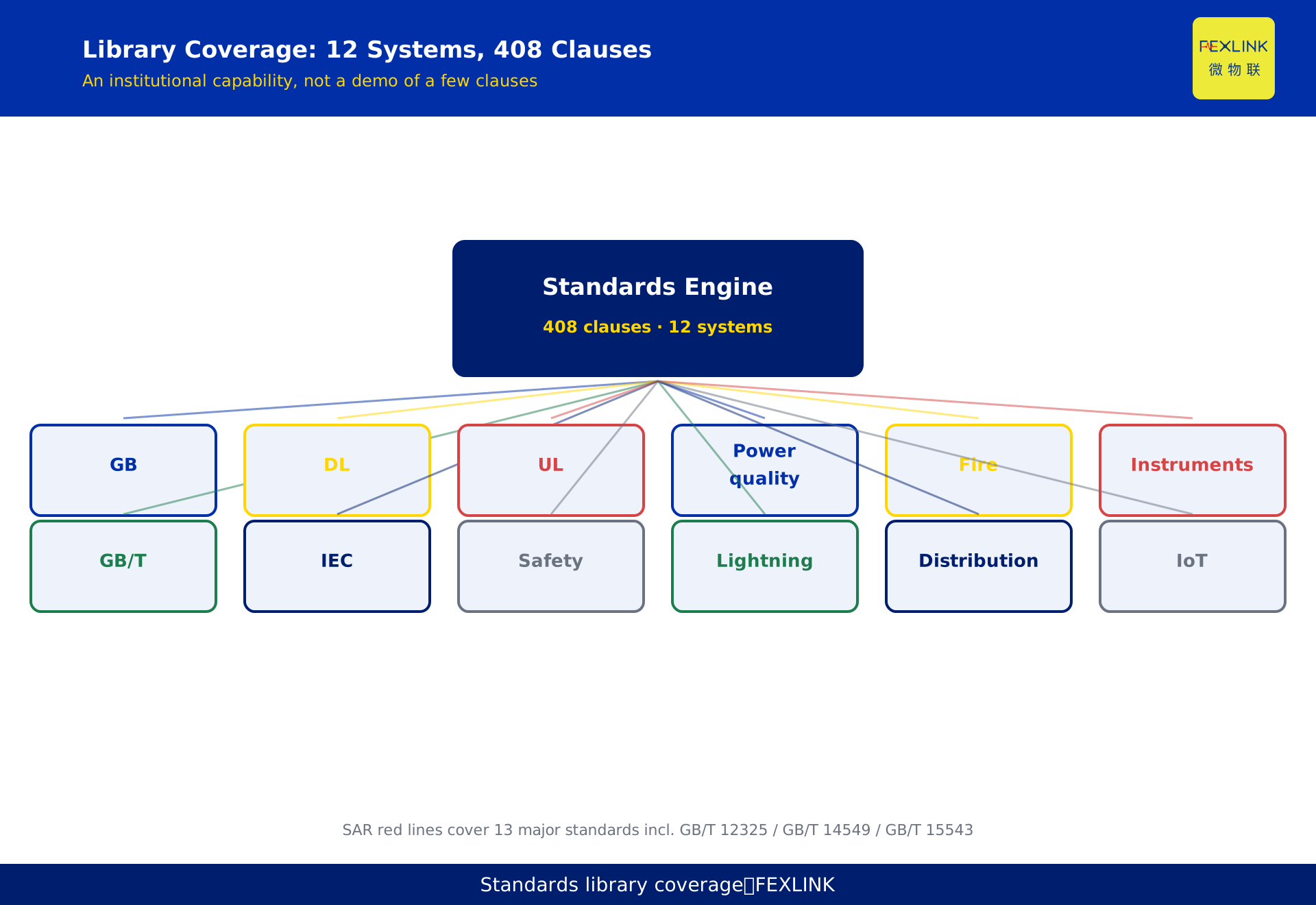
Direct Answer
An alarm can carry its matching national-standard clause automatically because the system embeds a "standards engine": standard clauses from GB, GB/T, DL, IEC, UL and other systems are structured and digitized into a searchable, matchable rule library; when an alarm triggers, the engine matches the relevant clause by alarm type and parameter and pushes it together with the alarm to the responder. Every alarm then carries its compliance basis and handling requirements — field engineers no longer dig through standard manuals for the basis, actions have a documented source and confidence, and post-event audits are fully traceable. This turns a bare threshold crossing into an actionable instruction with a legal basis.
Why Alarms Should Carry Their Basis: A Real Pain in Compliant Handling
In traditional electrical monitoring, one inefficient step is widely ignored: when the alarm comes, where is the basis? Seeing "harmonic limit exceeded" or "voltage deviation out of range," the field engineer's first reaction is usually "what is the limit again?" — then flipping through standards, asking colleagues, or acting on memory. Several problems follow: it is slow (a few minutes spent looking up standards may be the window in which a hazard grows); it is inconsistent (different people act on different versions and interpretations); and it leaves no evidence (later, no one can say which standard and which clause was the basis, making audits and reviews difficult).
This problem grows with alarm volume. A single alarm can be handled with manual lookup, but when a system covers dozens of circuits and produces dozens of alarms a day, manual lookup becomes unaffordable; and in night shifts or outsourced operation, staff familiarity with standards varies, so missing basis directly degrades handling quality. Standard embedding moves "looking up the standard" from a human step to a system step — not people going to the standard, but the standard coming to people with the alarm.
What "Standard Embedding" Is: Clauses from Paper to Rule Library
Standard clauses originally live in long paper or PDF documents — readable by people, unusable by machines. The standards engine's first step is structuring: clause text is decomposed into fields such as "parameter item, limit, applicable scenario, handling requirement" and stored item by item. A harmonic clause, once stored, becomes a searchable record like "harmonic content limit + applicable voltage level + recommended action for exceeding."
The second step is mapping rules: structured clauses are mapped to alarm types and parameter dimensions. A three-phase voltage unbalance alarm links to the relevant GB/T 15543 clauses; a harmonic alarm links to GB/T 14549. Once the mapping is built, the engine can quickly find "which clause to give" when an alarm triggers.
Mapping granularity and accuracy are the crux of this step. Too coarse (standard number only), the pushed clause may be irrelevant to the parameter at hand. Too fine (individual limit entries), huge manual verification is required. In practice a three-level index is used — standard, section, clause: the alarm first hits the standard, then locates the clause most relevant to the parameter, while full text remains available for deeper reading. Accuracy depends on aligning clause semantics with parameter dimensions, and the mapping table needs joint maintenance by standards experts and system engineers.
The third step is ongoing maintenance: the library is not built once and done. Standards get revised and replaced; the library must follow, so pushed clauses are always the currently effective versions. This is precisely why digitizing matters — version comparison, replacement, and traceability are far more efficient than paper.
How Matching Happens: Alarm Trigger → Clause Auto-Link
The matching flow has four stages:
Alarm generation. Monitoring devices detect a parameter exceeding its limit or another anomaly and generate an alarm carrying alarm type, parameter value, and location.
Rule matching. The engine receives the alarm and searches the rule library by alarm type and parameter dimension — harmonic alarms hit harmonic standards, voltage-deviation alarms hit voltage-deviation standards, unbalance alarms hit unbalance standards. Matching granularity can reach individual clauses: not just "GB/T 14549" but the specific limit clause most relevant to the current parameter.
Clause assembly. The matched clause is assembled with the alarm into a complete "alarm with standard basis": parameter value, limit, clause content, and handling advice presented together.
Push with the alarm. The assembled result is pushed to responders in alarm detail pages, notifications, or work orders. What responders see is not a single sentence "value exceeded" but the full context: "value exceeded + basis standard + recommended action."
Three Common Links: Harmonics, Voltage Deviation, Unbalance
The value of standard embedding is most visible in three high-frequency alarms' "carried clauses":
Harmonic alarms → GB/T 14549. When harmonic content or total harmonic distortion exceeds limits, the engine links the GB/T 14549 "Power Quality — Harmonics in Public Supply Networks" limit clause, telling the site the harmonic limit for that voltage level and how far the current value is over.
Voltage-deviation alarms → GB/T 12325. When voltage deviation is out of range, the engine links GB/T 12325 "Power Quality — Supply Voltage Deviation" allowable ranges, helping judge whether the issue is on the supply side or the load side.
Unbalance alarms → GB/T 15543. When three-phase voltage unbalance exceeds limits, the engine links GB/T 15543 "Power Quality — Three-Phase Voltage Unbalance" limits, giving the qualified band for unbalance.
These three standards appear constantly in power-quality monitoring; embedding turns them from "files in a drawer" into "immediate reference at alarm time."
The 408-Clause Library across 12 Systems: Coverage Boundary
How wide is the coverage? In the FEXLINK standard service: a 408-clause library spanning 12 standard systems — GB, GB/T, DL, IEC, UL and more — covering electrical safety, power quality, lightning protection, fire protection, distribution, instrumentation, and IoT. The SAR red-line part covers 13 major standards including GB/T 12325, GB/T 14549, and GB/T 15543.
Wide coverage means different alarm types all find their basis — not only power-quality alarms but also electrical-safety (residual current, insulation, temperature), lightning-protection (grounding, SPD), and fire-protection (arcing, leakage) alarms. The library's architecture determines that standard embedding is not a demonstration of individual clauses but an institution-wide support capability.
The Value of Standard Embedding: Handling with Basis, Audit with Evidence, Training with Textbook
For handling: basis is front-loaded, response is faster. Clauses arrive with the alarm; the field no longer searches standards; judgment shifts from "look it up" to "read it," shortening the time from alarm to action.
For audit: evidence is retained, review is traceable. The standard basis carried by each alarm is automatically kept. In post-event audits, incident reviews, and compliance checks, one can verify clause by clause "which standard and clause was the basis then, and whether handling complied" — a complete evidence chain.
For training: standards are the textbook, capability accumulates. Newcomers usually take time to absorb standards; embedding makes standards appear repeatedly during real handling — learning by doing beats reading clauses alone.
For decisions: data supports management improvement. The accumulated standard basis itself is an asset — which alarms recur, which clauses they rely on, whether handling was adequate. Over time this feeds back into equipment strategy: repair, replace, upgrade. Across sites, the distribution of clause-linked alarms becomes an input for where to invest in remediation first — which building, line, or process carries the heaviest standard-basis load. Embedding thus extends from single-alarm handling to overall management improvement, and the more alarms carry their basis, the faster the organization's standard literacy grows.
The Relationship with Red Lines: Red Line as Floor, Standards as Support
Standard embedding and the red-line mechanism from the previous article are two levels of the standards system: red lines are the floor; embedding is the support. Red lines (e.g., residual current ≥300 mA) are mandatory national baselines — on trigger they emit the highest-level alarm directly, bypassing weighted computation. Embedding pushes a wider set of clauses into ordinary alarms so every alarm has a basis. Together: red lines hold the "never-crossed" floor, embedding supports "everyday handling basis," and weighted analysis plus trend recognition provide "early hazard detection."
Implementation Notes: Version Updates and Library Maintenance
Standard embedding carries a maintenance responsibility that must be faced squarely: library currency. National standards get revised and superseded; pushing obsolete clauses misleads handling. Three points matter: keep a standard version ledger stating which version each clause is based on; sync standard updates regularly, replacing affected clauses promptly; and stamp clause version information on pushed alarms so responders know which edition they rely on. The value of embedding rests on "accurate basis"; without version discipline, the value erodes.
Scope and Limitations
The "standards engine / standard embedding" mechanism described here (structured clause ingestion, automatic clause matching pushed with alarms, the 408-clause/12-system library, SAR covering 13 major standards) follows the FEXLINK product knowledge base (Taiyi central-control system standard service). The standard mappings (harmonics→GB/T 14549, voltage deviation→GB/T 12325, unbalance→GB/T 15543) are a common power-quality arrangement; limits should follow currently effective versions, and stricter requirements of special scenarios apply per the governing codes. Actual library coverage depends on deployment configuration. Example scenarios are anonymized illustrations and do not refer to any specific customer.