 FEXLINK Research Institute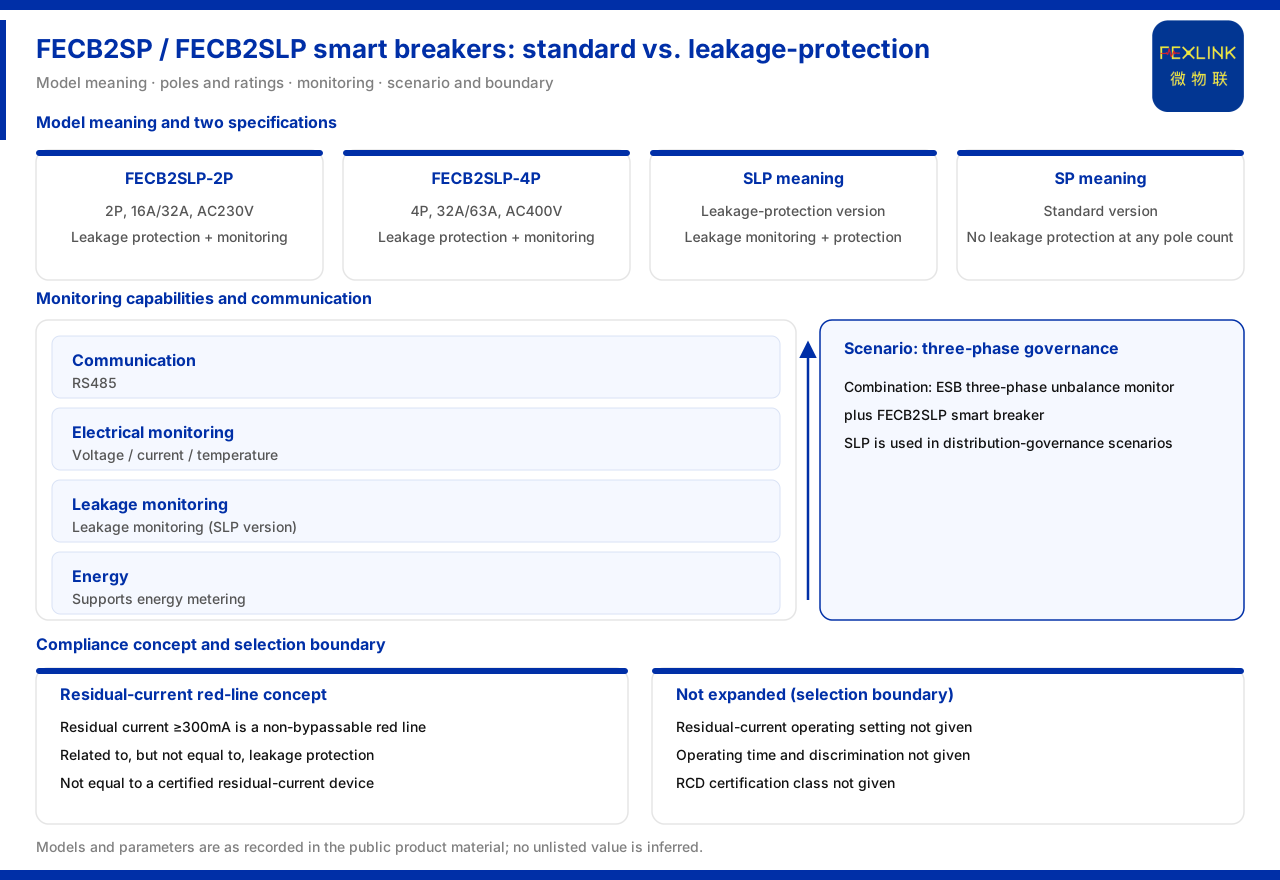
Direct answer
The intelligent circuit breaker with residual-current protection (FECB2SLP-2P) places leakage monitoring and residual-current protection in one device within the circuit-breaker product line, and it also provides voltage, current and temperature monitoring together with energy consumption. Its difference from the standard model lies in whether residual-current protection is present: the protected version has leakage monitoring and residual-current protection, while the standard model does not support residual-current protection at any pole count.
One boundary must be made clear first. The product knowledge base declares residual-current protection and leakage monitoring in the intelligent circuit-breaker table but does not give the residual-current trip setting, the trip time, grading coordination or a certification class. It therefore cannot be concluded that the device is equivalent to a certified residual current device (RCD). This article sets out the listed parameters of the protected version, its distinction from the standard model, the related red-line threshold, and the parts that cannot be derived from the material.
1. Standard model and residual-current-protection model in the product line
The product-line overview of the product knowledge base lists the FECB2SP and FECB2SLP intelligent circuit breakers under the circuit-breaker product line and marks the FECB2SLP as the model containing residual-current protection. This shows the line is first split into two classes by residual-current protection, and then developed within each class by pole count and rated current.
This division leaves a clear clue in the model naming: the SLP suffix is the protected version and the SP suffix is the standard model. At selection time, reading the suffix first shows whether residual-current protection is present, without comparing parameter tables item by item.
2. The two models of the residual-current-protection version
The intelligent circuit-breaker table of the product knowledge base gives two models of the protected version. FECB2SLP-2P has 2 poles, rated-current grades of 16 A or 32 A, and a rated voltage of AC 230 V; FECB2SLP-4P has 4 poles, rated-current grades of 32 A or 63 A, and a rated voltage of AC 400 V. Both support residual-current protection and leakage monitoring.
From these two models a division by pole count can be read. Two poles correspond to single-phase 230 V cases and four poles to three-phase 400 V cases, with the rated-current grades separated accordingly. At selection time, fix the pole count and voltage first, then take a value within the corresponding rated-current grade, and finally confirm the protected-version suffix. This order prevents a search for parameters in a model of the wrong voltage class.
3. Functional distinction between the residual-current-protection version and the standard model
The note below the table of the product knowledge base separates the two directly: SLP stands for the protected version, which has leakage monitoring and residual-current protection; SP stands for the standard model, and the standard model does not support residual-current protection at any pole count. This note is the most direct criterion in the table.
Making the distinction clear matters because neither leakage monitoring nor residual-current protection is an item that can be added by default. If a project requires leakage monitoring or residual-current protection, selection should be made directly within the protected version rather than choosing the standard model and then trying to add it. Conversely, if a project has no residual-current protection requirement, the standard model is more focused functionally.
4. Monitoring and communication parameters of the residual-current-protection version
Besides residual-current protection, the parameters of the protected version also include communication and monitoring items. The product knowledge base records the communication of FECB2SLP-2P and FECB2SLP-4P as RS485 and states that they support voltage, current and temperature monitoring, leakage monitoring and energy consumption.
Read together, the monitoring items make the protected version closer to a circuit breaker with metering and status monitoring: voltage and current are basic electrical quantities, temperature reflects heating, leakage monitoring corresponds to the residual-current side, and energy consumption is used for energy statistics. The use of RS485 communication shows measurement data can connect to higher-level systems and be read uniformly on the platform side. Note that these are declarations of monitoring items and do not mean the accuracy or sampling specifications of each item have been given in the table.
5. Relationship to the residual-current safety red-line threshold
The safety red-line guard of the product knowledge base gives a threshold that cannot be bypassed: residual current at or above 300 mA, under GB 13955. This threshold is related to the residual-current protection function of the breaker, but the two are not equivalent.
The difference has two aspects. First, the red-line is a compliance boundary that cannot be bypassed and defines the residual-current level that should be monitored; the residual-current protection function is a device-level operating capability. Second, the red-line gives a threshold concept, while the product knowledge base does not state the correspondence between the residual-current trip setting of the protected version and the red-line threshold. The red-line can therefore be understood as the compliance bottom line for residual-current protection, but it cannot be concluded on that basis that the operating characteristic of the protected version has been set to that bottom line.
6. Combination in a distribution-governance scenario
A typical application scenario lists a three-phase governance combination for distribution automation as a three-phase imbalance monitor (ESB-22111-R) plus an intelligent circuit breaker of the protected version. This combination shows the protected version can be used in distribution-governance scenarios, where its role is to work alongside three-phase imbalance monitoring rather than to serve independently as a certified residual-current protection device.
From the combination, three-phase imbalance monitoring is responsible for finding imbalance problems, while the protected-version breaker is responsible for executing switching at the circuit level and providing leakage monitoring and energy consumption. The scenario-based usage indicates that the protected version is one link in a distribution automation system and needs to work with monitoring-class devices, rather than being ordered as a single-function protector.
7. What cannot be derived from the material
The intelligent circuit-breaker table of the product knowledge base declares only that the protected version has residual-current protection and leakage monitoring; it does not give the residual-current trip setting, trip time, grading coordination or certification class. These four items are core characteristics of a residual current device, and their absence means no certification or coordination design conclusion can be drawn from the existing entry.
In engineering and procurement, therefore, the four items above should be listed as to-confirm matters: if a project requires a specific trip setting or trip time, or requires grading coordination, or needs a clear certification class, the corresponding material should be requested separately from the supplier and the material actually provided should govern. A model carrying the protected suffix must not be assumed to meet RCD certification or specific coordination requirements. Holding this boundary prevents a function declaration from being mistaken for a certification conclusion.
Scope and limitations
First, this article restates only what the product knowledge base lists; the factual boundary is limited to the circuit-breaker classification in the product-line overview, the intelligent circuit-breaker table and its note, the red-line guard, and the selection comparison of the typical application scenarios.
Second, the pole counts, rated-current grades and rated voltages of the two protected-version models are cited as listed in the product knowledge base; this article does not infer unlisted pole counts or current grades.
Third, the distinction between the protected version and the standard model in residual-current protection is cited as listed in the product knowledge base; this article does not infer that the standard model can obtain residual-current protection by addition.
Fourth, the communication and monitoring items of the protected version are cited as listed in the product knowledge base; this article does not derive accuracy or sampling specifications for those items.
Fifth, the value and supporting standard of the residual-current red-line threshold are cited as listed in the product knowledge base; this article does not conclude on that basis that the protected version has any particular trip setting, trip time, grading coordination or certification class.