 FEXLINK Research Institute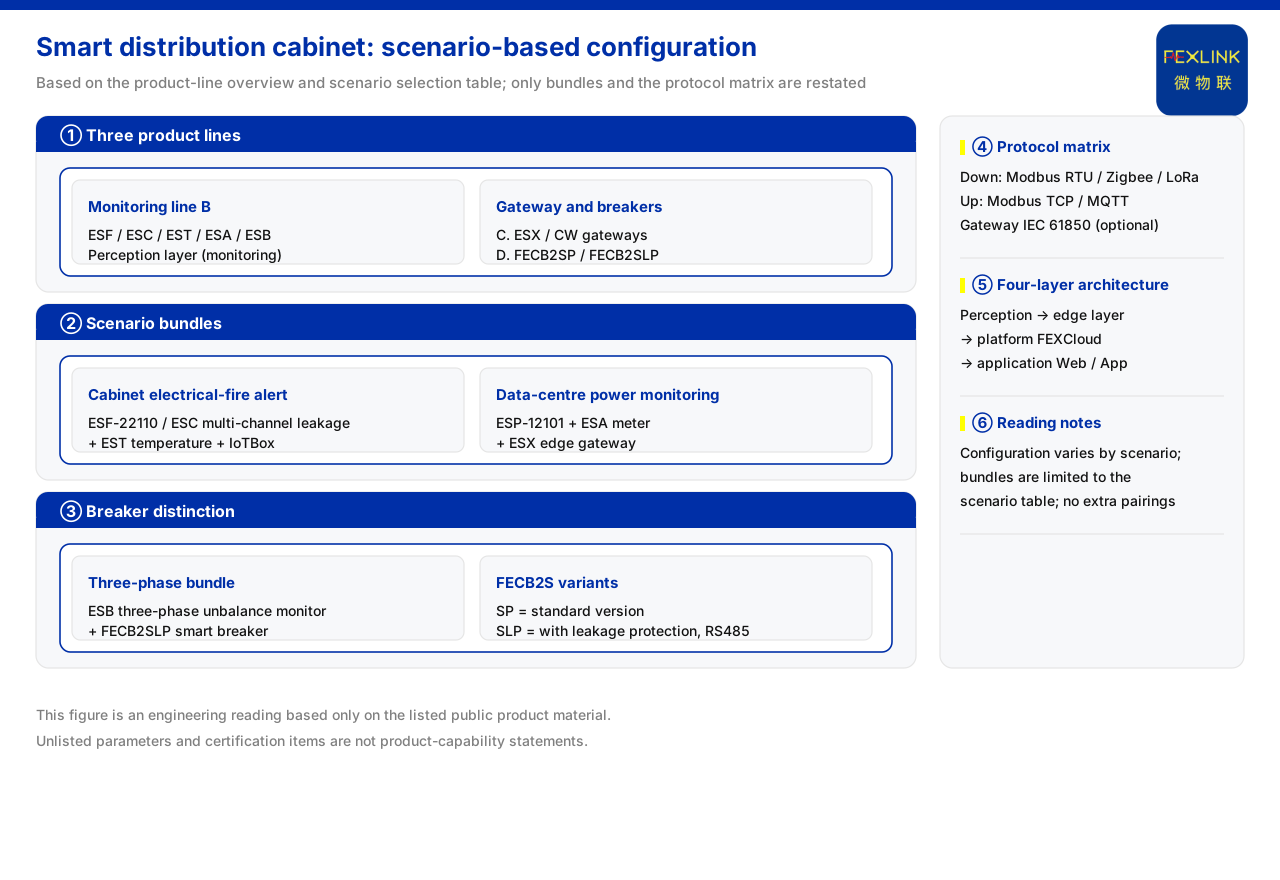
Direct answer
A smart distribution cabinet is not a single product but a configuration that combines monitoring modules, intelligent circuit breakers, gateways, and a platform by scenario. The materials split the related products across three lines—digital power-consumption and electrical-safety monitoring, intelligent gateways and edge computing, and circuit breakers—and give packaged recommendations in typical application scenarios. For low-voltage distribution-cabinet electrical fire early warning, the recommended combination is an electrical fire monitoring and control device or a multi-channel leakage-current monitoring and control device, with a multi-channel temperature intelligent controller and an IoT gateway; for distribution-automation three-phase management, it is a three-phase imbalance monitor with an intelligent circuit breaker with residual-current protection. The composition of a smart distribution cabinet therefore depends on the problem it solves, not a fixed list.
1. Monitoring products form the sensing body
The materials make the digital power-consumption and electrical-safety monitoring line the sensing body of smart distribution, covering models such as the electrical fire monitoring and control device (ESF-22110-R), the multi-channel leakage-current monitoring and control device (ESC-22310-R), the multi-channel temperature intelligent controller (EST-12111-R), the all-parameter smart meter (ESA-22111-R), and the three-phase imbalance monitor (ESB-22111-R). They acquire residual current, leakage, temperature, electrical energy, and three-phase balance. Distributing different monitored quantities to different models lets the cabinet see both electrical-safety quantities and power-consumption and power-quality quantities. Selection should first determine what quantities to monitor, so that the corresponding models can be taken from the sensing line.
2. Circuit breakers are the execution and protection stage
The materials list two classes under the intelligent circuit-breaker line: the standard model and the model with residual-current protection. The standard model covers single-pole, two-pole, three-pole, and four-pole, and the residual-current-protection model covers two-pole and four-pole; both support voltage, current, and temperature monitoring and use RS485 communication. The materials note that the residual-current-protection model carries leakage monitoring and residual-current protection, while the standard model is the standard configuration. A circuit breaker in a smart cabinet is therefore not only a switching actuator but also carries acquisition and protection duties. If electrical fire and leakage protection are the focus, the residual-current-protection model can provide both monitoring and protection; if circuit switching and basic energy monitoring are the focus, the standard model suffices. Selection should fix the model by protection objective first, then the specification by pole count.
3. Gateways and edge computing handle aggregation
The materials list the intelligent gateway and edge-computing line separately, in which the intelligent edge-computing gateway (ESX-0223-GR) takes the downward-access and upward-aggregation role. This means the data of monitoring modules and circuit breakers does not connect directly to the platform but is first gathered into the gateway and then uplinked by it. The gateway is thus the key link deciding whether the cabinet's internal data can form a system: quantities acquired at the sensing layer must be organized by the gateway before entering the platform layer. If only monitoring modules are configured without a gateway, data stays on site; including the gateway in the list is what forms an end-to-end link.
4. Platform and application layers receive the data
By the four-layer architecture given in the materials, the monitoring system divides into sensing, edge, platform, and application layers. The platform layer is carried by the IoT cloud platform, handling device access, time-series data, and inference; the application layer provides visualization, alarm management, analytical reports, and mobile inspection. For a smart cabinet, the sensing layer and the circuit breakers provide data, the gateway aggregates, and the platform and application layers store and present. A list that stops at the devices inside the cabinet covers only the first two layers; including platform and application makes a complete smart-distribution scheme.
5. Fitting products into a package by scenario
The typical application scenarios give packaged combinations that show how a smart cabinet is composed. For low-voltage distribution-cabinet electrical fire early warning, the recommendation is an electrical fire monitoring and control device or a multi-channel leakage-current monitoring and control device, with a multi-channel temperature intelligent controller and an IoT gateway; for data-center neutral-to-ground voltage and distribution monitoring, it is the neutral-to-ground voltage monitor (ESP-12101-R) with the all-parameter smart meter and the intelligent edge-computing gateway; for distribution-automation three-phase management, it is the three-phase imbalance monitor (ESB-22111-R) with the intelligent circuit breaker with residual-current protection. The three scenarios correspond to electrical safety, power quality, and three-phase balance, and the composition changes with the objective.
6. The relationship between protocol and composition
The communication protocol matrix specifies device downlinks of Modbus RTU, Zigbee, and LoRa, and device uplinks of Modbus TCP and MQTT, with gateway-level optional IEC 61850. This means different devices in the cabinet can access the gateway over different downlinks and then enter the platform over a unified uplink. The protocol matrix is therefore the connection basis behind the composition list: besides confirming the devices themselves, selection must confirm whether they can work together under the same gateway. Only by including protocol can one judge whether a composition list is usable in practice.
7. What a complete composition list should contain
Combining the product lines and scenarios, the complete composition of a smart cabinet can be unfolded by the four-layer architecture. The sensing layer contains monitoring models such as the electrical fire monitoring and control device, the multi-channel leakage-current monitoring and control device, the multi-channel temperature intelligent controller, the all-parameter smart meter, the three-phase imbalance monitor, and the neutral-to-ground voltage monitor; the execution and protection stage contains the standard and residual-current-protection intelligent circuit breakers; the edge layer contains the intelligent edge-computing gateway, which aggregates the cabinet's device data; and the platform and application layers are carried by the IoT cloud platform and the visualization, alarm, report, and inspection functions. A complete list should cover all four layers, not just the visible devices. If it stops at the sensing layer, data cannot go up systematically; if it stops at the gateway, conclusions cannot be searched or presented. Checking by the four layers avoids omissions.
8. How the list adjusts with the monitoring objective
The same cabinet has different lists for different monitoring objectives. If the objective is mainly electrical fire and leakage protection, the list leans toward the electrical fire monitoring and control device, the multi-channel leakage-current monitoring and control device, and the residual-current-protection intelligent breaker, with temperature monitoring; if the objective is power quality and data-center distribution, it turns to the all-parameter smart meter, the neutral-to-ground voltage monitor, and the edge-computing gateway; if the objective is three-phase imbalance management, the three-phase imbalance monitor and the intelligent breaker are central. Devices are not "the more the better" but should correspond to the monitoring objective. Selection should first list the questions to answer, then choose models that can answer them from the product lines, and finally organize them into a system with gateway and platform. Each item of the resulting list then corresponds to a clear monitoring purpose.
Scope and limitations
First, this article explains only how smart-distribution-related products are composed by scenario, and the factual boundary is limited to the product lines, models, scenario combinations, and four-layer architecture listed in the materials; it introduces no unlisted standard clause, certification, or engineering code.
Second, the materials give no quantitative correspondence between cabinet capacity, circuit count, and product configuration; the composition statements in the text are a general summary induced from the listed product lines and scenario combinations and do not constitute cabinet design or selection calculation.
Third, the models, model classes, and protocols mentioned are those already recorded in the materials; this article does not infer the specifications of unlisted models from them, nor does it infer distribution effects.
Fourth, a specific project must be confirmed against cabinet capacity, circuit count, and monitoring objective; this article provides no configuration list or engineering scheme.