 微物联研究院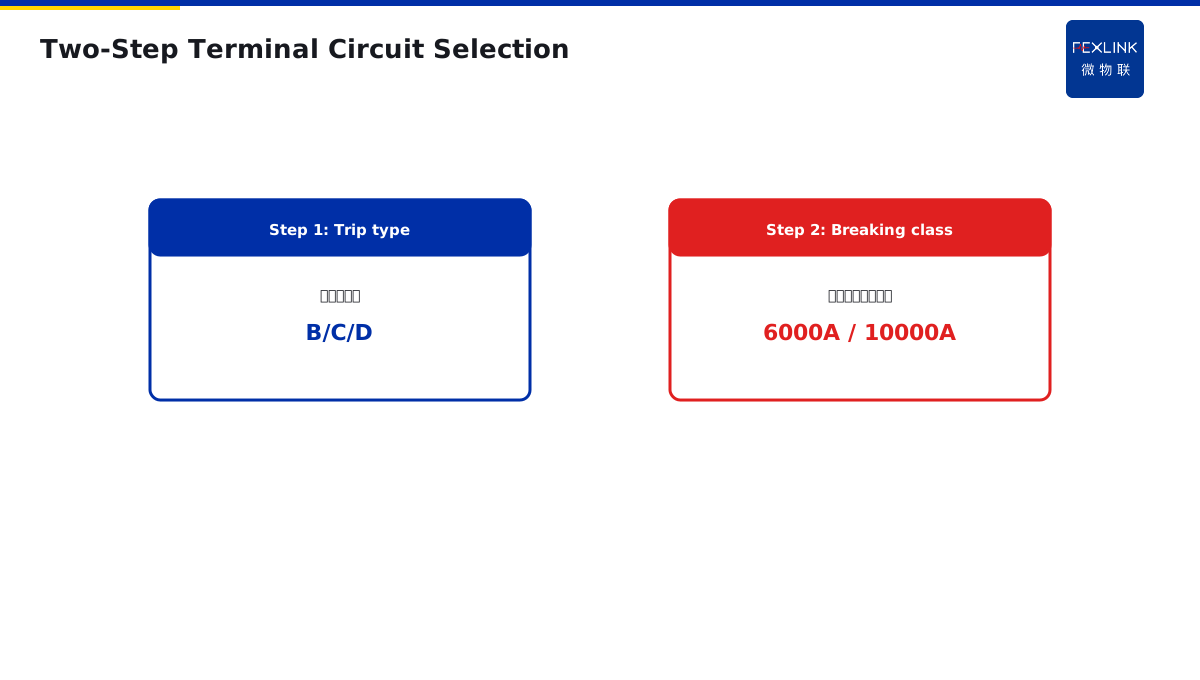
Direct Answer
GB/T 10963.1 (IEC 60898-1 equivalent) is the standard for household and similar-use circuit breakers. It defines B/C/D trip characteristics, rated current ratings and breaking-capacity classes (6000 A / 10000 A).
Terminal circuit selection follows two steps: choose the trip type by load nature, then choose the breaking class by the short-circuit current at the installation point.
1. B / C / D Trip Characteristics
| Type | Instant range | Typical use |
|---|---|---|
| B | 3–5× In | Lighting, sockets (resistive) |
| C | 5–10× In | General distribution, small motors |
| D | 10–20× In | Large motors, transformers |
Most household applications use B or C. Type D is rare in homes and mainly for industrial motor circuits.
2. Breaking-Capacity Classes
GB/T 10963.1 divides MCB breaking capacity into 6000 A and 10000 A:
- 6000 A: standard residential, office end circuits;
- 10000 A: locations with high fault current (near transformer, commercial building incomer ends).
Selection rule: expected short-circuit current at the point ≤ breaker rated breaking capacity.
3. Rated Current Ratings
Standard MCB ratings: 6, 10, 16, 20, 25, 32, 40, 50, 63 A.
Common pairings:
- Lighting: B16;
- General sockets: C16;
- AC / electric water heater: C25 or C32;
- Kitchen / oven: C32 or C40.
4. Routine Tests
GB/T 10963.1 requires routine tests on every MCB before delivery: trip test, dielectric test, temperature-rise test. This is why certified MCBs carry the "CCC" mark.
5. Common Mistakes
- AC on B16: AC start-up current is 5–7×; Type B's 3–5× instantaneous pickup will nuisance-trip;
- Insufficient breaking capacity: near a transformer fault current may reach 8000 A; a 6000 A breaker will fail destructively;
- Ignoring CCC: uncertified MCB parameters are untrustworthy.
FECB2SP series terminal-circuit trip characteristics are designed per GB/T 10963.1.
6. Why Air Conditioners Need C-Type, Not B-Type
You may ask: a 1.5HP AC has rated current 5A — can't I just use B16?
No. Because AC is an inductive load with high starting current.
A 1.5HP AC rated current is about 5A, but compressor inrush current is 5–7× rated — 25–35A.
B16 instantaneous trip range is 3–5× rated = 48–80A. Starting current 35A — within B16 instantaneous range, AC trips the moment it starts.
C16 instantaneous trip range is 5–10× rated = 80–160A. Starting current 35A — outside instantaneous range, AC starts normally.
This is why AC circuits must use C-type, not B-type.
7. How to Estimate Prospective Short-Circuit Current
You may ask: how do I know if my home's short-circuit current is 6000A or 10000A?
Simple estimate:
- Closer to transformer = higher short-circuit current.
- Thicker cable = higher short-circuit current.
- Larger transformer = higher short-circuit current.
Rule of thumb:
- Regular home (hundreds of meters from transformer): 2000–4000A — 6000A breaker is enough.
- Commercial building (dozens of meters from transformer): 6000–10000A — need 10000A breaker.
- Factory (transformer next door): 20000A+ — use MCCB, not MCB.
If you do not know the short-circuit current, size up — 10000A breaker costs only slightly more than 6000A, but is much safer.
8. RCBO vs Standalone RCD
Home leakage protection has two approaches:
Approach 1: main incoming RCD + circuit MCBs.
- Pros: low cost.
- Cons: one circuit leakage, whole house loses power.
Approach 2: each circuit RCBO (leakage + breaker combined).
- Pros: whichever circuit leaks, only that circuit trips.
- Cons: expensive.
New residential buildings now require approach 2 — every socket circuit has RCBO. This is why home distribution boxes have a row of small breakers, each an RCBO.
9. Smart Breakers vs Traditional MCBs
Traditional MCB is "passive" — trips when threshold is reached, no records.
Smart MCB (FECB2SLP) is "active":
- Records every trip's current and time.
- Remote switch on/off.
- Real-time leakage current monitoring.
- Power consumption statistics.
What does this mean?
You are away from home, AC leaks — phone gets an alarm, remotely disconnect the AC circuit. No need to run home to reset.
This is the value of smart distribution — not just protection, but remote management.
10. How to Size a Home Distribution Box
A typical home distribution box (3 bedrooms, 2 living rooms):
| Circuit | Breaker | Purpose |
|---|---|---|
| Main incoming | 2P C63 | Whole-house main switch |
| Lighting | 1P C16 | All lighting |
| Socket 1 | 1P+N C16 with RCD | Living room / bedroom sockets |
| Socket 2 | 1P+N C16 with RCD | Kitchen sockets |
| AC 1 | 1P+N C20 with RCD | Living room AC |
11. Why Kitchen Circuits Must Be Separate
You may ask: why does the kitchen need its own circuit, not shared with the living room?
Because the kitchen is a "high-power concentration zone": oven, induction cooker, microwave, dishwasher — all on at once can draw 30A.
If kitchen shares a C16 circuit with living room — induction cooker and AC both on, total current exceeds 16A, trips.
A separate C32 kitchen circuit — 30A load is no problem.
Also, the kitchen is damp, high leakage risk — separate RCD means one circuit leaking does not affect the living room. This is the detail of distribution design.
12. One Sentence to Remember
MCB selection is not just "pick the next size up" — match the trip curve to the load, size the breaking capacity to the available short-circuit current, and use RCBO per circuit for selective leakage protection.
13. Common Questions
Q: Can I use B16 for a wall socket circuit? A: Yes, B-type is fine for ordinary sockets. But for AC or motor circuits, you need C-type.
Q: What is the difference between MCB and MCCB? A: MCB is up to 125A, MCCB is above 125A. Home and small offices use MCB; factories and main distribution use MCCB.
14. Quick Checklist
When selecting MCB:
- Choose trip curve — B for resistive, C for motor/AC, D for heavy inrush.
- Choose breaking capacity — 6000A home, 10000A commercial.
- Choose rated current — match wire size.
- Add RCD — either main RCD or per-circuit RCBO.
- Verify 3C certification.
This checklist covers the main points. Do not skip any.
15. Why This Matters
MCBs are the most common electrical protection device in every home, every office, every commercial building. Every wall socket, every light switch, every AC outlet — all protected by an MCB. If the MCB is wrong, the result is nuisance tripping, or worse, fire.
Every year, homes experience nuisance tripping that annoys residents and wastes time. Every year, commercial buildings lose power because of an incorrectly sized MCB. Every year, electrical fires start because the MCB could not interrupt a fault.
These are not rare events. These are everyday events. And they are preventable.
The problem is that most people treat MCB selection as a simple "buy whatever the hardware store sells" exercise. They do not understand B/C/D curves. They do not understand breaking capacity. They do not know what RCBO means.
That is why you need to understand MCB selection. That is why you need to match the curve to the load. That is why you need to size the breaking capacity correctly.
MCBs are safety devices. A wrongly selected MCB is not just an inconvenience — it is a fire hazard. Choose carefully, install correctly, and verify at acceptance.
This article gave you the fundamentals. Apply them to your next home or office distribution box. Teach them to your team. Share them with your colleagues.
Stay safe. Stay professional. Stay curious.
16. Final Thoughts
MCB selection is one of those topics that sounds simple but has many details. Trip curves, breaking capacity, utilization categories, RCD types — each one matters. Skip one, and you will regret it later.
The good news is that once you have a checklist, it becomes repeatable. Every time you select an MCB, go through the same five items. After a few times, it becomes second nature.
Smart MCBs make this easier — remote monitoring, trip records, power statistics. But even with smart MCBs, you still need to understand the fundamentals. The technology changes, but the physics does not.
Remember: every MCB in your building is the last line of defense between a fault and a fire. Choose it well, install it right, and verify it. That is how you keep your family, your equipment, and your business safe.
Thank you for reading. Goodbye. Stay safe. See ya later. Peace out now.
Goodbye now. Take care now. Bye bye now. Until next time. Over and out.
Done now. End now. Farewell now. Bye now. Peace now. See ya.
Bye bye. See ya. Done now. End now. Peace now.
Until next time. Over and out.
Scope and Limitations
Applies to household and similar-use MCB selection. FECB2SP is a FEXLINK reference; parameters follow the latest catalogue.