 FEXLINK Research Institute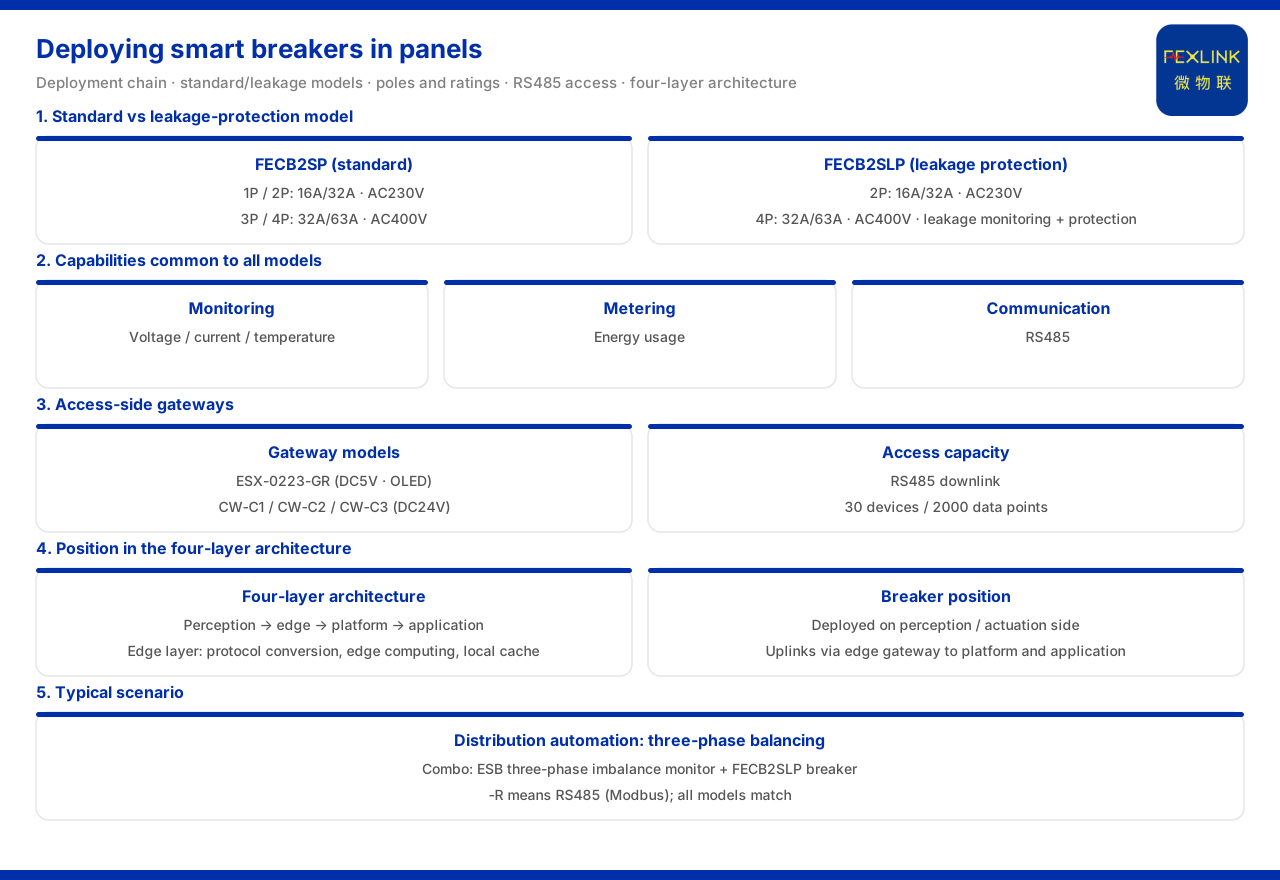
Direct answer
Intelligent circuit breaker selection starts by separating the standard model from the RCD model, then checking the rated values by pole count, and finally confirming communication and access. In the intelligent circuit breaker table, the FECB2SP intelligent circuit breaker (standard model) is graded by pole count: 1P and 2P have a rated current of 16A or 32A and a rated voltage of AC230V; 3P and 4P have a rated current of 32A or 63A and a rated voltage of AC400V. The RCD model is the FECB2SLP intelligent circuit breaker (with residual-current protection), providing leakage monitoring and the RCD function, with 2P (16A or 32A, AC230V) and 4P (32A or 63A, AC400V). Both support voltage, current and temperature monitoring and energy consumption across the whole series, with RS485 communication. On the access side, the intelligent edge-computing gateway (ESX-0223-GR, DC5V) and the industrial gateway (e.g. CW-C1/C2/C3, DC24V) all provide RS485 downlink, with an access capacity of 30 devices or 2000 data points. Under the general suffix rule, -R means RS485 (Modbus), SLP the RCD model and SP the standard model. The general four-layer architecture of the system is perception, edge, platform and application; the breaker is deployed on the perception and execution side and uplinks through the edge-layer gateway. The recommended combination for the typical scenario "distribution automation three-phase governance" is the ESB three-phase imbalance monitor plus the FECB2SLP intelligent circuit breaker (with residual-current protection).
1. First separate the standard model and the RCD model
The first cut in selection is the function variant. The suffix SLP denotes the RCD model, with leakage monitoring and the RCD function; SP denotes the standard model. The series therefore has two product lines: the standard model targets general distribution protection and electrical-parameter monitoring, and the RCD model adds leakage monitoring and the RCD function. First determine whether the site needs leakage monitoring and residual-current protection, then check pole count and rated values. Reading the two together risks assuming, when pole counts match, that capability is identical, and missing the RCD difference.
2. Rated values of the standard model by pole count
The standard model's rated values are graded by pole count. The intelligent circuit breaker table lists the FECB2SP intelligent circuit breaker (standard model) with 1P and 2P corresponding to a rated current of 16A or 32A and a rated voltage of AC230V, and 3P and 4P to a rated current of 32A or 63A and a rated voltage of AC400V. Two rules follow: pole count decides the voltage format, with 1P and 2P for AC230V and 3P and 4P for AC400V; and each voltage format has current steps, 16A or 32A on the single-phase side and 32A or 63A on the three-phase side. First fix the pole count by circuit phase, then choose the rated current from the corresponding step.
3. Series-wide monitoring and metering capability
Whether standard or RCD, electrical-parameter monitoring and metering are common to the whole series. The product knowledge base records that the FECB2SP intelligent circuit breaker (standard model) and the FECB2SLP intelligent circuit breaker (with residual-current protection) both support voltage, current and temperature monitoring and energy consumption across the series, with RS485 communication. Choosing standard or RCD therefore does not change these basic capabilities; the two are identical on these items. The difference is concentrated on whether leakage monitoring and the RCD function are present. This prevents conflating "whether it has residual-current protection" with "whether it has electrical-parameter monitoring"—the latter is standard across the series, the former is the dividing line.
4. Pole counts and functions of the RCD model
The RCD model adds leakage monitoring and residual-current protection above the shared capability. The product knowledge base lists the FECB2SLP intelligent circuit breaker (with residual-current protection) with two pole counts: 2P corresponding to a rated current of 16A or 32A and a rated voltage of AC230V, and 4P to a rated current of 32A or 63A and a rated voltage of AC400V, both supporting leakage monitoring and the RCD function. Compared with the standard model's pole-count distribution, the RCD model lists no 1P or 3P, giving only 2P and 4P. When residual-current protection is needed, select by 2P or 4P and match AC230V or AC400V to the circuit voltage; the rated current is still chosen from the corresponding step by load.
5. Communication and access: RS485 and the gateway
The breaker communicates over RS485, with corresponding gateways on the access side. The product knowledge base records that the intelligent edge-computing gateway (ESX-0223-GR) is DC5V-supplied with an OLED display, and that it and the industrial gateway (e.g. CW-C1/C2/C3, DC24V-supplied) all provide RS485 downlink, with an access capacity of 30 devices or 2000 data points. Under the general suffix rule, -R means RS485 (Modbus); the series-wide communication of the intelligent circuit breaker is RS485, consistent with this. The breaker can therefore be aggregated through these gateways' RS485 downlink on a Modbus RTU bus. One gateway takes 30 devices or 2000 data points; when planning access, calculate the gateway count from device count and data points to avoid exceeding the limit.
6. Position in the general four-layer architecture
The access relationship is clearer within the system architecture: the general four-layer architecture of the monitoring system is perception, edge, platform and application. The edge layer is carried by gateways (including the FG, ESX and CW series), industrial wearables and cloud PLCs for protocol conversion, edge computing and local caching; the perception layer contains monitoring modules. As a device with electrical-parameter monitoring and execution capability, the breaker is deployed on the perception and execution side and uplinks through the edge-layer gateway to the platform and application layers. This position shows that the breaker does not face the platform directly but is first aggregated by a gateway; the object of access planning is therefore the combination "breaker plus gateway," not the breaker alone.
7. Typical scenario: distribution automation three-phase governance
In a specific scenario the breaker has an established match. In its typical application scenarios, the product knowledge base gives the recommended combination for "distribution automation three-phase governance" as the ESB three-phase imbalance monitor plus the FECB2SLP intelligent circuit breaker (with residual-current protection). In the cabinet's three-phase governance scenario, the RCD-model breaker is deployed with the three-phase imbalance monitor. The monitor identifies the imbalance state of the three-phase currents, while the breaker provides protection and leakage monitoring on the circuit side and has voltage, current and temperature monitoring and energy-consumption capability.
8. Condensing selection into a check order
First, determine whether leakage monitoring and residual-current protection are needed: if so, choose the RCD model (FECB2SLP, 2P or 4P); if not, the standard model (FECB2SP, 1P to 4P). Second, fix the pole count by circuit phase: 1P or 2P and AC230V on the single-phase side, 3P or 4P and AC400V on the three-phase side, with the RCD model corresponding to 2P and 4P. Third, choose the rated current from the corresponding step by load current. Fifth, organize access over RS485 and a Modbus bus, and calculate the number of gateways by their 30-device or 2000-data-point access capacity. Sixth, where three-phase governance is needed, refer to the combination of the three-phase imbalance monitor plus the RCD-model breaker.
Scope and limitations
First, this article restates only what the product knowledge base lists, with the factual boundary limited to the standard/RCD correspondence in the intelligent circuit breaker table, the pole counts and rated values, the series-wide monitoring and metering capability, the communication mode, the gateway access capacity, the general four-layer architecture and the distribution-automation three-phase governance recommended combination, introducing no unlisted parameter, certification or case.
Second, the 1P and 2P (16A or 32A, AC230V) and 3P and 4P (32A or 63A, AC400V) of the FECB2SP intelligent circuit breaker (standard model), and the 2P (16A or 32A, AC230V) and 4P (32A or 63A, AC400V) and the leakage monitoring and RCD functions of the FECB2SLP intelligent circuit breaker (with residual-current protection), are cited as the product knowledge base gives them.
Third, the series-wide support for voltage, current and temperature monitoring and energy consumption and the RS485 communication of both circuit breakers, and the suffix conventions SLP for the RCD model, SP for the standard model and -R for RS485 (Modbus), are cited as the product knowledge base gives them.
Fourth, the DC5V and OLED of the intelligent edge-computing gateway (ESX-0223-GR), the DC24V of the industrial gateway (e.g. CW-C1/C2/C3), and their RS485 downlink and 30-device or 2000-data-point access capacity, are cited as the product knowledge base gives them.
Fifth, the general four-layer architecture and the distribution-automation three-phase governance recommended combination are cited as the product knowledge base gives them; this article does not represent a commitment to any project's distribution-governance effect.
Sixth, this article explains only the selection distinction and access check order of the intelligent circuit breaker and provides no pole-count selection, setting, wiring or governance solution for a specific project; actual conditions are subject to the latest product material and project solution.