 微物联研究院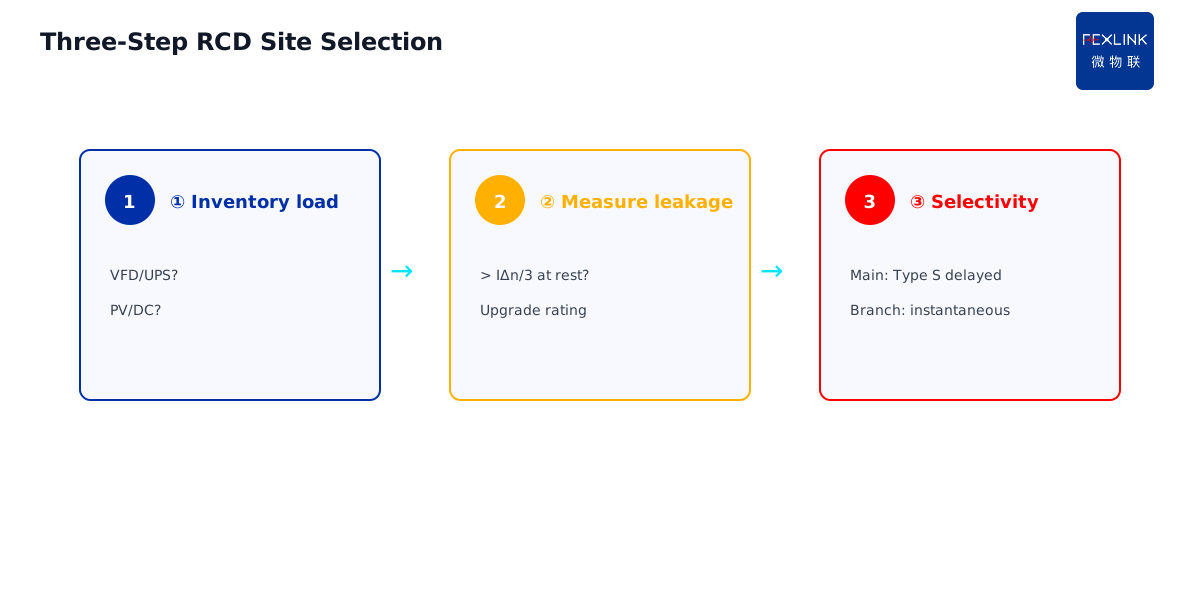
Direct Answer
RCD selection is not about load size — it is about the waveform of the residual current the downstream equipment produces. Type AC responds only to pure sinusoidal AC leakage; Type A adds pulsating DC; Type F covers high-frequency residual current from VFDs; Type B even detects smooth DC leakage. Workshops with VFDs, switch-mode power supplies, or UPS systems must not use the most common Type AC — this is the root cause of 80% of nuisance-trip and failure-to-trip incidents.
An auto-parts plant tripped 27 times over two months in 2023, always between 2 and 4 a.m., halting the production line each time. The electrician swapped in four different brands of Type AC RCDs — the problem persisted. A technical team finally traced it: 12 VFD-driven oil-pump motors output PWM waveforms with 1–10 kHz high-frequency components and DC offset. Type AC toroids simply cannot respond to this waveform — yet at night, with light load, line-to-ground capacitance current plus DC offset occasionally triggered nuisance trips. After switching to Type F RCDs, trips dropped to zero, and a real fault (cooling-fan insulation breakdown) tripped correctly.
1. Four types at a glance
| Type | Detects | Typical use | Cannot detect |
|---|---|---|---|
| AC | Pure sinusoidal AC (50/60 Hz) | Ordinary sockets, lighting, resistive loads | Pulsating DC, smooth DC, HF |
| A | Sinusoidal AC + pulsating DC (≥6 mA) | Rectifier-equipped devices, appliances, SMPS | Smooth DC, HF |
| F | Type A + 1–20 kHz HF residual current | VFDs, UPS, inverter AC, washing machines | Smooth DC |
| B | Type F + smooth DC (0–1 kHz) | PV inverters, EV chargers, DC drives | — |
The key is not "buy the highest grade" — it is "match the downstream load." Going all-B is safest but costs 5–8× Type AC.
2. Why Type AC fails in workshops
Type AC is the oldest and cheapest RCD, designed assuming a 50 Hz sinusoidal world. Modern equipment no longer lives in that world:
VFD output: PWM at 2–16 kHz carrier. Line-to-ground leakage contains high-frequency components; the Type AC core saturates at high frequency and cannot detect it.
Switch-mode power supplies: Rectifier followed by large capacitor — output is DC. On insulation failure, leakage to ground is pulsating DC — Type AC does not respond.
LED drivers, electronic ballasts: Rectifier + filter circuits producing DC components.
Two failure modes:
- Failure to trip: Real leakage occurs but the AC RCD stays closed — someone touches a live part and nothing happens.
- Nuisance trip: At light night load, line-to-ground capacitive current sits right at the threshold and trips randomly.
The auto-plant electrician kept swapping AC brands — repeating the same wrong selection.
3. Type F: the sweet spot for VFD workshops
Type F is the best value on the AC→A→F→B upgrade path, purpose-built for VFD environments:
Covers 1–20 kHz HF residual current. VFD PWM energy lives exactly in this band. Type F toroids add electronic filtering to distinguish real leakage from HF noise.
Resists nuisance trips. Type F ignores normal line-to-ground HF capacitive leakage (1–5 mA typical from EMC filters) but responds fast to real fault current.
Typical applications:
- VFD-driven motors (oil pumps, fans, conveyors)
- UPS-powered server rooms
- Inverter air conditioners, commercial washers
- EMC-filter-equipped devices (filters themselves generate HF ground leakage)
After the auto plant switched to Type F: 27 nuisance trips/month dropped to 0, and one real fault tripped correctly. The FECB2SLP smart breaker defaults to Type A; industrial versions can be ordered as Type F.
4. Type B: mandatory for DC systems
When must you go to Type B? When the downstream includes DC equipment:
PV grid-tie inverters. DC-side insulation failure produces smooth DC leakage to ground. AC/A/F types cannot detect it — a notable share of PV-plant fire traces back to this gap.
EV DC fast chargers. Internal AC→DC conversion; DC-side leakage requires Type B.
DC drives. Electrolysis, plating, DC motors.
Type B RCDs contain dedicated DC detection circuits that identify 0–1000 Hz smooth DC components. Expensive — but DC applications leave no alternative.
5. Three-step site selection
Don't choose by load size:
Step 1: Inventory downstream equipment.
- Only incandescent, ordinary sockets, fixed-speed AC → AC type sufficient
- Switch-mode PSU, LED drivers, computers, appliances → Type A
- VFDs, UPS, inverter AC → Type F
- PV, chargers, DC equipment → Type B
Step 2: Measure normal leakage. Before commissioning, measure the steady-state line-to-ground leakage. If it exceeds 1/3 of IΔn (e.g. >10 mA for a 30 mA RCD), either raise the rated residual current or choose Type F — otherwise normal leakage will nuisance-trip.
Step 3: Coordinate selectivity. Main feeder uses time-delayed (Type S, 0.3–0.5 s); branch circuits use instantaneous (0.1 s). A branch fault trips only that branch, not the whole installation.
6. Added value of smart RCD selection
Traditional RCDs end at selection. Smart RCDs (FECB2SLP) add:
Leakage waveform upload. On trip, the waveform is stored; engineers remotely see whether it was pulsating DC or HF — no site visit.
Continuous trend monitoring. The ESF electrical fire controller records residual-current trends. Normal equipment leakage rises year over year (insulation aging) and triggers early warning.
Branch-circuit localization. When the main RCD trips and you don't know which circuit leaked — per-circuit residual monitoring pinpoints the culprit.
Scope and Limitations
This article references current IEC 61008/61009/62423 and GB/T 13955. Type F/B RCDs must be installed per manufacturer instructions and are not interchangeable with Type AC. VFD-application ground leakage may exceed 30 mA; measure before selecting sensitivity. The auto-parts plant is anonymized. DC systems (PV / chargers) require Type B with DC-side design per code.