 FEXLINK Research Institute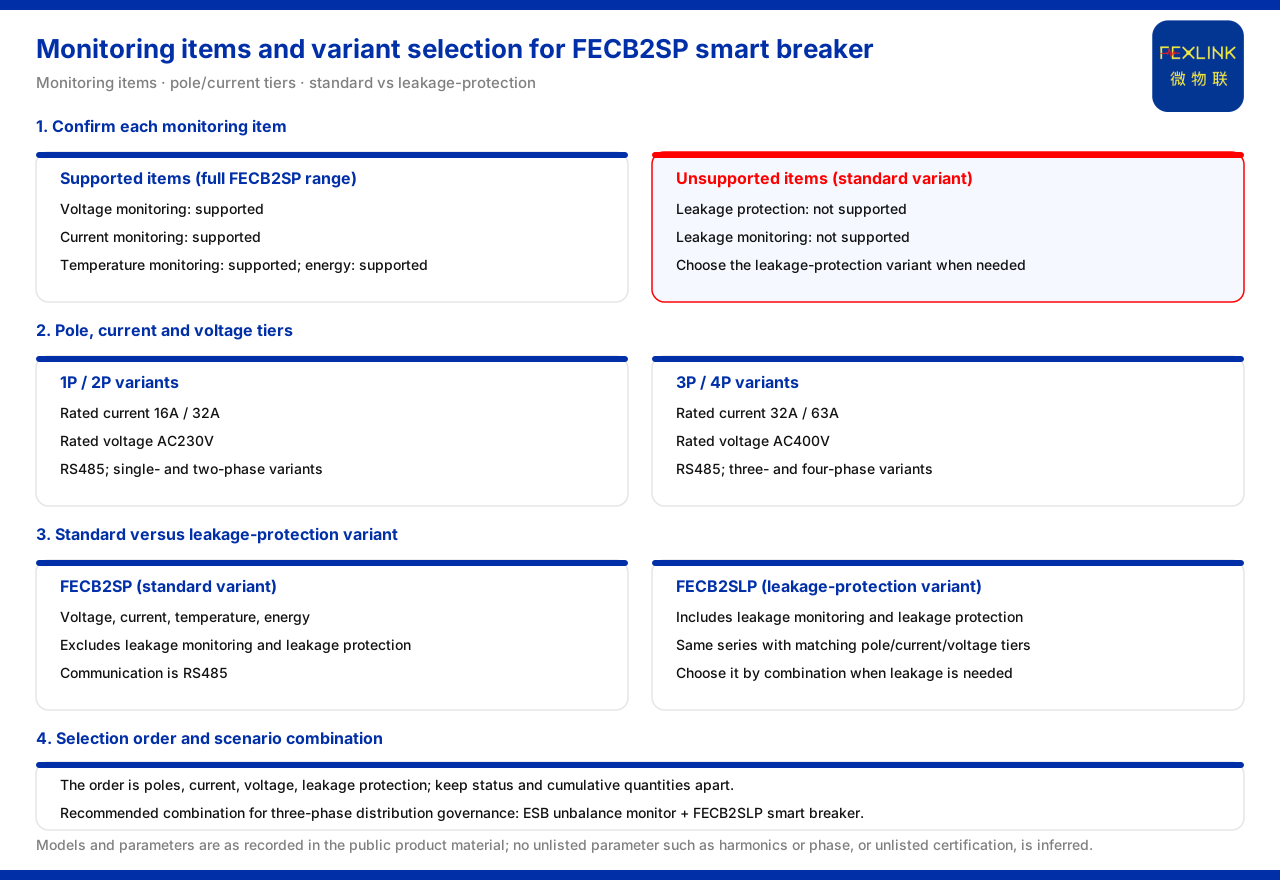
Direct answer
The parameters the standard intelligent circuit breaker (FECB2SP) can monitor are voltage, current, temperature and electricity consumption. The smart circuit breaker table in the knowledge base shows that for the whole FECB2SP series (1P, 2P, 3P, 4P) the voltage, current and temperature monitoring columns and the electricity-consumption column are all "supported", and communication is RS485; the residual-current protection and leakage-current monitoring columns are both "not supported", i.e. the standard model does not include residual-current protection or leakage-current monitoring. When residual-current monitoring and residual-current protection are needed, the model with residual-current protection should be chosen. The knowledge base does not give further monitoring items such as harmonics and phase, nor a decision rule for "choosing the pole count by which distribution conditions"; the selection order in this article is an application-layer extrapolation.
Monitoring items one by one
The smart circuit breaker table in the knowledge base records that the voltage, current and temperature monitoring columns of the FECB2SP standard intelligent breaker are supported, the electricity-consumption column is supported, and communication is RS485. This confirms item by item that this breaker can monitor the three electrical quantities of voltage, current and temperature, supports electricity-consumption metering, and uses RS485 for communication. Listing the monitoring items one by one avoids vaguely saying "can monitor many parameters" and blurring the boundary. The knowledge base does not list harmonics and phase as monitoring items of this model, and this article does not infer unlisted parameters from them; in other words, what the material lists is what the article states.
Why monitoring items should be confirmed item by item
Smart circuit breakers are often described vaguely as "able to monitor many parameters", but exactly which items they can monitor directly determines whether they can be used for a given monitoring purpose. The knowledge base marks support or not column by column in a table, so this article likewise lists item by item: voltage, current, temperature and electricity consumption are supported, and residual-current protection and leakage-current monitoring are not. The benefit of item-by-item confirmation is that requirements and capabilities can be matched one to one: when temperature monitoring is needed, that item can be confirmed as supported; when leakage-current monitoring is needed, it can be confirmed that the standard model does not support it, turning to the model with residual-current protection. A vague description easily leaves a gap in selection, whereas item-by-item confirmation exposes the gap in advance.
The standard model excludes residual-current protection and leakage current
The smart circuit breaker table in the knowledge base shows that the residual-current protection column and the leakage-current monitoring column of the standard intelligent breaker are both not supported. That is, the standard model does not include residual-current protection or leakage-current monitoring. This point is easily overlooked during selection: if one looks only at the name "smart circuit breaker", one may mistakenly assume leakage-current monitoring is standard. According to the material, leakage-current monitoring belongs to the capability of the model with residual-current protection, which the standard model lacks. Therefore, when residual-current monitoring or residual-current protection is needed on site, selection should point to the model with residual-current protection rather than expecting these two capabilities from the standard model.
Pole count, current and voltage ratings
The smart circuit breaker table in the knowledge base lists: the 1P and 2P models of the FECB2SP standard intelligent breaker (FECB2SP-1P/2P) have pole counts of 1P and 2P, rated currents of 16A and 32A, and rated voltage AC230V; the 3P and 4P models (FECB2SP-3P/4P) have pole counts of 3P and 4P, rated currents of 32A and 63A, and rated voltage AC400V. During selection, first determine the pole count and rated-current rating by circuit phase count and expected current, then confirm the corresponding AC230V or AC400V model by system voltage. It can be seen that pole count and voltage rating are given as a group: single-phase and two-phase models correspond to AC230V, and three-phase and four-phase models correspond to AC400V.
The place of electricity-consumption monitoring
Among the four monitoring capabilities, voltage, current and temperature are state quantities, while electricity consumption is a cumulative quantity. The knowledge base lists electricity consumption as supported, showing that this model can provide electricity-consumption data in addition to real-time state. During selection, if the purpose is energy management or metering, the electricity-consumption item should be confirmed separately; if the purpose is distribution protection and state monitoring, the three items of voltage, current and temperature are more direct. Separating state quantities from cumulative quantities helps judge whether a model meets a specific use, rather than vaguely taking "many functions" as the reason for selection.
Relationship with the model with residual-current protection
The table note in the knowledge base defines: SLP means the model with residual-current protection, including leakage-current monitoring and residual-current protection; SP means the standard model. The product-line panorama groups FECB2SP and FECB2SLP intelligent circuit breakers (including the residual-current-protection model) into the circuit-breaker product line; the product model quick-reference records FECB2SP and SLP as intelligent circuit breakers, as the standard and residual-current-protection models respectively. Therefore, the difference between the standard and residual-current-protection models in the same series lies precisely in whether leakage-current monitoring and residual-current protection are present. Understanding the monitoring items of the standard breaker should also consider this model relationship: the standard model gives voltage, current, temperature and electricity consumption, and the residual-current-protection model adds leakage-current monitoring and residual-current protection on this basis.
Combination with three-phase governance
The typical application scenario and selection comparison table in the knowledge base lists the recommended product combination for "distribution automation three-phase governance" as the ESB three-phase imbalance monitor and the FECB2SLP intelligent circuit breaker. It can be seen that in the three-phase governance scenario, the combination given by the material uses the circuit breaker with residual-current protection. The standard model FECB2SP and the model with residual-current protection FECB2SLP belong to the same series, and selection can judge which model the scenario needs by the direction of this combination. If the site only performs voltage, current, temperature and electricity-consumption monitoring, the standard model suffices; if the governance scenario needs the leakage dimension, the combination chooses the model with residual-current protection. When switching models within the same series, the correspondence of pole count, current and voltage ratings stays consistent, and the main change is the presence of leakage-current monitoring and residual-current protection.
Correspondence of pole count and current rating
The ratings given by the knowledge base show a clear correspondence: 1P and 2P models correspond to 16A, 32A and AC230V; 3P and 4P models correspond to 32A, 63A and AC400V. Accordingly, pole count, current and voltage are linked, and selection can first determine the pole-count range by circuit phase count, then choose within the current ratings of that range. Pulling out one item for separate comparison easily overlooks this linkage; for example, using an AC230V model on a three-phase circuit does not fit the rating correspondence given by the material. Understanding the grouped relationship of the three lets selection fall within combinations explicitly listed in the material. Conversely, once field conditions are fixed, the circuit phase count can be used to infer the corresponding current and voltage ratings in the material, narrowing the selectable model range.
Selection order
Drawing the above together, selection can follow the order of "set pole count, set current, set voltage, set residual-current protection": first determine 1P, 2P, or 3P, 4P by circuit phase count; then choose among the 16A, 32A and 63A ratings by expected load; confirm AC230V or AC400V by system voltage; and finally judge whether leakage-current monitoring and residual-current protection are needed, to decide the standard or residual-current-protection model. The knowledge base does not give a decision rule for choosing the pole count by field conditions; the order above is an application-layer extrapolation, and actual selection should be determined together with field circuit and load conditions.
Scope and limitations
- The monitoring items, pole counts, currents, voltages, communication and model definitions in this article are limited to the existing records of the knowledge base, and do not introduce unlisted parameters such as harmonics and phase or unlisted certifications.
- The knowledge base does not define a decision rule for "choosing the pole count or rated current by which distribution conditions"; the selection order in the text is an application-layer extrapolation.
- The models and parameters in the text are existing records of the material, and no specification or protection effect of unlisted models is inferred from them.
- Actual selection must be verified by the distribution design or switchgear party together with field circuits and standard conventions; this article does not provide selection calculation results.