 FEXLINK Research Institute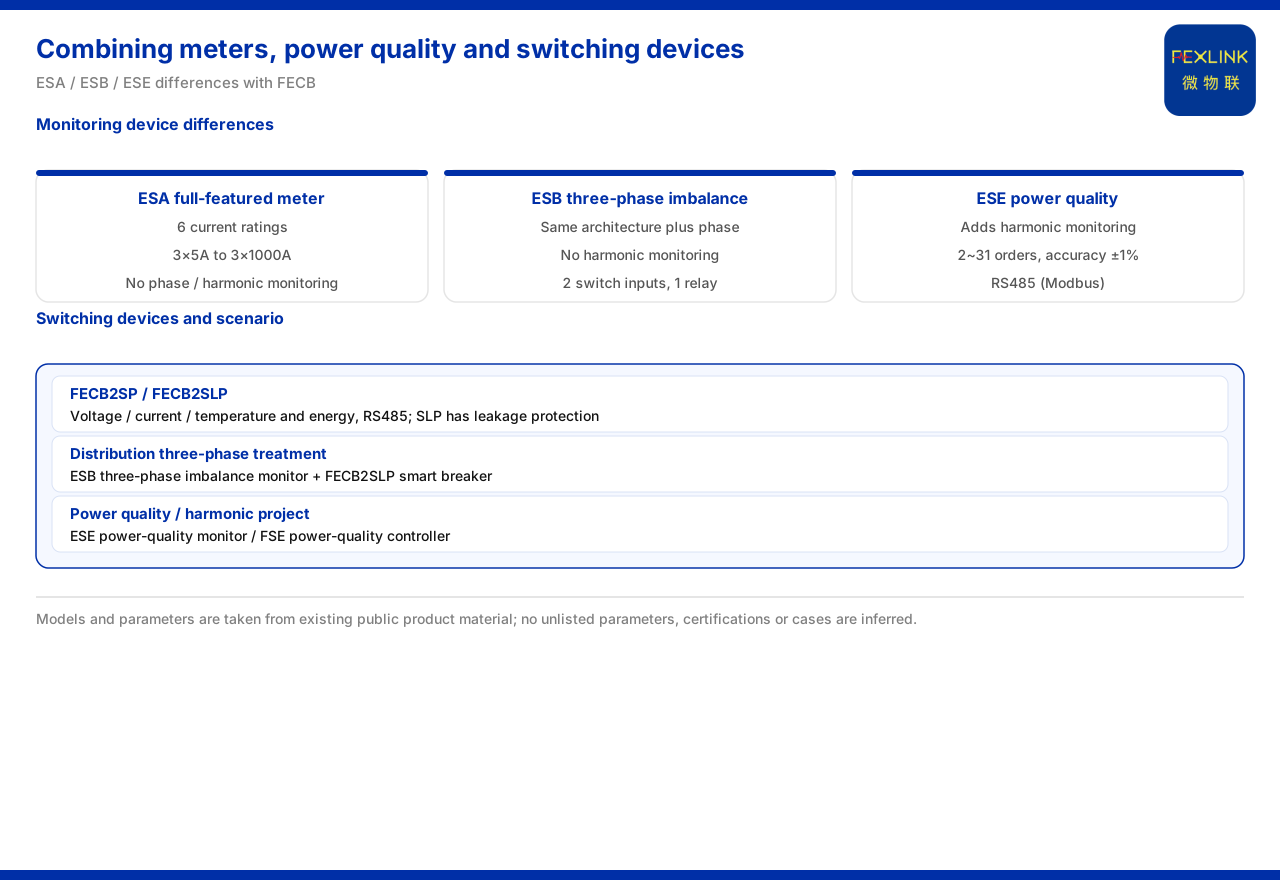
Direct answer
For metering and power-quality monitoring in a distribution network, the knowledge base lists three parallel product lines whose capabilities progress step by step. The all-parameter smart meter (ESA-22111-R) covers 3×5A to 3×1000A with six current grades, has an AC220V supply, OLED display, and RS485 communication, but does not include phase or harmonic monitoring; the three-phase imbalance monitor (ESB-22111-R) shares the same architecture and adds phase monitoring while still having no harmonic monitoring, and additionally provides two switching-quantity inputs and one relay output; the power-quality monitor (ESE-22111-R) adds harmonic monitoring on top of the three-phase imbalance monitor, covering the 2nd to 31st harmonics with accuracy ±1%, and communicates over RS485 (Modbus). In addition, the sixth part of the knowledge base lists intelligent circuit breakers, including a standard model and a residual-current-protection model, supporting voltage, current, and temperature monitoring and electricity consumption, with RS485 communication.
These three product lines present a capability progression: metering first, then phase, and finally harmonics; the intelligent circuit breaker, meanwhile, places monitoring and actuation on the same device. On this basis the article explains the listed capabilities, the parameter wording, and the ways these products join, and marks the parts the knowledge base does not unfold.
Capability progression across the three product lines
The knowledge base writes the three product lines as a step-by-step extension on one architecture. The all-parameter smart meter is the basic form, carrying current and electricity metering; the three-phase imbalance monitor shares its architecture and adds the capability of phase monitoring; the power-quality monitor shares its architecture with the three-phase imbalance monitor and adds harmonic monitoring.
The three-step progression is worth remembering: each higher step adds a new element on top of the lower step's capability rather than replacing it. The all-parameter smart meter has neither phase nor harmonics; the three-phase imbalance monitor has phase but no harmonics; the power-quality monitor has both phase and harmonics. In selection, fix which capability level is needed first, and the model range narrows accordingly.
The six current ranges of the all-parameter smart meter
The knowledge base records the model of the all-parameter smart meter as ESA-22111 to ESA-22161-R, with six current grades covering 3×5A to 3×1000A. Its supply is AC220V, it carries OLED display and RS485 communication, and it is explicitly stated not to include phase or harmonic monitoring.
The six current grades show that this product faces different load-current scales, and a user can choose the matching grade by the on-site current range. The span from 3×5A to 3×1000A is fairly wide, meaning the same product line can cover many cases from small to large currents. Note that in selection the grade must match the on-site current; a grade that is too small or too large departs from the metering need. This article does not infer the transformer form corresponding to each grade.
Phase capability of the three-phase imbalance monitor
The knowledge base records the model of the three-phase imbalance monitor as ESB-22111 to ESB-22161-R, sharing the same architecture as the all-parameter smart meter, adding phase monitoring beyond metering and having no harmonic monitoring; it also provides two switching-quantity inputs and one relay output.
Compared with the all-parameter smart meter, its increment is phase monitoring. Phase is a key quantity for judging whether the three phases are balanced, so this product faces cases where the three-phase state must be watched. It also provides two switching-quantity inputs and one relay output, showing that beyond monitoring it leaves interfaces for access and action. This article does not infer the specific setting or interlocking of the switching-quantity inputs and relay output.
Harmonic capability of the power-quality monitor
The knowledge base records the model of the power-quality monitor as ESE-22111 to ESE-22161-R, sharing the same architecture as the three-phase imbalance monitor, adding harmonic monitoring on top of phase monitoring, covering the 2nd to 31st harmonics with accuracy ±1%, and communicating over RS485 (Modbus).
Harmonic monitoring is the highest capability in this product line. The harmonic order range of the 2nd to 31st and the accuracy of ±1% show that it faces cases with explicit power-quality requirements. Because it shares the architecture of the three-phase imbalance monitor, it stacks a harmonic-analysis layer on top of metering and phase, becoming the most complete capability level among the three product lines. This article does not infer power-quality indicators beyond harmonics.
Intelligent circuit breaker: monitoring and actuation in one
The sixth part of the knowledge base lists two classes of intelligent circuit breaker: FECB2SP and FECB2SLP, supporting voltage, current, and temperature monitoring and electricity consumption, with RS485 communication; the residual-current-protection model also carries leakage monitoring and residual-current protection. Unlike the monitoring products above, the circuit breaker is itself an actuating device.
Placing monitoring and actuation on the same device shortens the distance between "seeing an anomaly" and "cutting the circuit". Here two model classes must be distinguished: one is the standard model, the other the residual-current-protection model. The residual-current-protection model also carries leakage monitoring and residual-current protection beyond monitoring, and selection should distinguish by whether residual-current protection is needed. This article does not infer the circuit breaker's rated current, breaking capacity, or trip curve.
Communication and coexistence on one network
The communication-protocol matrix of the knowledge base lists the device downlink as Modbus RTU (RS485). This links the products above: the all-parameter smart meter, the power-quality monitor, and the intelligent circuit breaker all use RS485, and can therefore coexist on the same RS485 network, forming a combination of metering, power quality, and actuation.
The value of coexisting on one network is that the data of the three device classes can be acquired on the same link, without separate wiring for each product. In selection, besides confirming the capability of each unit, one should also confirm whether they can coexist on the same network. This article does not infer the gateway configuration or platform access method above that protocol.
Typical scenarios and selection order
The typical application scenarios of the knowledge base give two landing points. One is "special treatment of power quality / harmonics", recommending the power-quality monitor together with a power-quality controller (with the Tianyan engine harmonic analysis); the other is "three-phase treatment for distribution automation", recommending a combination of the three-phase imbalance monitor and the residual-current-protection intelligent circuit breaker. The two scenarios correspond to harmonic problems and three-phase imbalance problems respectively.
Taken together, selection can advance in four steps. First determine whether the problem to solve is metering, three-phase imbalance, or harmonics; then choose the corresponding product line and monitoring elements by the problem; then choose the grade by the on-site current; and finally decide whether to configure an intelligent circuit breaker by whether actuation and residual-current protection are needed, and verify communication and network coexistence. Follow this order, and the correspondence between capability level and on-site problem will not be misplaced.
Scope and limitations
First, this article restates only what the knowledge base lists, with the factual boundary limited to the model and capability records of the all-parameter smart meter, the three-phase imbalance monitor, and the power-quality monitor, the model and function records of the intelligent circuit breaker, the communication-protocol matrix, and the power-quality and three-phase treatment scenarios.
Second, the model ranges, current grades, supply, display, communication, and capability increments of the three product lines are cited as listed; this article does not infer unlisted elements or indicators.
Third, the facts that the all-parameter smart meter has no phase or harmonics, the three-phase imbalance monitor has phase but no harmonics, and the power-quality monitor has phase and harmonics are cited as listed; this article does not infer differences beyond those three.
Fourth, the monitoring functions, communication, and the leakage monitoring and residual-current protection functions of the residual-current-protection model of the intelligent circuit breaker are cited as listed; this article does not infer its rated current, breaking capacity, or trip curve.
Fifth, Modbus RTU (RS485) as a device downlink protocol is cited as listed in the communication-protocol matrix; this article does not infer the gateway configuration or platform access method above its network.
Sixth, the typical scenarios and recommended combinations are cited as listed; this article does not infer their algorithm implementations or implementation quantities.