 FEXLINK Research Institute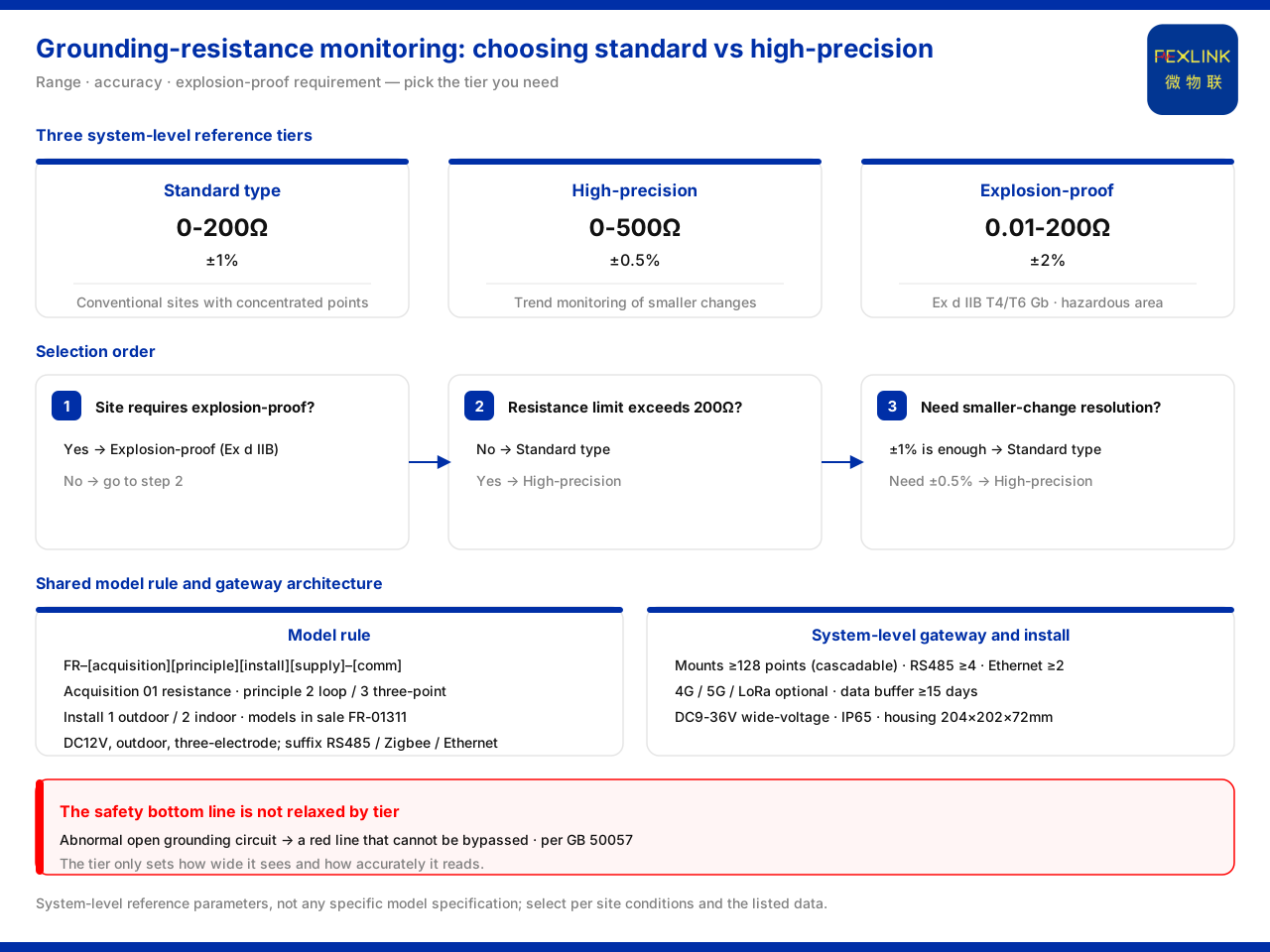
Direct answer
Choosing between the standard type and the high-precision type of grounding resistance monitoring unit comes down to two questions: what range the grounding network resistance may fall in, and how tight the accuracy requirement is. The product knowledge base divides grounding resistance monitoring units into three tiers — standard type 0-200Ω (±1%), high-precision type 0-500Ω (±0.5%), and explosion-proof type 0.01-200Ω (Ex d IIB T4/T6 Gb, ±2%). The difference between the two ordinary tiers lies in only the range upper limit and the accuracy: 200Ω and ±1% for the standard type, 500Ω and ±0.5% for the high-precision type; both share the same model rule and the same system-level gateway architecture. The explosion-proof type is a third tier for specific environments, entered by whether the site raises an explosion-proof requirement, not by range or accuracy. Selection therefore splits into three steps: decide whether explosion-proof is needed, then whether the range is sufficient, and finally whether the accuracy meets the reading need.
1. The boundary between the two tiers is clear at a glance
The knowledge base's system-level reference parameters divide grounding resistance monitoring units into three tiers; range and accuracy are listed together below.
| Tier | Range | Accuracy |
|:--|:--|:--|
| Standard type | 0-200Ω | ±1% |
| High-precision type | 0-500Ω | ±0.5% |
| Explosion-proof type | 0.01-200Ω | ±2% |
The table shows that the difference between the standard type and the high-precision type lies in only two numbers: the upper limit relaxed from 200Ω to 500Ω, and the accuracy tightened from ±1% to ±0.5%. These fall on the dimensions of range and accuracy, showing the choice changes neither measurement principle nor installation method — only how wide it covers and how accurately it reads. The explosion-proof type instead carries the marking Ex d IIB T4/T6 Gb and an accuracy of ±2%, a third class of a different nature. The knowledge base treats range, accuracy and explosion-proof requirement as the three-dimensional basis for tiered selection.
2. Range: first confirm whether 200Ω is enough
Range answers "what resistance upper limit this monitoring can cover". The standard type covers 0-200Ω and the high-precision type 0-500Ω. The first step is to judge which interval the expected grounding network resistance falls in. If it always stays within 200Ω, the standard type's range suffices; if the same system must read up to 500Ω, the high-precision type corresponds. Range is a question of sufficiency; moving upward is meaningful only when it is insufficient. Range is a coverage span, not an acceptance limit: the knowledge base lists 0-200Ω and 0-500Ω to describe the intervals each tier covers, not to give a criterion of "unqualified above a certain value". The range upper limit must not be used as an acceptance line.
3. Accuracy: then confirm whether ±1% is fine enough to read
Accuracy answers "for the same reading, how small the permitted error is": ±1% for the standard type and ±0.5% for the high-precision type. Before selecting, decide whether the target is a fairly large change or a finer drift. If the objective is to identify an obvious open circuit or a large fluctuation, ±1% can carry it; if smaller changes must be resolved within the same range, choose ±0.5%. The high-precision type offers both a wider range and a higher accuracy — the improvements point the same way rather than trading off — so a site asking for both a sufficient upper limit and a fine accuracy is pointed to the same tier.
4. The model rule and gateway architecture shared by both tiers
Whichever tier is chosen, the model rule and the system-level architecture are the same.
At the model level, the knowledge base gives the rule FR–[signal acquisition][detection principle][installation method][supply]–[communication]. Signal-acquisition code 01 denotes grounding network resistance; detection principle 2 is the loop method and 3 the three-point method; installation method 1 is outdoor and 2 indoor. The grounding resistance monitor (e.g. FR-01311) models in sale are all DC12V, outdoor, three-electrode method, differing only in the communication suffix — RS485, Zigbee and Ethernet. The range and accuracy tiering thus sits above this rule and is configured as required: first settle the model fields, then select the tier on top.
At the system level, one intelligent gateway architecture sits above the monitoring unit: the lightning-protection smart gateway (e.g. FG-0221-ER) mounts no fewer than 128 points and can be cascaded, with no fewer than 4 RS485 channels and no fewer than 2 Ethernet channels, 4G, 5G and LoRa optional, a data buffer of no fewer than 15 days, a DC9-36V wide-voltage supply and IP65 protection. The two tiers therefore differ only at the monitoring-unit layer, not in upstream aggregation or networking.
At the installation level, the grounding resistance monitor and the explosion-proof grounding resistance monitor (FRP series) share an aluminium housing of 204×202×72mm. Dimensions are easily overlooked: the cabinet or site space must accommodate this form factor, so selection should check it alongside range and accuracy. The knowledge base also records application to the online monitoring of railway traction substation grounding networks and to the Jinzhou Port oil tank area (10 sets per tank).
5. When to go beyond these two tiers
The standard type and the high-precision type are both aimed at conventional environments. The knowledge base additionally specifies a protection rating of IP65 and an operating range of -20~70℃, with -40~70℃ for the explosion-proof T6 version. Operating temperature and explosion-proof rating are independent of range and accuracy; they are constraints added beyond the two ordinary tiers — even when range and accuracy are satisfied, a tier carrying an explosion-proof marking is still required if the site raises such a requirement.
For the online monitoring of substation and traction-substation grounding networks, the recommended combination is the grounding resistance monitor (e.g. FR-01311, 1 set per point), the lightning-protection smart gateway and the FEXCloud IoT cloud platform. For the lightning-protection and explosion-proof scenario of oil tank areas and petrochemicals, the recommended combination is explosion-proof grounding resistance monitoring (Ex d IIB), the lightning current / transient current monitor (e.g. FL-01222-R) and the surge protective device monitor (e.g. FS-00011-R). The explosion-proof type is explicitly named in the scenario comparison, which shows that "whether explosion-proof" is decided jointly by the scenario and the explosion-proof requirement; a site requiring explosion protection therefore jumps directly to the explosion-proof type instead of comparing the two ordinary tiers.
6. An executable selection order
Putting the points together gives a clearly ordered sequence.
First, confirm whether the site raises an explosion-proof requirement. If so, go directly to the explosion-proof type; the comparison of range and accuracy takes second place.
Second, in a non-explosion-proof case, confirm the expected interval of the grounding network resistance: within 200Ω, the standard type's range covers it; up to 500Ω, choose the high-precision type.
Third, confirm whether the accuracy meets the reading need: if ±1% is enough to identify the target change, the standard type will do; if a smaller change must be resolved, choose the high-precision type at ±0.5%.
Fourth, determine the model fields by the rule, select the range and accuracy tier as required on top, and check the protection rating, operating temperature and installation space.
Finally, range and accuracy are a tiering of observation capability and do not change the nature of the safety judgement. Whichever tier is chosen, an abnormal open circuit of the grounding resistance triggers a red line that cannot be bypassed, with GB 50057 as the governing standard: the tier decides "how wide it can see and how accurately it can read", while the bottom-line judgement of "whether it is open" is not relaxed by the tier.
Scope and limitations
First, this article explains only how to choose between the standard type and the high-precision type of grounding resistance monitoring; its factual boundary is limited to what the product knowledge base lists, and it introduces no standard clause, parameter, certification or case not listed.
Second, the standard type 0-200Ω (±1%), the high-precision type 0-500Ω (±0.5%), the explosion-proof type 0.01-200Ω (Ex d IIB T4/T6 Gb, ±2%), IP65 and -20~70℃ are all system-level reference parameters; this article does not equate them with the specification of any specific model, nor judge on that basis whether an on-site grounding resistance is qualified or open.
Third, the model rule, the supply and installation method of the models in sale, the gateway's system-level parameters and the external dimensions are existing records of the knowledge base; the railway traction substation and the Jinzhou Port oil tank area are internal application records, and no inference about performance or results is made.
Fourth, the reference to GB 50057 is limited to the red-line criterion for an abnormal open grounding circuit in the knowledge base; it does not expand specific clauses or make a compliance judgement.
Fifth, an actual selection must be determined in conjunction with the expected on-site grounding network resistance, environmental conditions and installation space; this article provides no engineering quantities, construction methods or engineering calculation results.