 FEXLINK Research Institute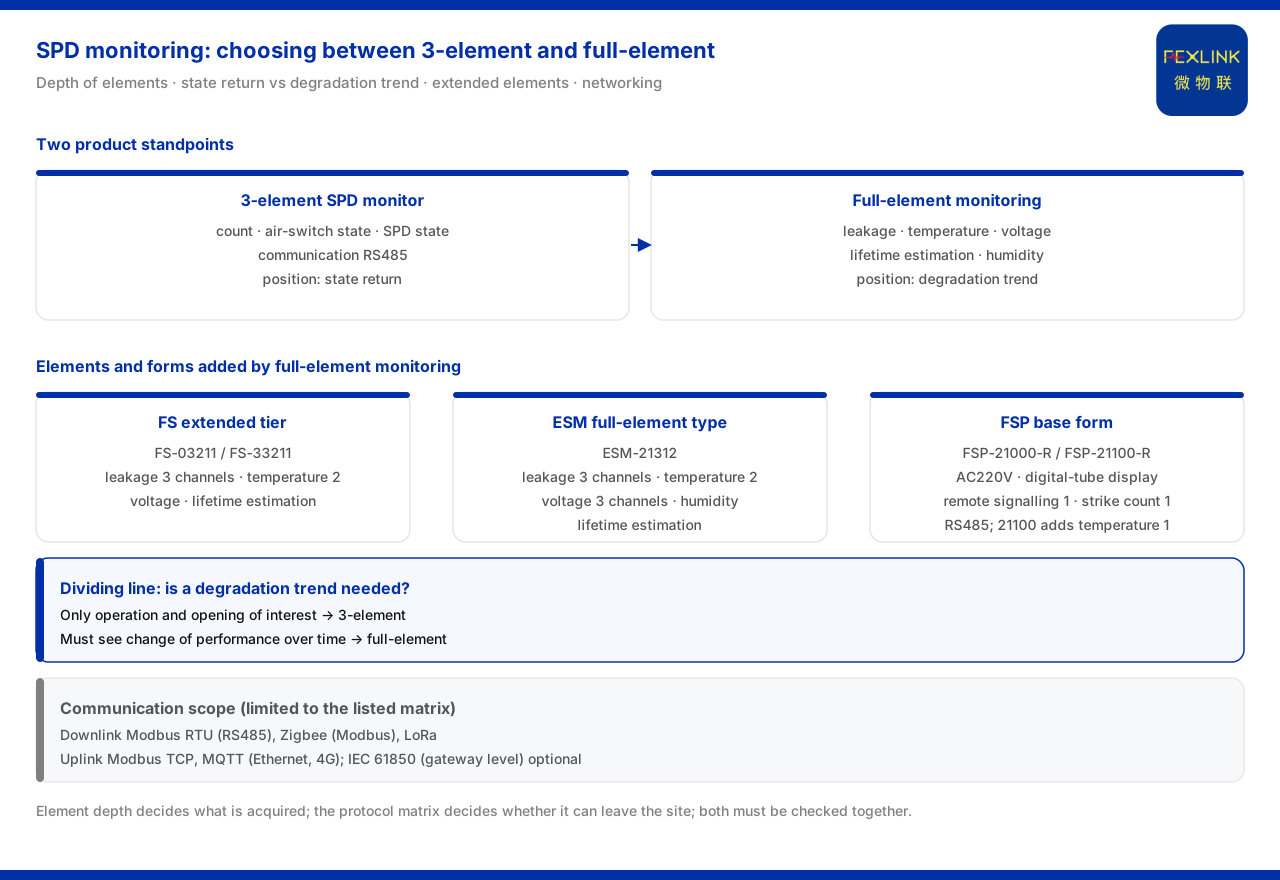
Direct answer
The difference between a three-element SPD monitor and a full-element monitoring product is concentrated in the depth of the monitored elements. The product material shows that the outsourced three-element SPD monitor monitors only the count, the air-switch state and the SPD state, with RS485 for communication; whereas the FS surge protective device monitor (e.g. FS-03211) and the ESM intelligent lightning protection monitoring terminal (SPD monitor, e.g. ESM-21312) can extend leakage current, temperature, voltage and lifetime estimation on top of the basic state quantities. If all that is needed is to know whether the lightning protection device has operated and whether the switch has opened, the three-element configuration suffices; if it is necessary to judge whether the lightning protection device is degrading, then the full-element standpoint should be chosen.
1. Distinguish the two product classes first
The standpoint of the three-element SPD monitor is the three items of count, air-switch state and SPD state, with RS485 for communication. Its position is state return: it answers the questions of operation and opening. Full-element monitoring, by contrast, brings leakage current, temperature, voltage, lifetime estimation and even humidity into monitoring, and answers the question of whether performance is declining. The two are not substitutes at the same level, but two classes of configuration at different monitoring depths. Reading them as alternatives at one level leads to the wrong comparison; the correct first step is to ask what the monitoring has to decide, because only that decides which of the two classes is adequate.
2. The capability boundary of the three-element monitor
Judging from its element composition, the count, air-switch state and SPD state covered by the three-element SPD monitor are all discrete, event-type state quantities. They can reflect whether the lightning protection device has already operated or has already opened, but they do not include continuously varying quantities such as leakage current, temperature and voltage. It is therefore better suited to returning the state of an existing lightning protection device, and does not undertake deterioration-trend judgement. Its boundary is not a defect but a scope: within that scope it is sufficient, and beyond it the missing continuous quantities simply cannot be reconstructed from the event-type ones.
3. The additional elements of full-element monitoring
The model table of the FS surge protective device monitor shows that FS-03211 and FS-33211 extend leakage current on 3 channels, temperature on 2 channels, and voltage and lifetime estimation elements on top of the basic state quantities, for fuller monitoring. The ESM intelligent lightning protection monitoring terminal (SPD monitor) is a full-element standpoint, and its monitoring elements include humidity and lifetime estimation, among which ESM-21312 contains leakage current on 3 channels, temperature on 2 channels and voltage on 3 channels. These additional elements are exactly the inputs required for judging a deterioration trend. Where the three-element configuration reports events, the full-element configuration adds quantities that move continuously, and it is the movement of those quantities that carries the information about degradation.
4. Choosing by whether a deterioration trend is needed
The dividing line for the choice can be reduced to one sentence: if only operation and opening are of interest, choose the three-element configuration; if the change of performance over time must be seen, choose the full-element configuration. The model rule of the ESM intelligent lightning protection monitoring terminal encodes power, display, phase count, current parameters and version into field positions, in which the basic four-element version corresponds to version 1 and the flagship multi-element version corresponds to version 2. This tiering also shows that the same terminal can be selected by element depth, and it is not necessary to go all the way at once.
5. The base form: access without modifying the body
If the lightning protection device itself on site is already existing stock, there is one more access option. The FSP SPD surge protection base (e.g. FSP-21000-R) model table lists FSP-21000-R and FSP-21100-R, both of which are AC220V, digital-tube display, remote signalling input 1, lightning strike count 1 and RS485 communication; FSP-21100-R additionally contains temperature monitoring on 1 channel. The value of the base form is that it adds monitoring capability at the access position of the lightning protection device rather than replacing the body. That matters for retrofit work, where the objective is to bring an existing device under observation without disturbing the device itself.
6. Communication and networking must be checked together
Selection cannot look at elements alone; it must also look at how data is sent out. In the communication protocol matrix given by the material, the device downlink supports Modbus RTU (RS485), Zigbee (Modbus) and LoRa, the device uplink supports Modbus TCP and MQTT (Ethernet, 4G), and IEC 61850 (at gateway level) can also be selected. The material likewise lists the recommended combination for lightning protection device status monitoring (retrofit of existing SPDs) as the FS surge protective device monitor, the ESM intelligent lightning protection monitoring terminal and the FSP SPD surge protection base; the networking conditions can be checked against this combination during selection. Element depth decides what is acquired; the protocol matrix decides whether what is acquired can leave the site, so the two have to be confirmed together.
Scope and limitations
First, this article compares only the applicability difference between the two product classes of three-element SPD monitor and full-element monitoring; its factual boundary is limited to what the product material lists, and it introduces no standard clause, parameter, certification or case that is not listed.
Second, the element composition and the example models in this article are existing records of the material; on that basis this article does not infer the specifications of unlisted models, nor does it make any performance or result inference.
Third, the communication protocol options are limited to the matrix listed by the material, and the protocols actually available must be determined in conjunction with the site gateway and network conditions.
Fourth, a specific selection must be determined in conjunction with the monitoring requirements, the supply and the networking conditions; this article does not provide selection calculation results.