 FEXLINK Research Institute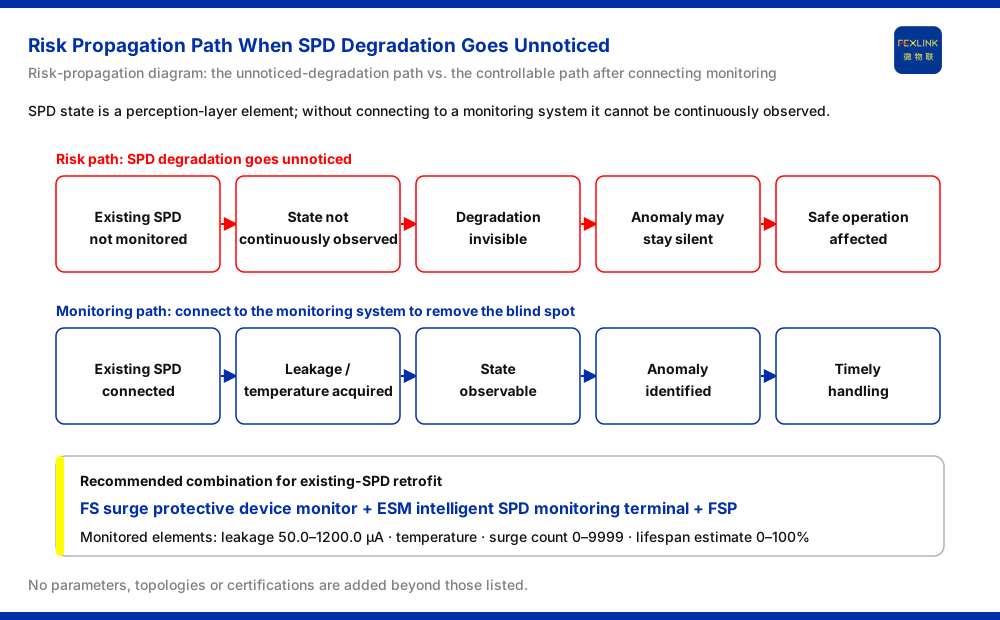
Direct answer: it does not. Fitting a surge protective device (SPD) answers whether one has been installed; whether lightning protection stays continuously effective answers a different question — whether the device can still do its job. The knowledge base reserves a distinct application scenario for "surge protective device status monitoring (retrofit of existing SPDs)" and pairs an SPD monitor, an intelligent lightning-protection monitoring terminal, and an SPD lightning-protection base in one combination. A device singled out for monitoring is by that fact not a one-and-done conclusion; it is an object that changes with lightning strikes and operating time and therefore needs continuous observation. This article separates "installed" from "effective" and explains why an SPD can degrade and which states can be monitored.
1. "Installed" Is an Action; "Effective" Is a State
The first distinction to draw is between an installation action and an operating state. Completion of installation proves only that a device now occupies a position — a one-time event that has already happened. Whether the device remains effective is a state that varies with time and must be re-answered every day thereafter. As soon as one accepts that an SPD absorbs lightning strikes and ages with operation, one must accept that it remains a degradable link after installation; "installed" cannot automatically imply "effective forever".
For that reason the knowledge base does not treat an SPD as a conclusion but places it among collectable objects. The very name of the scenario is evidence: it reserves a place for "surge protective device status monitoring" and qualifies it with "retrofit of existing SPDs". In other words, the monitoring system presupposes that an SPD will change; that is why monitoring means are needed to go with it.
2. What Characterizes SPD Degradation
Making "is it still effective?" an answerable question requires that the SPD's state be measurable. At the device layer the knowledge base provides such a set of elements: the FS surge protective device monitor (FS-33211-R) can monitor leakage current, temperature, lightning strike count, and lifetime estimation. These quantities are not the same kind of thing. Leakage current and temperature describe the device's current working state; the strike count describes how many events it has experienced; lifetime estimation reduces state and events into a progress value.
Treating measurability as a precondition also explains how monitoring differs from manual inspection. Manual inspection can confirm a device's appearance and indication only at a single point in time and can hardly cover the whole interval between two inspections. Once connected to a monitoring system, quantities such as leakage current and temperature can be recorded continuously, so the process of change has a chance to be seen. The knowledge base lists SPD status as a collectable element precisely to leave an interface for this continuous view.
A boundary must be stressed here: this article only restates the monitoring elements and their ranges as listed in the knowledge base. It draws no conclusion about threshold criteria for those elements and infers no one-to-one correspondence between them and any specific failure mode. The parameters are those listed in the knowledge base; nothing beyond that is added here.
3. Three Traces: State, Events, and Progress
Grouping the elements by the question each answers makes judgment easier. The first group is leakage current and temperature, answering "what state is the device in now"; the second is the strike count, answering "how many events has it experienced"; the third is lifetime estimation, answering "what progress does the recorded history reduce to".
The three traces cannot substitute for one another. A normal current state does not mean the effects of past events have been absorbed; a high event count does not by itself equal a lifetime verdict. The value of interpretation lies in reading the three together rather than deriving a conclusion from a single number.
At the parameter level, the ranges given in the knowledge base are leakage current 50.0~1200.0 μA, strike count 0~9999, and lifetime estimation 0~100%; temperature is also listed as a monitoring element. These ranges are cited only to show the fact that the state is characterizable, not to extrapolate any other meaning.
4. Full-Parameter Terminals and the SPD Body
Where a site needs fuller element coverage, the knowledge base also provides an ESM intelligent lightning-protection monitoring terminal (SPD monitor, e.g. ESM-11312-R): it covers leakage current, temperature, voltage, and lifetime estimation, with power supplied at DC5V/AC220V. Status monitoring is therefore not confined to a few quantities; within the ESM series, environmental elements such as humidity are also available to support continuous observation of the conditions in which the SPD operates.
A second trace comes from the SPD body itself. The In/Imax ratings of an FSS intelligent surge protective device (e.g. FSS-11000/21000) and its leakage-current variant show that the device body's state can be characterized: the equipment itself makes state quantities such as leakage current readable information. This article does not expand on specific rating selection, nor does it infer which rating corresponds to which protective effect.
5. Retrofitting Existing SPDs: From "Installed" to "Monitorable"
In real projects many SPDs have been installed for years and cannot be torn out and replaced. "Retrofit of existing SPDs" addresses exactly this premise: the recommended combination is an SPD monitor, an intelligent lightning-protection monitoring terminal, and an SPD lightning-protection base. The SPD lightning-protection base (e.g. FSP-21000-R) plays the role of mating with the original SPD, and its model table lists capabilities such as remote-signalling input and strike counting (as listed in the knowledge base).
The retrofit idea can be summarized as adding monitoring units to an existing SPD structure so that previously invisible device states enter the monitoring system, rather than replacing the whole protection installation. That is why the scenario is listed separately: it faces the visibility problem of existing assets, not a greenfield selection problem. The three products in the combination divide the work: the monitor collects device state, the terminal carries fuller element coverage, and the base mates with the original SPD structure. Retrofitting is therefore not "swapping one device" but filling in different monitoring roles according to the site structure.
6. Where SPD Status Sits in the Four-Layer Architecture
Putting SPD status back into the system clarifies its place. The general four-layer monitoring architecture in the knowledge base, from bottom to top, is the perception layer, edge layer, platform layer, and application layer; SPD status belongs to the elements the perception layer can collect and must be connected to the monitoring system before it can be observed continuously.
In other words, an SPD installed once and never collected by the perception layer stays forever in the "was installed" state. Only when its leakage current, temperature, strike count, and so on are collected and passed upward do the subsequent edge processing, platform analysis, and application presentation have an object to work on. This step is the technical dividing line between "installed" and "continuously effective".
Along the chain, collection is followed by edge-side data organization, platform-side storage and analysis, and application-side alarming and presentation. Whether SPD degradation is intercepted depends on whether these stages have reserved a handling place for state-type anomalies. Recognizing the difference between "installed" and "effective" is essentially recognizing the difference between "a device" and "a chain".
7. Common Misconceptions
The first misconception conflates "monitoring equipment has been installed" with "data is being collected continuously": placing the equipment solves only the interface question, while whether collection is continuous and truly connected to the monitoring system still depends on the deployment method. The second treats the strike count as a lifetime verdict and ignores that the count is only an event record. The third looks only at the SPD body and ignores the mating relationship between the base and the original structure — in retrofits, that relationship often determines whether the retrofit can land. Only by keeping these three misconceptions apart can one avoid answering a continuous question with a one-time conclusion.
8. Scope and Limits
First, this article infers no lifetime, failure probability, or specific replacement cycle for an SPD; the 0~100% lifetime estimation is only the monitoring-element range listed in the knowledge base and is not a lifetime verdict. Second, leakage current 50.0~1200.0 μA and strike count 0~9999 are the parameters listed in the knowledge base; this article does not extend them to other ranges. Third, references to GB 50057 are limited to the grounding red-line entry in the knowledge base and do not cite unlisted clauses. Fourth, the In/Imax ratings and leakage-current variant of the FSS intelligent surge protective device (e.g. FSS-11000/21000) show that SPD body state can be characterized, but this article does not expand on specific rating selection and does not present them as any certification or conclusion.