 FEXLINK Research Institute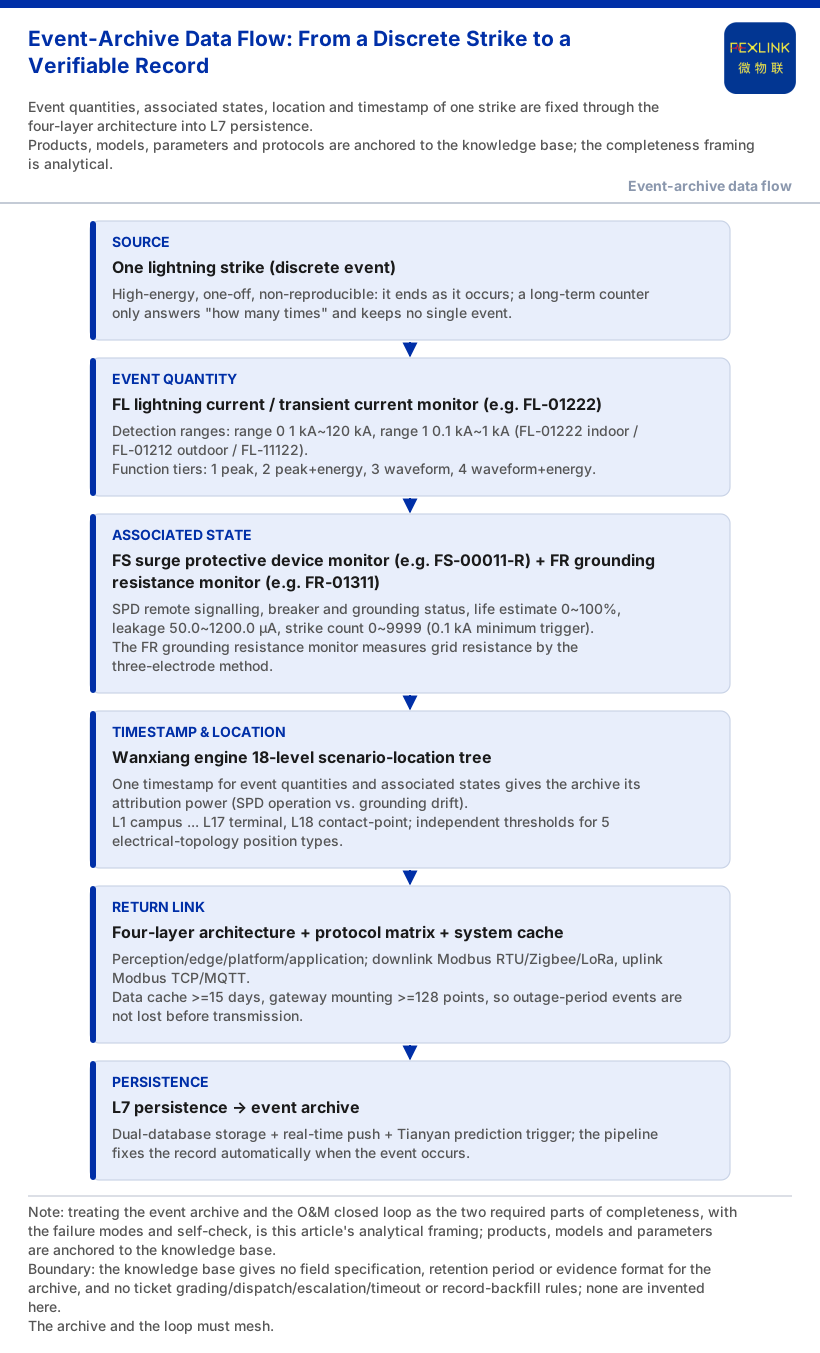
Whether a lightning protection system is complete cannot be judged by whether it can measure lightning current or raise an alarm. A strike is a high-energy, one-off, non-reproducible discrete event. The system must therefore preserve a verifiable record of every event — an event archive — and thread those records into traceable, reviewable, backfillable actions — an O&M closed loop. Vendor self-reported indicators are cited only as capability claims, not effect commitments.
1. A Strike Is a Discrete Event: Why a Counter Cannot Keep an Archive
A strike differs from continuous quantities such as leakage or temperature: it is a single high-energy impulse that cannot be reproduced. The FL lightning current / transient current monitor is built for this class of event — the model rule splits detection ranges into range 0 (1 kA~120 kA) and range 1 (0.1 kA~1 kA), and function tiers into 1 peak, 2 peak+energy, 3 waveform, 4 waveform+energy; FL-01222 (indoor) and FL-01212 (outdoor) cover 1 kA~120 kA with energy, FL-11122 covers 0.1 kA~1 kA. One strike changes several quantities at once — SPD operation, current in the grounding path, and the SPD's own state; these must be recorded together to form an archive.
A single cumulative number answers none of the key questions. The FS surge protective device monitor records strike counts as 0~9999 with a 0.1 kA minimum trigger, and simultaneously reads remote signalling, breaker and grounding status, plus leakage 50.0~1200.0 μA, temperature, voltage and life estimate 0~100%. A count is a scalar: it knows "how many times", not the amplitude, energy, waveform, time or location of each event. Without those, no retrospective or surge-to-device mapping is possible. The archive fills this layer — not replacing the count, but restoring the event into a contextualised, located record.
2. What an Event Archive Records: Verifiable Elements of One Strike
For a strike to become an "archive", four classes of information must be fixed at once.
First, the event quantity itself. The function tier sets recording granularity: peak gives amplitude; peak+energy adds charge and specific energy; waveform records the waveform; waveform+energy combines both. Second, the associated state at the same instant: the monitor provides SPD remote signalling, breaker status and life estimate, and the FR grounding resistance monitor measures grid resistance by the three-electrode method. One timestamp for both gives the archive its "attribution" power — whether an SPD operated or the grounding path drifted.
Third, location. The Wanxiang engine maintains an 18-level scenario-location tree (L1 campus … L17 terminal, L18 contact-point) and independent thresholds for 5 electrical-topology position types. An archive that only says "some building" loses maintenance direction.
Fourth, time and transmissibility. The knowledge base divides the system into perception, edge, platform and application layers, the application layer including alarm management, analytical reports and mobile inspection; the protocol matrix specifies downlinks Modbus RTU, Zigbee and LoRa and uplinks Modbus TCP/MQTT; the system-level parameters give data cache ≥15 days and gateway mounting ≥128 points, so outage-period events are not lost before transmission. The archive lands at L7 persistence of the seven-stage pipeline — dual-database storage, real-time push and triggering of Tianyan prediction. The pipeline fixes it automatically when the event occurs.
3. The O&M Closed Loop: Turning the Archive into Action and Review
An archive does not by itself reduce risk; the loop does. Its first stage is the criterion: the six-level alarm system runs from Normal (85-100) to BJ2 (0-19, immediate shutdown), and sets BJ1 (20-39) a 48-hour handling limit; the 5 non-bypassable red lines include abnormal open circuit of grounding resistance (GB 50057) and residual current ≥300 mA (GB 13955). D7 temporal risk scoring (0-100) carries system-level risk within the seven-dimensional perception.
The second stage generates and locates it. The seven-stage pipeline runs from L1 ingest to L7 persistence in under 2 seconds, with L3 validation performing a pre-check before model computation. The Taiyi front end provides a composite cockpit, a 3D digital twin locating alarms to a device, and a mobile H5.
The third stage makes the loop outlast one event. The Tianyan S-02 uses CUSUM to detect weak drift while leakage is still in the safe range (e.g. 18 mA), warning 4-12 weeks ahead. Once results and archives flow back, they can recalibrate thresholds and adjust life assessment and maintenance plans — the difference between a closed loop and a plain dashboard.
The boundary must be drawn: the knowledge base does not give how tickets are graded, dispatched, escalated on timeout or backfilled, nor the evidence format or retention period. What is verifiable is the capability it rests on: event-quantity granularity, readability of associated states, location precision, persistence and push.
4. Two Failure Modes
An incomplete system shows one of two modes.
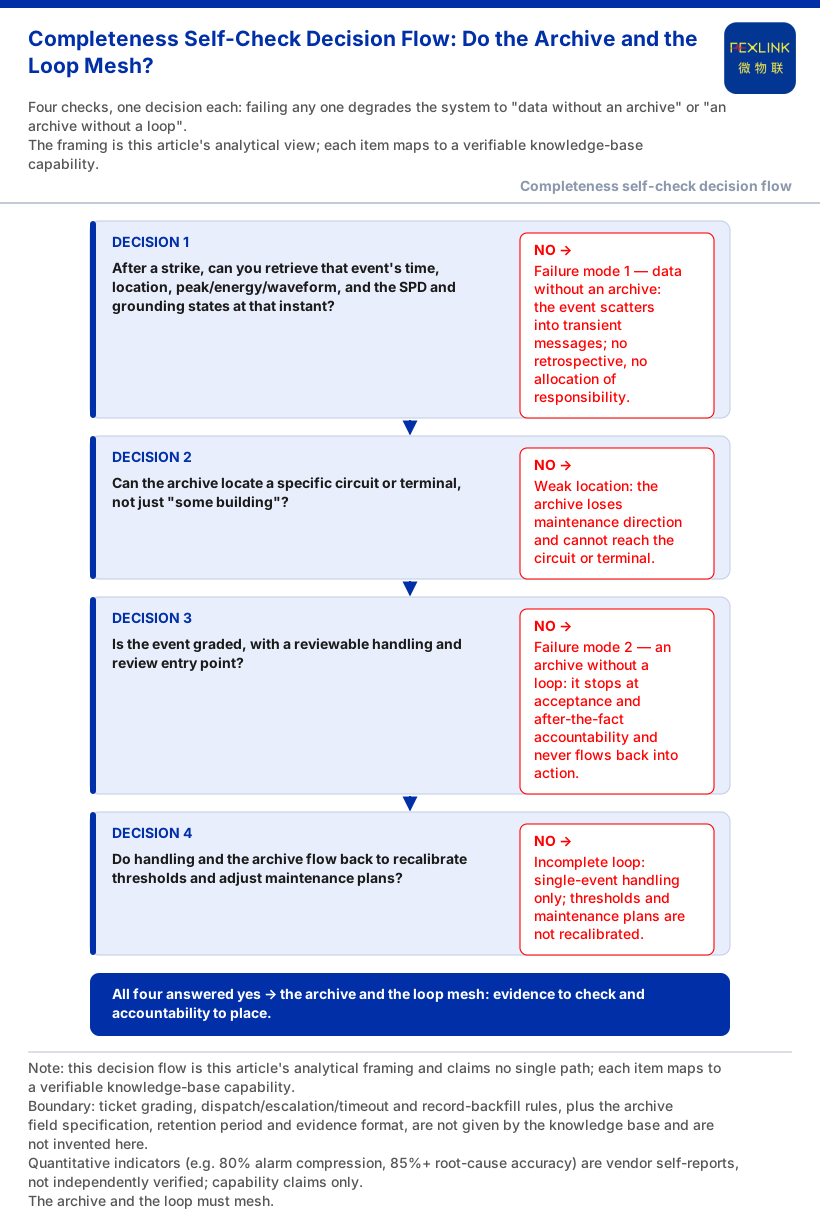
First, data without an archive. An event raises an alarm once, then scatters into transient messages without becoming a searchable record. After the next strike, O&M still cannot say how large the previous surge was, where it landed, or what the SPD state was; the data looks plentiful, yet nothing supports a retrospective or an allocation of responsibility.
Second, an archive without a loop. The archive is complete and exportable but stops at acceptance and after-the-fact accountability, never flowing back into maintenance actions, replacement decisions or threshold correction. A loop without archive support cannot be reviewed, and vendor figures e.g. 80% alarm compression, 85%+ root-cause accuracy, vendor-reported, remain capability claims, not realised effects.
5. An Operable Completeness Self-Check
Four questions test it once.
First, after a strike, can you retrieve that event's time, location, peak/energy/waveform, and the SPD and grounding states at that instant?
Second, can the archive locate a specific circuit or terminal, rather than only "some building"? See the L17-L18 location and topology-cascade tracing up to 6 levels.
Third, is the event graded, with a reviewable handling and review entry point? See the six-level alarms and red lines, and the application-layer alarm management and mobile inspection; specific ticket rules must be agreed per project.
Fourth, do handling and the archive flow back to recalibrate thresholds and adjust maintenance plans?
If a question cannot be answered, the system leans to "data without an archive" or "an archive without a loop"; only when all four answer yes do they mesh.
6. Boundaries: What This Article Does Not Claim
Second, the knowledge base gives no field specification, retention period or evidence format for the archive, and no ticket grading, dispatch/escalation/timeout or record-backfill rules; the article invents none of these implementation details.
Third, the quantitative indicators are vendor self-reports; cite them only as capability claims, never as handling limits, retrofit returns or procurement grounds.
Fourth, the article reuses no other registered article's landing point: strike-counting vs lightning-event-diagnosis granularity, post-strike data order, alarm grading and ticket practice and the usefulness argument are not developed; it answers only why a system needs an event archive and an O&M closed loop.
Conclusion
The archive and the loop solve two problems: the archive turns one strike from a "transient message" into a "searchable record" — peak, energy, waveform, location, time and the same-instant SPD/grounding states fixed together; the loop turns records into "someone does it, it can be reviewed, it flows back" actions — grading, fast location, front-end handling and trend advancement form one chain. An archive without a loop is only a backup; action without an archive cannot be reviewed. Only when the two mesh does a system have both evidence and accountability.