 FEXLINK Research Institute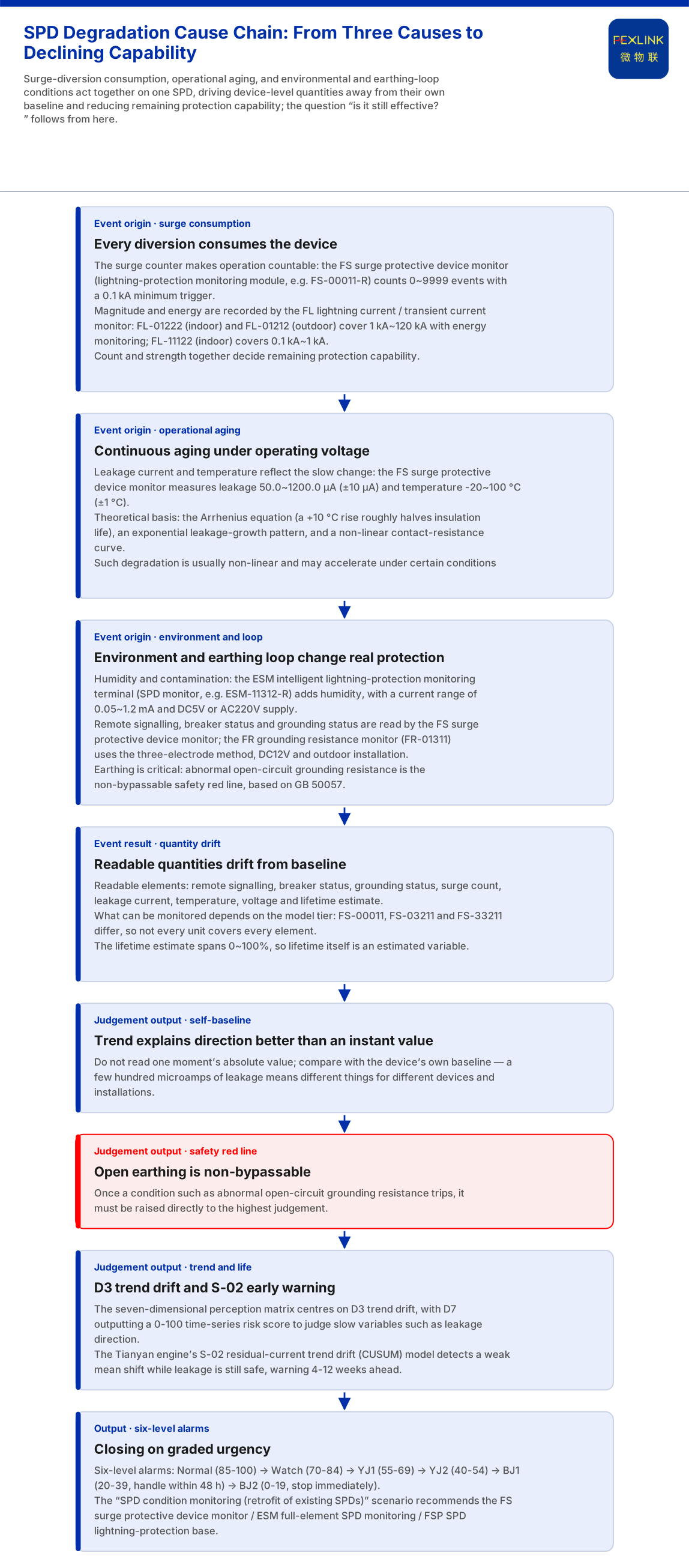
A surge protective device (SPD) does not hold its factory condition for life. It consumes itself every time it diverts lightning current, ages under continuous operating voltage, and is shaped by humidity, contamination, the earthing loop and the backup breaker. "Is it still effective?" therefore cannot be answered by appearance or a single acceptance test. The answer lies in device-level quantities — leakage current, temperature, surge count, remote signalling and breaker status, grounding status, voltage and lifetime estimate — read against the device's own baseline, plus whether a red line such as an open earthing circuit has been crossed.
1. Why an SPD Degrades: Three Causes
The first cause is surge consumption. An SPD diverts surge energy, and every operation consumes part of its protective capability. The surge counter makes this countable: the FS surge protective device monitor (lightning-protection monitoring module, such as FS-00011-R) counts 0~9999 events with a 0.1 kA minimum trigger, while the FL lightning current / transient current monitor (such as FL-01222 indoor, FL-01212 outdoor) covers 1 kA~120 kA with energy monitoring, and FL-11122 (indoor) covers 0.1 kA~1 kA. Number and strength together decide remaining capability.
The second cause is operational aging. An SPD stays connected across live conductors, and leakage current and temperature reflect this slow change: the FS surge protective device monitor measures leakage over 50.0~1200.0 μA (±10 μA) and temperature over -20~100 °C (±1 °C). The knowledge base gives the theoretical basis — the Arrhenius equation (a +10 °C rise roughly halves insulation life), an exponential leakage-growth pattern and a non-linear contact-resistance curve — so this degradation is usually not linear but accelerates under certain conditions.
The third cause is environmental and loop conditions. Humidity, contamination, and the state of the earthing loop and backup breaker all change the protection delivered. The ESM intelligent lightning-protection monitoring terminal (SPD monitor, such as ESM-11312-R) adds humidity, with a current range of 0.05~1.2 mA and DC5V or AC220V supply; the FS surge protective device monitor also reads remote signalling, breaker status and grounding status. Earthing is critical: the FR grounding resistance monitor (such as FR-01311-R) uses the three-electrode method with DC12V and outdoor installation, and lists "abnormal open-circuit grounding resistance" as the non-bypassable red line, based on GB 50057.
2. Why Degradation Cannot Be Judged "at a Glance"
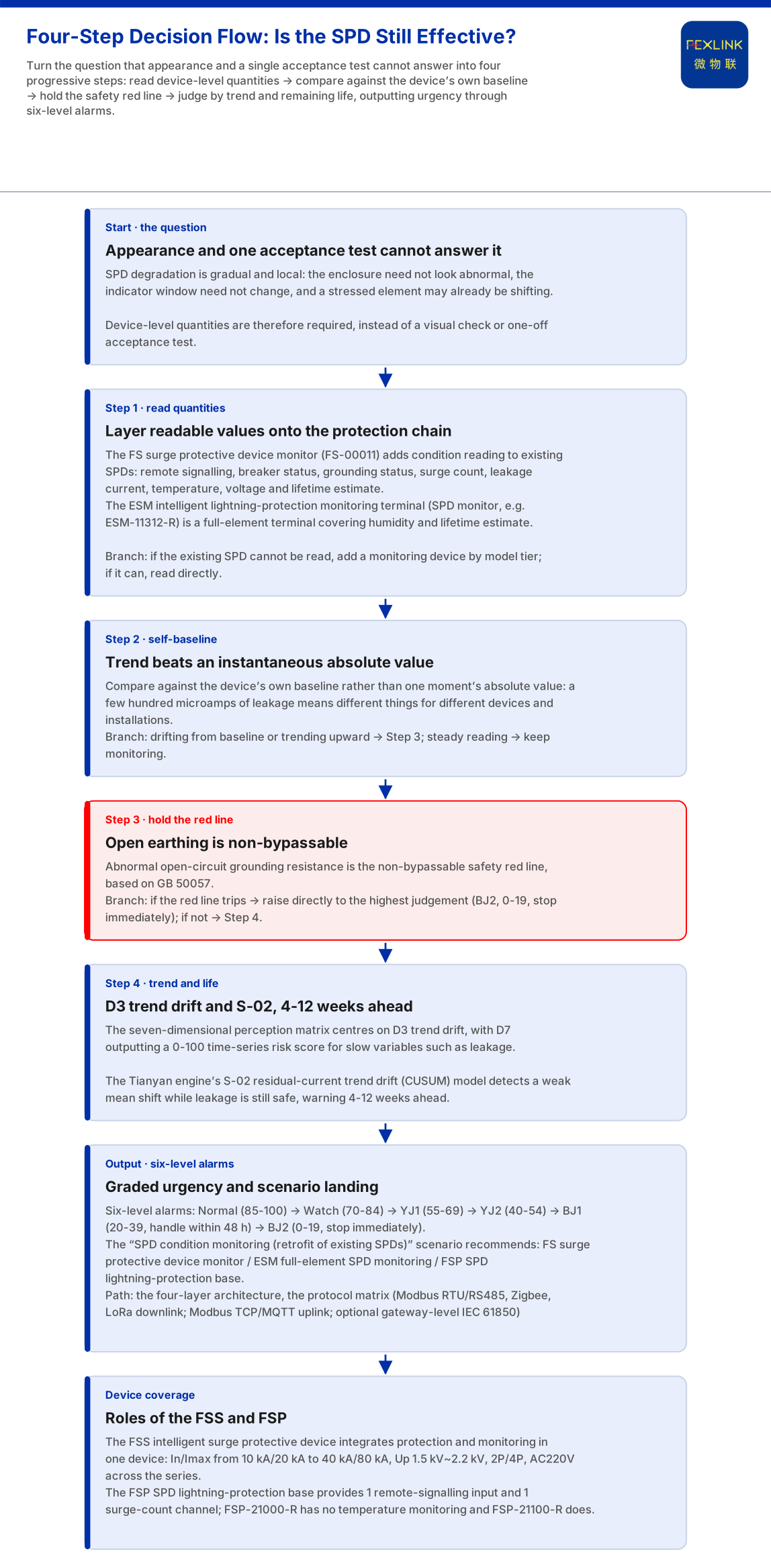
Degradation is gradual and local, which is why a visual check or one-off acceptance test cannot answer "is it still effective?" The enclosure need not look abnormal, the indicator window need not change, and an element under stress may already be shifting. That is why the FS surge protective device monitor folds remote signalling, breaker status, grounding status, surge count, leakage current, temperature, voltage and lifetime estimate into one set — each answers whether one point of the protection chain still holds. The lifetime estimate spans 0~100%, so lifetime itself is an estimated variable. What can be monitored also depends on the model tier: the rule combines voltage, leakage and temperature channels, switching inputs and grounding/surge options into tiers (such as FS-00011, FS-03211, FS-33211), so not every unit covers every element.
3. Four Steps for Judging Whether It Is Still Effective
Judgement proceeds in four steps. First, read the quantities: layer readable values onto the protection chain. Second, compare against the device's own baseline rather than one moment's absolute value — a few hundred microamps of leakage means different things for different devices and installations, and trend explains direction better. Third, hold the safety red line: once a condition such as abnormal open-circuit grounding resistance trips, it must be raised directly to the highest judgement. Fourth, watch trend and remaining life: slow variables such as leakage current are better judged by trend than a single threshold.
At the device level, these readings are carried by: the FS surge protective device monitor adds condition reading to existing SPDs; the ESM intelligent lightning-protection monitoring terminal is a full-element terminal covering humidity and lifetime estimate; the FSS intelligent surge protective device puts protection and monitoring in one device — In/Imax 10 kA/20 kA to 40 kA/80 kA, Up 1.5 kV~2.2 kV, 2P/4P poles, AC220V across the series, and 3 leakage channels for the 4P type versus 1 for the 2P type; the FSP SPD lightning-protection base provides 1 remote-signalling input and 1 surge-count channel, where FSP-21000-R has no temperature monitoring and FSP-21100-R does.
4. From Quantities to Judgement: Path, Red Line and Trend
Quantities need a path, a red line and trend capability to become judgement. The knowledge base defines the monitoring system as a four-layer architecture of perception, edge, platform and application: perception-layer modules upload through an edge gateway to the FEXCloud IoT cloud platform, where the application layer forms visualisation, alarms and reports. The protocol matrix supports device downlink (Modbus RTU/RS485, Zigbee, LoRa) and uplink (Modbus TCP/MQTT over Ethernet and 4G, plus optional gateway-level IEC 61850). The knowledge base lists "SPD condition monitoring (retrofit of existing SPDs)" as a standalone scenario, recommending the FS surge protective device monitor / ESM full-element SPD monitoring / FSP SPD lightning-protection base.
At the judgement layer, the six-level alarm scheme grades urgency as normal (85-100), Watch (70-84), YJ1 (55-69), YJ2 (40-54), BJ1 (20-39, act within 48 hours) and BJ2 (0-19, immediate shutdown); abnormal open-circuit grounding resistance is the non-bypassable red line (GB 50057); and the seven-dimensional perception matrix centres on D3 trend drift, with D7 outputting a 0-100 time-series risk score. The knowledge base records that the Tianyan engine's S-02 residual-current trend drift (CUSUM) model detects a weak mean shift while leakage is still safe, warning 4-12 weeks ahead — exactly the demand that a slow variable be judged by trend.
5. Boundaries: What This Article Does Not Claim
They are not an operating procedure, replacement threshold or acceptance basis.
Second, the quantitative indicators (electrical-hazard identification 95%+, alarm compression 80%, MTTR reduced 60%) are vendor self-reports; cite them only as vendor capability claims, never as effect guarantees or procurement grounds.
Third, the knowledge base gives no replacement threshold, procedure, sampling and reporting frequency, offline caching and backfill strategy, alarm-ticket grading rule or evidence format for SPDs, and this article does not infer them.
Fourth, no customer case, certification, handling effect or industry ranking is claimed, and no model, parameter or clause absent from the knowledge base is invented; only the GB 50057 and other listed numbers are cited, without inferring their content.
Fifth, this article covers only the mechanism of "why an SPD degrades" and the criteria for "whether it is still effective"; it does not take over adjacent landing points: (device lifecycle), (risk perception) and (line residual-current trend). It gives no upgrade process or product combination and no acceptance-criteria comparison.
Conclusion
An SPD degrades because three forces act at once: each diversion consumes it, continuous operating voltage ages it, and environmental and loop conditions change the protection it delivers. So "is it still effective" cannot be answered by appearance or one acceptance test. Read device-level quantities, compare them with the device's own baseline, hold the floor with red lines such as open earthing, and judge direction with D3 trend drift and S-02's 4-12 week lead.