 FEXLINK Research Institute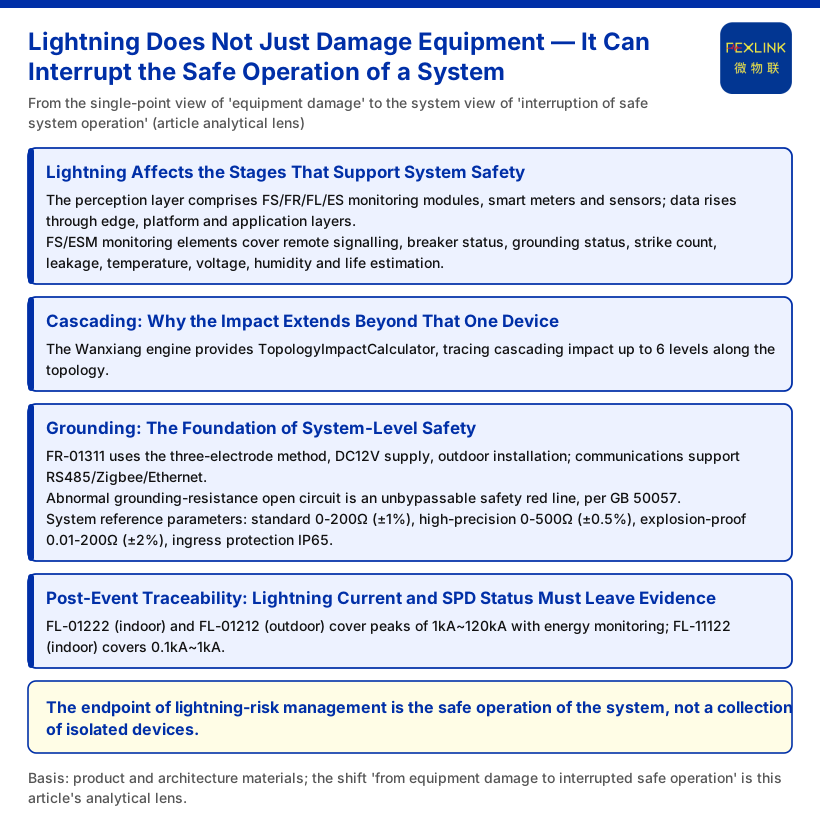
Mention lightning and most people think first of which device got fried. In a distribution room, a data centre or a charging station, however, the greater concern is often not the charred casing of a particular item but whether the system still retains the ability to operate safely after the strike. This article shifts the discussion of lightning consequences from the single-point view of "equipment damage" to the system view of "interruption of safe system operation". One clarification up front: this reframing is the article's analytical lens for organising the topic; the product knowledge base does not state it directly. Treat it as a viewpoint to validate per project.
Lightning Affects Several Stages That Support System Safety
According to the knowledge base, the general four-layer architecture of the monitoring system has a perception layer built from FS/FR/FL/ES series monitoring modules, smart electricity meters and sensors, with data uploaded stage by stage to the edge, platform and application layers. This means the value of a lightning-protection and electrical-safety system lies not only in one terminal device but in the way it links on-site conditions into a path from perception to application.
The elements continuously monitored along that path themselves mark the supporting points of system safety. Across the FS surge protective device monitor and the ESM intelligent lightning-protection monitoring terminal, the monitored elements span remote signalling, air-switch status, grounding status, lightning-strike count, leakage current, temperature, voltage, humidity and lifetime estimation. Monitoring alone does not mean the same question is being answered: grounding status concerns whether energy can be discharged safely, lightning-strike count concerns what the system has recently endured, and leakage current and temperature concern whether insulation and connections are degrading. When any one stage becomes abnormal, the effect is no longer confined to a single device; it may extend to whether the whole system can still operate safely.
Placed back into the four-layer architecture, these elements serve different operational questions: grounding status and leakage current answer "is the safety floor still there", air-switch status and remote signalling answer "are the protective branches available", temperature, voltage and humidity answer "is the operating environment stable", and lifetime estimation and lightning-strike count answer "how much margin does the equipment have left and what has it recently withstood". Whether a system can operate safely depends on whether these answers can be obtained continuously. Miss any one category, and the system may degrade from "evidence-based" to "guesswork after the fact" when lightning strikes.
Cascading: Why the Impact Extends Beyond That One Device
A four-layer architecture means on-site anomalies propagate up the chain and ultimately affect alarms, assessment and operations actions — this is the source of the gap between "equipment damage" and "operational interruption". The knowledge base records that the Wanxiang engine provides a dedicated analysis engine, TopologyImpactCalculator (topology-level cascade impact), able to trace up to 6 layers through the topology. This shows that cascading impact is not an abstract worry but something that can be modelled and traced.
Grounding: The Foundation of System-Level Safety
Of the several key stages, grounding is the easiest to regard as "fit and forget", and the least dispensable. Take the FR-01311 of the FR grounding resistance monitor: it uses three-electrode measurement, is powered at DC12V, is installed outdoors, and supports RS485/Zigbee/Ethernet communication. More important is its red-line property: the knowledge base designates "abnormal open circuit of grounding resistance" as the non-bypassable red line, on the basis of standard GB 50057. In other words, grounding is not a one-off construction item but a safety floor that must be continuously verified.
On system-level parameters, the knowledge base gives the reference parameters of the grounding resistance monitoring system: standard monitoring unit 0–200 Ω (±1%), high-precision type 0–500 Ω (±0.5%), explosion-proof type 0.01–200 Ω (Ex d IIB T4/T6 Gb, ±2%), protection rating IP65. The significance of these figures is not the values themselves but that they turn "is the grounding reliable" into a state quantity that can be quantified, compared and traced.
Post-Event Traceability: Lightning Current and SPD Status Must Leave Evidence
Once safe operation has been interrupted, the most important question is often "what actually happened, and how do we avoid it next time". The FL lightning current / transient current monitor provides the corresponding capability: FL-01222 (indoor) and FL-01212 (outdoor) have a peak range of 1 kA–120 kA and support energy monitoring, while FL-11122 (indoor) has a peak range of 0.1 kA–1 kA. This kind of continuous monitoring provides a data basis for post-event traceability, without relying on on-site visual judgement alone.
Why "The Equipment Didn't Break" Does Not Equal "The System Is Safe"
From the equipment view, a lightning strike that leaves things powered and visually undamaged often counts as "nothing happened". The system view asks finer questions: is the grounding discharge path still intact? Has the cascading impact already spread to downstream layers through the topology? How many strikes has the system actually withstood recently, and is there a record to check? These questions may not show up as equipment damage, yet they directly determine whether the system can still respond reliably the next time an anomaly arrives. Equating "not broken" with "safe" means giving up the answers to these questions.
Boundaries and Limitations
First, this article's reframing "from equipment damage to interruption of safe system operation" is an analytical viewpoint. The knowledge base does not state it directly; it should be understood as a method of organising the topic, not an established conclusion.
Second, the knowledge base records the Wanxiang engine's "cascade risk coverage of 100%"; that metric is supplier-stated and has not been independently verified. It may be cited as a vendor capability claim, but it should not be the sole basis for a procurement decision or an external commitment.
Third, the knowledge base records internally that the FR/FRP series grounding resistance monitor has been applied to grounding-grid online monitoring at railway traction substations and the Jinzhou Port oil-tank area, among other projects; this is a knowledge-base-internal application reference and has not been independently verified. This article mentions it only as a source note, not as performance evidence.
These three limitations define the scope of the article's argument: it deals with whether lightning can interrupt the safe operation of a system, and with which continuously monitored state quantities support that judgement. It does not constitute an endorsement of the lightning-protection effect, availability or track record of any specific engineering project. The grounding ranges and the FR/FL models and parameters cited here are limited to those listed in the corresponding knowledge base entries, with no extrapolation of range, certification or effect; an implementation scheme must still be verified item by item against the site boundary and applicable standards.
Conclusion
Understanding lightning risk as "risk to safe system operation" shifts the focus forward: rather than tallying losses after equipment burns out, continuously capture the state of grounding, power, signals and the monitoring chain before and after a strike. For the client's electrical/safety lead and the operations manager of a critical facility, this means answering one question at the scheme stage: when an anomaly arrives, can this system still operate safely — not merely whether lightning arresters were installed.
The conclusion differs slightly for three readers: the client's electrical/safety lead needs to write it into acceptance criteria — what is delivered is not just equipment but sustainable state visibility; the data-centre and critical-facility operations manager needs to bring it into emergency plans — knowing which state quantities to check first and where to retrieve data during an anomaly; the engineering company's scheme engineer needs to complete perception, transmission and evidence retention at the design stage rather than adding monitoring at acceptance. The common point for all three roles is a single sentence: the goal of lightning risk management is the safe operation of the system, not a collection of isolated devices.