 FEXLINK Research Institute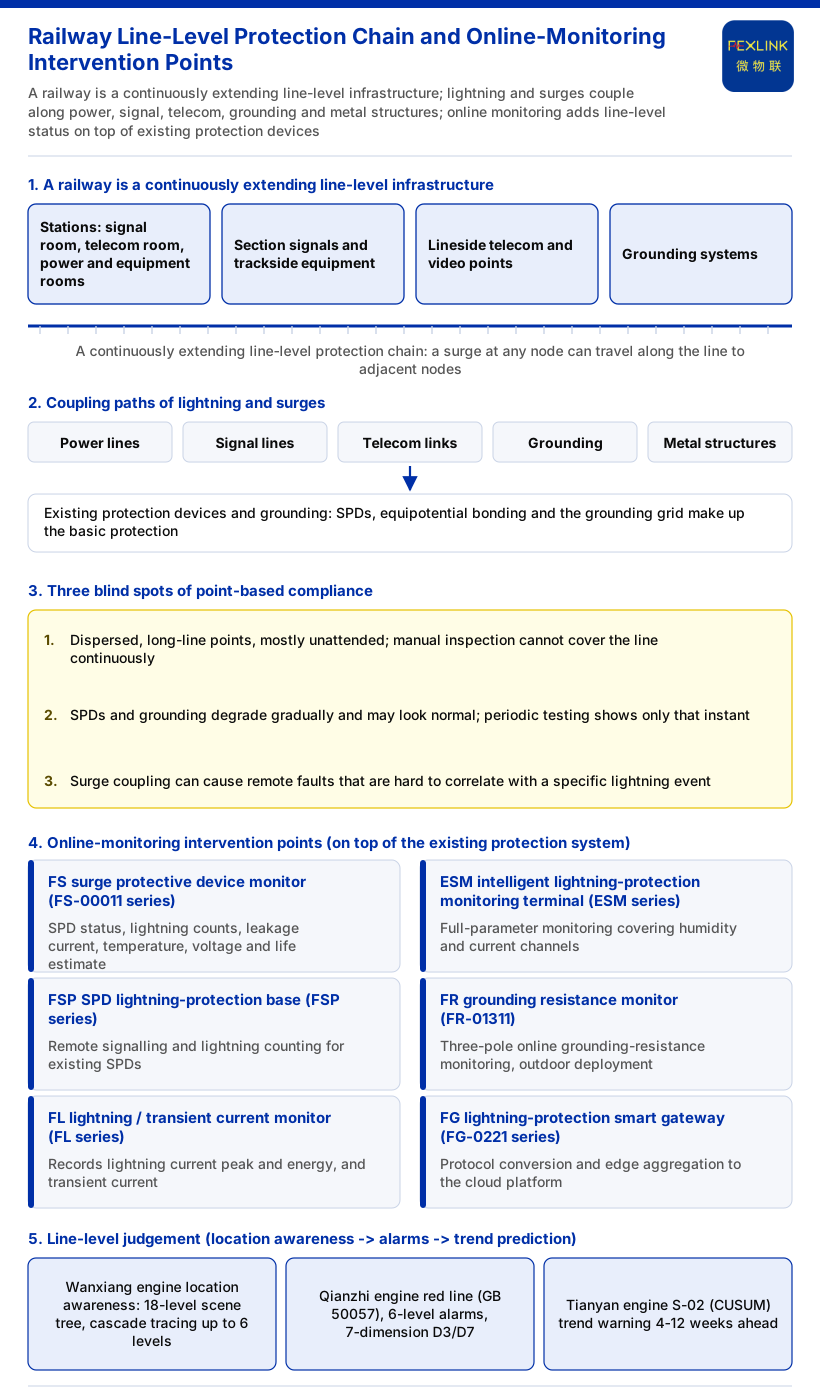
Why a Railway System Needs Intelligent Lightning-Protection Online Monitoring
Railway lightning protection is hard not at a single point but along the line. Signal, communication and power rooms inside stations; section, trackside and lineside equipment outside them; and the grounding system that ties them together make up one continuously extending protection chain. Traditional protection is designed and accepted point by point: this room received power and signal surge protective devices, that cabinet passed its grounding test. Operations instead cares which points carry higher risk and which protections no longer work. Online monitoring adds that layer: on existing devices it adds the ability to collect, upload and alarm, turning scattered protection status, strike events, grounding changes and degradation trends into readable data. The railway-as-line-level-protection-chain reading is the lens used here; the products, models, parameters and platform-level capabilities below follow current product documentation.
A Railway's Protection Target Is a Chain, Not a Point
A railway differs from a single building in being continuously extending infrastructure. A strike or surge need not stay in the device it hit; it can travel along power lines, signal lines, communication links, the grounding system or metal structures and surface elsewhere. Railway protection therefore cannot ask only whether an SPD is installed at a point. It must also ask whether that point has taken a strike or surge, whether its protective device still works, whether grounding is stable, and whether a given fault relates to a protection event. All point to one requirement: continuous online data rather than an installation acceptance record.
Why Point Compliance Cannot Answer Line-Level Status
Three characteristics of the engineering structure make point compliance unable to answer line-level status.
First, points are scattered and mostly unattended: lineside equipment may sit in sections, near bridges and tunnels or at remote yards, and periodic inspection cannot cover the change after a random strike, so a surge action is often confirmed only after a failure.
Second, degradation is gradual and appearance may look normal: SPD and grounding performance declines with strikes and operation, testing reflects only that instant, and the interval between tests is when risk accumulates.
Third, coupling and correlation are difficult: one surge may surface as remote communication loss, an offline device or an abnormal power module, and without a continuous record of protection actions, matching a fault to a lightning event is hard.
Online Monitoring Turns Protection Status and Strike Events into Readable Data
The product line provides the bridge from protective device to readable status.
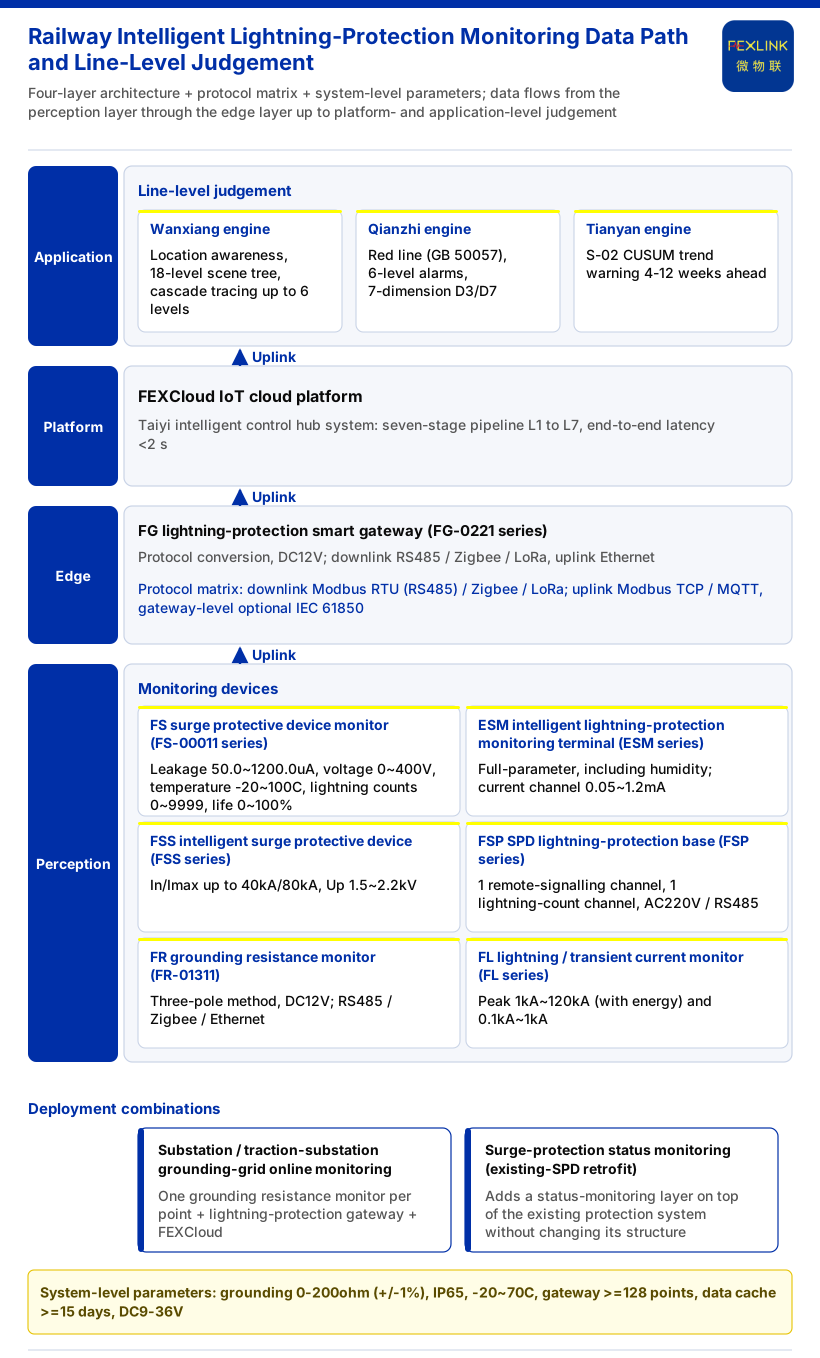
SPD status and lifetime: the surge protective device monitor (for example, FS-00011-R) covers remote signalling, air-switch status, grounding status, strike counting, leakage current, temperature, voltage and lifetime estimation, with key parameters leakage current 50.0~1200.0 μA (±10 μA), voltage 0~400.0 V (±0.1 V), temperature -20~100 °C (±1 °C), strike counting 0~9999 (minimum trigger 0.1 kA) and lifetime estimation 0~100%. The intelligent lightning-protection monitoring terminal (for example, ESM-11312-R) is a full-element terminal whose monitored elements include humidity. The intelligent surge protective device (for example, FSS-24100) offers In/Imax steps from 10 kA/20 kA to 40 kA/80 kA with Up from 1.5 kV to 2.2 kV. The SPD lightning-protection base (for example, FSP-21100-R) provides a remote-signalling input and strike counting.
Grounding status: the grounding resistance monitor (FR-01311) uses the three-electrode method with DC12V supply and outdoor installation, supporting RS485, Zigbee and Ethernet, turning grounding status from a manual measurement into an online quantity. Product documentation also notes railway traction-substation grounding-grid online monitoring for this series, cited only as background and not used to prove necessity.
Lightning-current events: lightning current / transient current monitors include wide-range models (for example, FL-01212-R) covering 1 kA~120 kA with energy monitoring and narrow-range models covering 0.1 kA~1 kA. Aggregation: the lightning-protection smart gateway (FG-0221-ER) is a protocol-conversion type with RS485 and Zigbee downlinks and an Ethernet uplink.
From Scattered Points to Line-Level Judgement: Aggregation, Location and Criteria
Readable data needs a path, a location and criteria.
On the path, the monitoring system is organised in a four-layer architecture of perception, edge, platform, and application layers: perception modules upload through edge gateways to the FEXCloud IoT cloud platform, and the application layer renders visualisation, alarms and reports. A protocol matrix supports downlinks including Modbus RTU (RS485), Zigbee and LoRa, and uplinks including Modbus TCP/MQTT plus the gateway-level optional IEC 61850. System-level reference parameters include grounding units covering steps such as 0-200 Ω (±1%) and a gateway that mounts ≥128 points with data caching of ≥15 days.
On location, a railway's value lies in knowing which section is involved: the Wanxiang engine maintains independent thresholds and risk models for five electrical topology position types and supports alarm-based localisation through an 18-level scenario localisation tree, with cascading topology impact traceable up to six layers, mapping points to topology positions.
Two criteria apply. The first is a red line: abnormal open circuit of the grounding resistance is non-bypassable (per GB 50057) and no one may raise its threshold, alongside residual current ≥300 mA (GB 13955). The second is grading and trend: the six-level alarm-grading runs Normal (85-100), Watch (70-84), YJ1 (55-69), YJ2 (40-54), BJ1 (20-39, act within 48 hours) and BJ2 (0-19, shut down immediately); the seven-dimension perception matrix centres on D3 trend drift with D7 outputting a 0-100 risk score; the Tianyan engine's S-02 residual-current trend drift (CUSUM) detects a weak mean shift while leakage is still safe (for example, 18 mA) and warns 4-12 weeks ahead. On the data path, the Taiyi intelligent control hub system's seven-stage pipeline (L1 ingest, L2 cleansing, L3 pre-check, L4 Qianzhi analysis, L5 Wanxiang assessment, L6 fusion decision, L7 persistence) runs end to end in under 2 seconds. Judgement thus moves from point-by-point acceptance to a traceable time series on a locatable topology.
Landing on Railway Scenarios: Traction-Substation Grounding Grids and Existing SPDs
Two combinations relate directly to railways. The first is substation / traction-substation grounding-grid online monitoring, recommended as grounding resistance monitor (one set per point) plus lightning-protection smart gateway plus FEXCloud. The second is lightning-arrester condition monitoring (retrofit of existing SPDs), recommended as surge protective device monitor, full-element SPD monitoring, or SPD lightning-protection base. The first addresses grounding-grid status on the traction side; the second addresses protective devices at existing points in stations and along the line. Together they cover whether grounding is reliable and protection still works, and the landing can be an added monitoring layer over an existing protection system rather than a rebuild. Product documentation gives only the scenario-to-product mapping, not railway standards, retrofit procedures, construction sequences or quantity bases, which are not inferred here.
Boundaries: What This Article Does Not Claim
First, this article reads a railway as a line-level protection chain and does not use "intelligent lightning-protection online monitoring" as a railway system-level product name; its content is not an operating procedure or acceptance basis.
Second, the quantitative value indicators in product documentation (such as electrical-hazard identification 95%+, alarm-compression ratio 80%, warning lead of 4-12 weeks, MTTR reduced 60%, and 8-20% energy-saving space) are vendor capability claims, not performance guarantees, retrofit returns or procurement grounds.
Third, the note on railway traction-substation grounding-grid online monitoring is background only and not used to prove necessity; no concrete effects are given for rail potential, traction return current, stray current or signal interruption, and none are asserted.
Fourth, no railway-specific standards or clauses, standard compliance, customer case, certification or handling effect is claimed, and no model, parameter or standard absent from product documentation is invented; only listed identifiers such as GB 50057 and GB 13955 are cited, without inferring their clauses.
Fifth, this article focuses on the railway line-level protection chain and does not expand into room upgrades, highways, new-energy stations, wind farms or single topics such as grounding-grid configuration, grounding-test intervals, signal power or station distribution.
Conclusion
Railways need intelligent lightning-protection online monitoring not because devices are scarce but because a railway is a continuously extending line-level protection chain: points are scattered and mostly unattended, SPD and grounding degradation is gradual and may look normal, surge coupling makes remote faults hard to match to lightning events, and point compliance cannot answer whether protection along the line still works. The bridge is clear: the surge protective device monitor for SPD status and lifetime, the intelligent lightning-protection monitoring terminal for full elements, the intelligent surge protective device and SPD lightning-protection base for grades and base signalling, the grounding resistance monitor for grounding, and the lightning current / transient current monitor for strike events, aggregated through the lightning-protection smart gateway with the four-layer architecture and protocol matrix, located to line topology through location awareness, held by the abnormal grounding open-circuit red line and six-level alarms, moved earlier by the Tianyan engine's residual-current trend drift, and landed on the combinations of traction-substation grounding-grid online monitoring and retrofit of existing SPDs. Terminology and product names follow current product documentation.