 FEXLINK Research Institute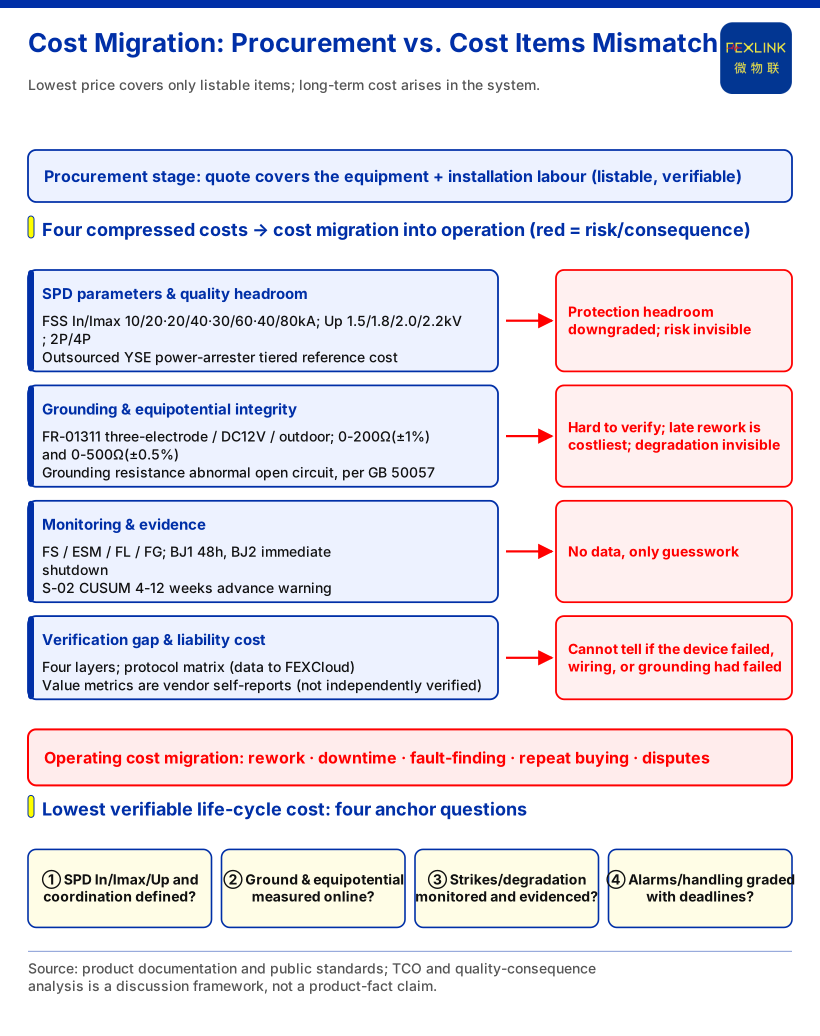
In lightning-protection tendering, "lowest bid wins" looks like saving the owner money — until operation hands those savings back many times over. The lowest price covers only procurement items that can be written into a bill of quantities and seen at acceptance, while what decides long-term cost — parameter headroom, grounding and equipotential integrity, and monitoring and verification capability — is exactly what such lists omit and acceptance cannot easily reveal. The claim is broken down below into verifiable engineering quantities; facts are from the knowledge base.
1. The Quote Prices Hardware; the Cost Happens in the System
Start by separating two ideas: purchase price and total cost of ownership (TCO). Purchase price covers only equipment and installation labour; TCO also includes rework, downtime, fault-finding, repeat purchasing, disputes and compliance reviews during operation. Low-price competition works by squeezing the stages a bill of quantities can verify, which produces a structural mismatch: the money buys equipment, but the problems appear in the connections between equipment, in parameter headroom and in information visibility. Each compressed cost below, however, maps to concrete parameters and capabilities in the knowledge base.
2. First to Be Squeezed: SPD Parameters and Quality Headroom
A surge protective device (SPD) is the component most easily downgraded in a low-price scheme. The knowledge base gives the selectable grades of the FSS intelligent SPD: In/Imax from 10kA/20kA, 20kA/40kA and 30kA/60kA to 40kA/80kA, with Up from 1.5kV, 1.8kV and 2.0kV to 2.2kV, and 2P/4P configurations. Behind the three letters "SPD" sit four different levels of discharge capacity and residual voltage, so the price legitimately differs. The outsourced YSE power arresters confirm the tiering: single-phase 20kA and 40kA share a reference cost of 68, while 60kA and 80kA share 95; three-phase 20kA/40kA is 120 and 60kA/80kA is 195. When a tender says only "provide SPDs" without fixing In/Imax/Up and coordination, the bidder can choose the grade that just fits the list.
A qualification is required: the knowledge base gives selectable parameter tables and reference costs only, with no statistics on degradation rate, failure probability or service life (thin, no invention). The article can say only that parameter grades participate in protection design, not infer a project's damage or failure rate.
3. Second: Grounding and Equipotential Bonding — Invisible, Easily Deferred
Grounding is the stage that is hardest to verify at acceptance and most expensive to redo later. The knowledge base describes the FR grounding-resistance monitor FR-01311: three-electrode method, DC12V supply, outdoor mounting, with RS485/Zigbee/Ethernet communications. The knowledge base adds system-level reference parameters: monitoring units of 0-200Ω (±1%), 0-500Ω (±0.5%) or an explosion-proof Ex d IIB T4/T6 0.01-200Ω (±2%), IP65, -20~70°C. The knowledge base lists "abnormal open circuit of the grounding resistance" among five non-bypassable red lines, based on GB 50057; a trigger emits the highest-level alarm directly and skips all weighted scoring.
Grounding status thus has both a non-negotiable standard floor and a need for professional measurement. If acceptance samples once and operation has no online means, degradation stays invisible until equipment fails after a strike and grounding must be reworked. The red line and the FR/grounding parameters are verified the knowledge base facts.
4. Third: Monitoring and Evidence — Without Data, Fault-Finding Is Guesswork
Lightning protection is a classic low-frequency, high-consequence risk: without monitoring, one storm's damage is inferred from experience; with it, judgement has evidence. Verifiable monitoring capabilities include the FS surge protective device monitor, which covers remote signalling, air-switch status, grounding status, lightning-strike count, leakage current, temperature, voltage and lifetime estimation, with leakage current 50.0~1200.0μA (±10μA), voltage 0~400.0V (±0.1V), temperature -20~100°C (±1°C), strike count 0~9999 (minimum trigger 0.1kA) and lifetime estimation 0~100%. The ESM intelligent monitoring terminal is a full-element unit including humidity, with DC5V or AC220V supply. Among FL lightning-current and transient-current monitors, FL-01222 (indoor) and FL-01212 (outdoor) cover 1kA~120kA with energy monitoring, while FL-11122 (indoor) covers 0.1kA~1kA. This data is aggregated and uplinked by the FG intelligent gateway, a protocol-conversion type with RS485/Zigbee downlink, Ethernet uplink and DC12V supply.
On the platform side, the six-level alarm scheme requires BJ1 (20-39 points) to be handled within 48 hours and BJ2 (0-19 points) to shut down immediately, while the Tianyan engine S-02 residual-current trend-drift (CUSUM) model can warn 4-12 weeks ahead while leakage is still within the safe range. For a low-price scheme, cutting monitoring is almost imperceptible: the count of devices on the acceptance list does not drop, but operation loses the data needed for localisation and review. The knowledge base provides no quantitative comparison between downtime loss, fault-localisation time and monitoring coverage.
5. Fourth: Verification Gaps and Liability Cost
Much of a lightning-protection system's quality surfaces only after acceptance. Low-price schemes often save on verifiability as well: without online data, no one can afterwards say whether equipment failed, wiring was non-compliant, or grounding had already failed. The four-layer monitoring architecture (perception—edge—platform—application) and the communications protocol matrix show how data from FS/FR/FL/ES modules is aggregated through gateways into FEXCloud and turned into visualisation, alarms, reports and inspections at the application layer; the Taiyi intelligent-control hub described in runs a seven-stage pipeline end to end in under 2 seconds. In addition, the quantitative value indicators listed (electrical-hazard identification rate 95%+, alarm compression ratio 80%, 4-12 weeks' warning lead time, MTTR reduced by 60%, and so on) are vendor self-reports, and cannot be used as a basis for TCO calculation.
6. What the Knowledge Base Does Not Answer (What This Article Does Not Claim)
Second, the article offers no TCO calculation model and no rework rate, failure rate, downtime duration, payback period, energy-saving benefit or other ROI figure; the knowledge base contains no such statistics (thin, no invention).
Third, it does not claim that low price is necessarily bad or high price necessarily good, and gives no bid-scoring rules, negotiation scripts or "what the floor price should be". Low price is not the problem; a mismatch between what is priced and where cost arises is.
Fourth, product parameters, models, standards and scenario combinations are all anchored to the knowledge base; model naming uses the locked terms — FS = surge protective device monitor, ESM = intelligent monitoring terminal (SPD monitor), FR = grounding resistance monitor, FL = lightning current / transient current monitor, FG = intelligent gateway, FSP = SPD base, FEXCloud = IoT cloud platform; the only standard cited is GB 50057 as listed in the knowledge base, without inferring its clauses.
Fifth, it does not reuse the landing points of registered or same-batch articles: existing-SPD upgrade product paths, engineering-firm organisational transition, testing firms' new business, the changing value of lightning-protection data, project-profitability diagnosis, customer value perception, long-term operations contracts or the shift from annual testing to continuous service; it answers only why the lowest price becomes more expensive in operation.
Conclusion: Replace "Lowest Price" with "Lowest Verifiable Life-Cycle Cost"
Lowest-bid awards end up dearest not because of price itself but because the quote covers only procurement items a list can verify, while rework, downtime, fault-finding and disputes fall outside it. To reverse this, owners can press on four verifiable anchors: are the SPD's In/Imax/Up and coordination written down; do grounding and equipotential bonding have measurement and online verification; do strikes and degradation have monitoring and evidence; do alarms and handling have grades and deadlines. None of these questions needs invented statistics; they require only checking the product parameters and scenario combinations already in the knowledge base. For suppliers, explaining and delivering these "invisible parts" is the way out of price competition. The method can be borrowed; the specific scheme and effects still need item-by-item confirmation against project and compliance requirements.