 FEXLINK Research Institute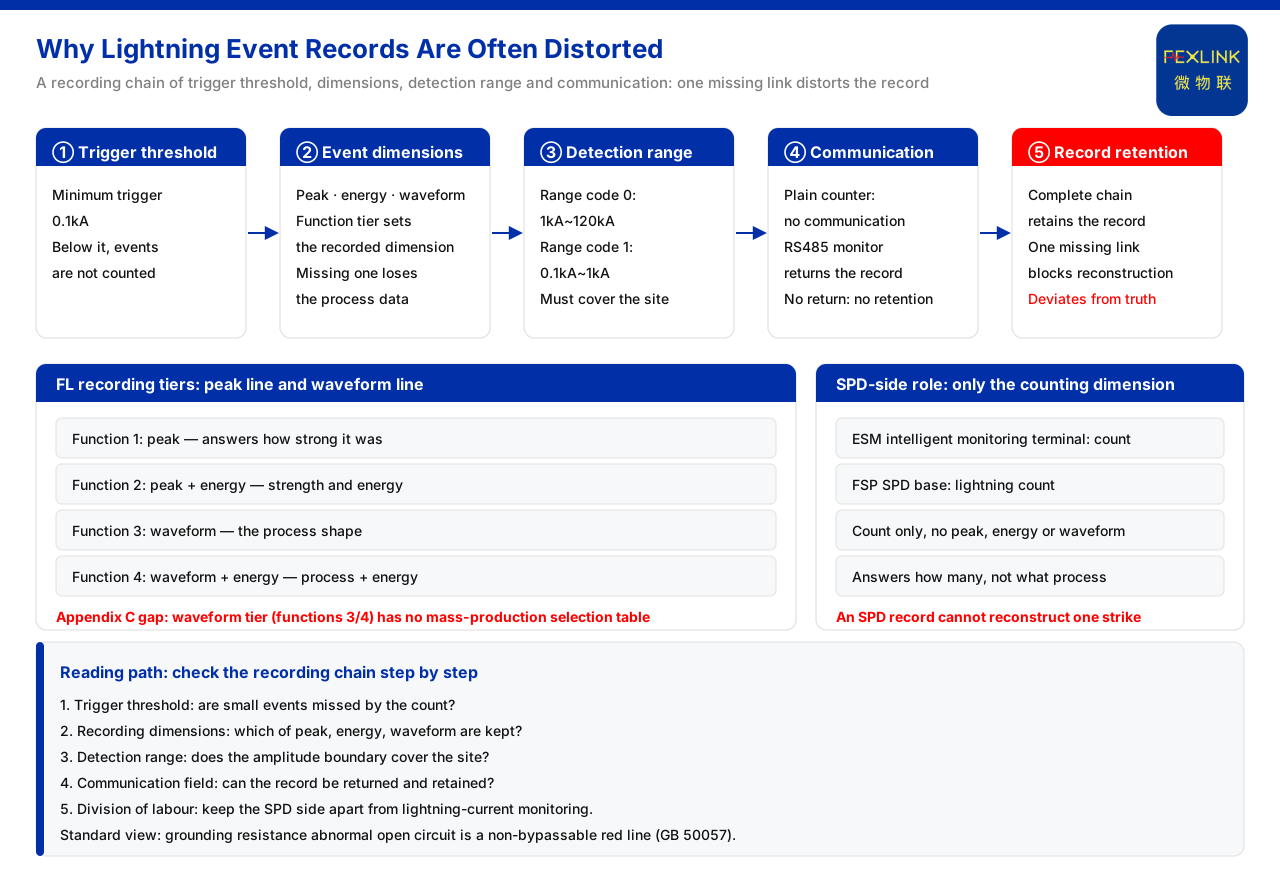
Direct answer
Lightning-strike event records are often distorted because "recording" is not a single action but a chain made up of a trigger threshold, recording dimensions, a communication link and the division of labour among devices; if any link in the chain is missing, the event data can no longer reconstruct the real process afterwards. The model rule of the product knowledge base for the FL lightning current / transient current monitor (FL-01222) shows that a lightning process can be kept as an event record only when it is recorded along the event dimensions of peak, energy and waveform; whereas monitoring on the SPD side mostly keeps only one dimension, "lightning count", and the waveform tier has no mass-production model under the current specification. Between "how many times it happened" and "what the process looked like", an information gap therefore opens.
Distortion comes from a recording chain, not from one value
To understand distortion, "recording" must first be taken apart. From the occurrence of a strike to the formation of a queryable record, three stages are passed: the threshold decides which events enter the record, the dimensions decide what the event is recorded as, and communication decides whether the record is kept. If any stage is not fixed by the site configuration, the record will deviate from the real process. Distortion must therefore be checked along this chain: whether the trigger misses small events, whether the dimensions lose process information, and whether the link sends anything back.
Event dimensions: what peak, energy and waveform each answer
The recording dimensions of a lightning process are not limited to one. According to the product knowledge base, the recording functions supported by the FL lightning current / transient current monitor fall into four tiers: function 1 records peak, function 2 records peak and energy, function 3 records waveform, and function 4 records waveform and energy. These four tiers can be grouped into two main lines: the peak line answers "how strong this event was", and the waveform line answers the shape of the process; energy does not form a tier of its own but is overlaid on the two main lines. This explains a key judgment: a lightning process can be retained as evidence usable for tracing only when it is recorded along the event dimensions of peak, energy and waveform. A mere marker of "it happened" answers neither intensity nor shape.
Model rule: the function tier and the detection range are two boundaries
In the model rule of the FL lightning current / transient current monitor, the model is composed of fields including detection range, channels, function, installation, supply and communication (FL–[detection range][channels][function][installation][supply]–[communication]). The function tier decides whether event recording is split into the peak line or the waveform line. The detection range is tiered by amplitude:
| Detection-range code | Covered amplitude |
|:--|:--|
| 0 | 1kA~120kA |
| 1 | 0.1kA~1kA |
This means "what can be recorded" and "up to what magnitude" must be fixed together: the function tier decides the recording dimension, the detection range the amplitude boundary. If either departs from the site's expectation, the record deviates from the real event.
Reading the model table: why the energy column shows "—"
Putting the rule onto specific models makes this clearer. The model table in the product knowledge base lists three classes of product, with their installation, peak range and energy-recording status as follows:
| Model | Installation | Peak range | Energy recording |
|:--|:--|:--|:--|
| FL-01222 | Indoor | 1kA~120kA | Supported |
| FL-01212 | Outdoor | 1kA~120kA | Supported |
| FL-11122 | Indoor | 0.1kA~1kA | — |
The first two, one indoor and one outdoor, have the larger amplitude and both support energy recording; the third falls in the low-amplitude tier, its energy column showing "—", which indicates that the mass-production model in that tier does not record along the energy dimension. The choice of detection range therefore changes not only the measuring range but the recording dimension as well.
The waveform-tier gap: why process reconstruction is difficult
Peak and energy answer intensity, but "process shape" depends on the waveform. Yet the product knowledge base records explicitly, among the known information gaps in Appendix C, that the waveform-tier FL models (functions 3/4) have no mass-production selection table for the time being. Under the current specification, a mass-production model aimed at waveform-level recording is therefore not yet selectable: the selectable models concentrate on the peak and energy dimensions, while the process dimension lacks a mass-production landing point. For a project that wishes to reconstruct the complete waveform, this is a direct source of the difficulty.
The counting threshold and ceiling: two range boundaries
Even at the most basic counting dimension, recording still carries boundaries. The key parameters given by the product knowledge base for the FS surge protective device monitor (for example FS-00011-R) are a lightning-count range of 0~9999 events and a minimum trigger of 0.1kA. These two figures each imply a boundary: a minimum trigger of 0.1kA means lightning events below that amplitude are not counted, and a ceiling of 9999 events means the counting dimension itself has a range boundary. The former makes small events "invisible" in the count, and the latter strips the count of its power to discriminate once the ceiling is reached. Superimposed, both cause the afterwards record to deviate from the actual lightning process.
The communication link: no return means no retention
Whether a record can be kept also depends on whether the link has a return capability. The quotation table places two classes of device side by side: the ordinary lightning counter (without communication) and the three-element SPD monitor with RS485 (count, switch status and SPD status). The former has no return capability, and only the three-element monitor with RS485 can upload count and status; whether communication is present therefore directly decides whether the event record can be retained. However detailed the count, if it does not enter a link capable of returning it, it cannot be retrieved afterwards — a link in "record distortion" easily overlooked.
SPD-side division of labour: only the counting dimension is kept
So how much lightning information can the SPD itself provide? In the product knowledge base, the model tables of the ESM intelligent lightning-protection monitoring terminal (for example ESM-21001-R, all-parameter SPD monitoring) and the FSP SPD lightning-protection base (for example FSP-21000-R and FSP-21100-R) all list only "lightning count" as the lightning-related element. This shows that SPD-side monitoring keeps only the count dimension for lightning, without peak, energy or waveform; an SPD record therefore answers "whether there was an event and how many times", but cannot reconstruct the process of a single strike. Judging intensity and shape must rely on a lightning-current monitoring stage able to record along event dimensions.
Standard perspective: recording must serve grounding-anomaly tracing
The value of an event record goes beyond counting. The red-line guard of the Qianzhi engine in the product knowledge base lists "abnormal open circuit of grounding resistance" as a non-bypassable red line, with GB 50057 as its basis. This means that lightning event records also need to support a national-standard floor check of the grounding state. The purpose of recording thus extends from counting occurrences to providing a basis for standardised tracing of grounding anomalies.
Key points for reading
Gathering the above into a single reading path: first look at the trigger threshold to confirm whether small events have been missed; then look at the recording dimensions to confirm which of peak, energy and waveform have been retained; then look at the detection range to confirm whether the amplitude boundary covers what the site expects; next look at the communication field to confirm whether the record can be returned and retained; and finally distinguish the SPD side from the lightning-current monitoring side, so as not to use count-dimension data to answer a process-dimension question.
Scope and limitations
This article explains only why lightning-strike event records are often distorted. Its factual boundary is limited to the product knowledge base: the model rule of the FL lightning current / transient current monitor, its function tiers and detection ranges; the FL model table's installation, peak range and energy-recording status; the known information gap about the waveform tier in Appendix C; the FS surge protective device monitor's lightning-count range and minimum trigger; the quotation-table distinction between the ordinary lightning counter and the three-element SPD monitor with RS485; the lightning count in the ESM intelligent lightning-protection monitoring terminal and FSP SPD lightning-protection base model tables; and the grounding resistance abnormal open circuit entry under GB 50057. These are model-and-architecture-level definitions, not a measurement conclusion for any specific event or a compliance determination. The article infers no distortion ratio and applies no capability across function tiers, detection ranges or model variants; for field configuration, check installation environment, function tier, detection range and communication field item by item.