 FEXLINK Research Institute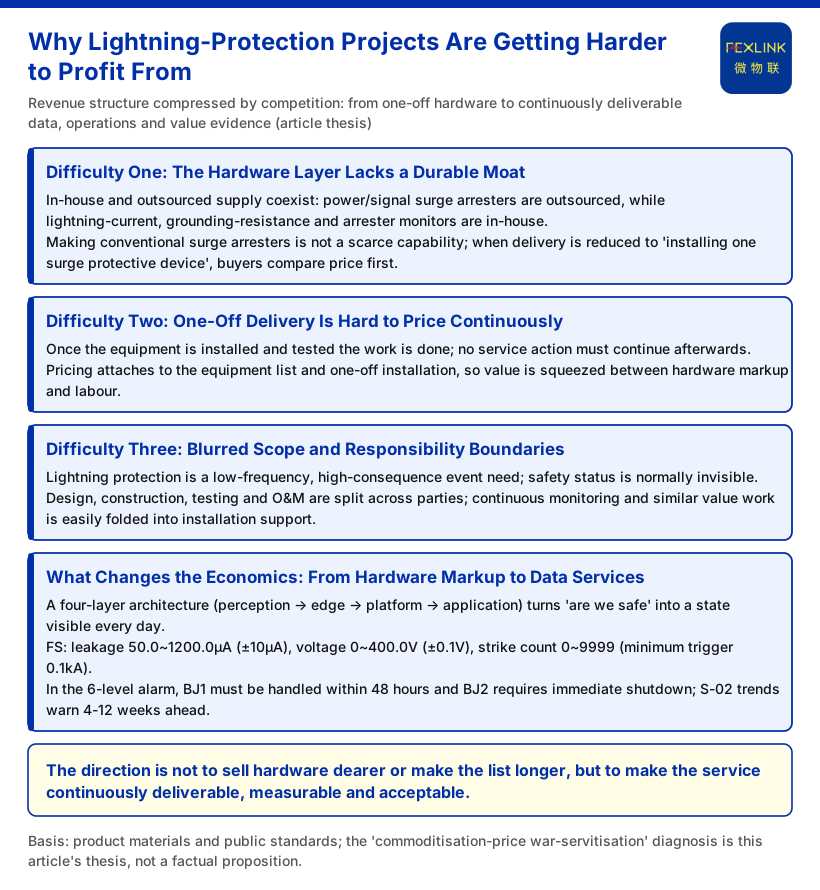
Lightning-protection projects are getting harder to profit from, and the problem is usually not demand but the value structure itself. Hardware is commoditising, one-off delivery is forced into price comparison, and blurred scope and responsibility boundaries make genuine incremental value impossible to price. Making a project cheaper or broader therefore barely improves margin; the way to change the economics is to shift revenue from one-off hardware towards continuously deliverable data, operations and value evidence. Below, verifiable facts from the knowledge base first explain why the money is hard to earn, then the article discusses which capabilities could change that structure and what it does not claim.
Difficulty One: Why the Hardware Layer Lacks a Durable Moat
From the supply side, hardware rarely carries profit over the long term. The knowledge base distinguishes in-house production from outsourcing: power-supply surge protectors and signal/network surge protectors belong to the outsourced YSE series, while lightning-current, grounding-resistance, arrester and surge-protector monitoring modules are produced in-house. That division describes only production organisation, but it supports the analysis here: the traditional surge protectors dominating an engineering bill of materials are not backed by a scarce manufacturing capability. When the deliverable is equated with fitting a surge protective device, the client's easiest comparison is price, not capability.
It must be stressed that commoditisation driving margin down is this article's judgement about the competitive structure; the knowledge base gives no relevant market or price data. The outsourcing fact that does exist is only one supply-side clue.
Difficulty Two: One-Off Delivery Is Hard to Price Continuously
Lightning protection is inherently project-shaped: once equipment is installed and the test passes, the job is complete. Result-type delivery has two consequences. First, acceptance and settlement coincide, so no service action must continue. Second, pricing can attach only to the equipment list and one-off installation, squeezing added value between hardware markup and labour. When the same equipment and installation are highly comparable across firms, price competition becomes almost the only variable.
One misreading should be avoided: the article does not deny the technical content of lightning protection; it says the one-off revenue shape can hardly turn that content into a durable pricing basis. If technical capability is visible only at delivery, it can be priced only then.
Difficulty Three: Blurred Scope and Responsibility Boundaries
Lightning protection is a low-frequency, high-consequence, event-driven need. The safety state is normally invisible, so the client struggles to tell whether service is happening; design, installation, testing and later O&M are also split across parties, leaving who is responsible for long-term safety unclear. As a result, value-creating work—continuous monitoring, trend analysis, event evidence—is easily folded into construction support and given away, while the risk stays with the engineering firm.
Together, the three points expose one gap: the service lacks a carrier that continuously generates data and a semantics that can be written into the deliverable. That is why cutting price or adding equipment rarely improves profitability.
What Changes the Economics: From Hardware Markup to Data Services
For the economics to change, the service must have a carrier that continuously generates data. The knowledge base defines the monitoring system as a four-layer architecture of perception, edge, platform and application layers; the perception layer collects data from FS/FR/FL/ES series modules and sensors and uploads it to the cloud platform and application layer. This sense-it, transmit-it, see-it path turns "is it safe?" from a one-off conclusion into a state visible daily, giving it a basis for continuous pricing.
The FS surge protective device monitor covers remote signalling, air-switch status, grounding status, lightning-strike count, leakage current, temperature, voltage and lifetime estimation, with leakage current 50.0~1200.0 μA (±10 μA), voltage 0~400.0 V (±0.1 V) and lightning-strike count 0~9999 (minimum trigger 0.1 kA). The ESM intelligent lightning-protection monitoring terminal is a full-element terminal with DC5V or AC220V supply. The FR-01311 grounding resistance monitor uses the three-electrode method, is DC12V-powered, outdoor-rated, with RS485/Zigbee/Ethernet communications. The FL lightning-current / transient-current monitor covers 1 kA~120 kA and 0.1 kA~1 kA peak ranges. The protocol-converting FG gateway uplinks via Ethernet with RS485/Zigbee downlink and DC12V supply. This equipment list is the source of what the service must deliver daily.
Translating Data into Acceptable Service Items
Data alone is not revenue; it must become service actions the client can accept. The knowledge base offers two semantic layers.
First, safety red lines: grounding status maps to the non-bypassable red line (grounding resistance abnormally open, per GB 50057), and a red-line trigger emits the highest-level alarm without participating in weighted scoring. This suits a clause that the red line is never relaxed.
Second, response grading: in the six-level alarm scheme, BJ1 (20-39 points) requires action within 48 hours and BJ2 (0-19 points) requires immediate shutdown, mapping directly to tiered response-time commitments.
There is also state-trend monitoring: the Tianyan engine's S-02 residual-current trend drift (CUSUM) model detects a weak mean shift while leakage is still safe, giving 4-12 weeks' advance warning, which suits predictive-warning-plus-planned-maintenance clauses. Event evidence (lightning-strike counts and event-parameter records) answers what happened recently, suiting event-reporting and traceability clauses.
Only when quantities become which threshold, how fast a response, and what evidence is retained does the service turn from inspection-plus-warranty into measurable, accountable deliverables. Data answers how things stand, O&M answers how quickly a problem is handled, and value evidence answers what state continuous investment has bought.
Scenarios and Terminology
The knowledge base gives combination anchors: for surge-protector condition monitoring (retrofit of existing SPDs), the recommended combination is the FS monitor, ESM full-element SPD monitoring and the FSP lightning-protection base; for online monitoring of substation and traction substation grounding grids, it is FR-01311 (one set per point) plus an FG gateway plus FEXCloud. The technical foundation of a service model can thus sit on existing SPDs and grounding grids rather than waiting for new-build work.
Boundaries and What This Article Does Not Claim
Second, the article provides no pricing model, quotation standard, return-on-investment (ROI) calculation or margin data, and claims no model, parameter, certification or case absent from the knowledge base; all parameters are limited to the corresponding knowledge-base entries, with no extrapolation.
Third, the quantitative value indicators (electrical-hazard identification rate 95%+, alarm compression ratio 80%, 4-12 weeks' warning lead time, fault-localisation time from days to 2 hours, MTTR reduced by 60%, comprehensive energy-saving potential 8-20%) are vendor self-reports. They may be cited only as vendor capability claims, never as project revenue commitments, pricing basis or contractual basis.
Fourth, notes FR/FRP-series application to railway traction substation grounding-grid online monitoring and the Jinzhou Port tank farm (10 sets per tank); this is an internal knowledge-base reference, cited only as a source note, not as performance evidence.
Conclusion
Lightning-protection projects are getting harder to profit from because the revenue structure built on one-off hardware delivery is being compressed by competition. The direction is not to sell equipment for more or lengthen the bill of materials, but to make service continuously deliverable, measurable and acceptable: build a data foundation through online monitoring, translate monitoring elements into acceptable items—safety red lines, response grading, trend warning and event evidence—and use them to support data services, O&M and value evidence. For engineering-firm leadership this means shifting quotation and organisation from project settlement to service evidence; for the client's project owner it means procurement expands from equipment to continuous state visibility. The direction can be borrowed, but the business model and effects still need item-by-item review against company and project conditions.