 FEXLINK Research Institute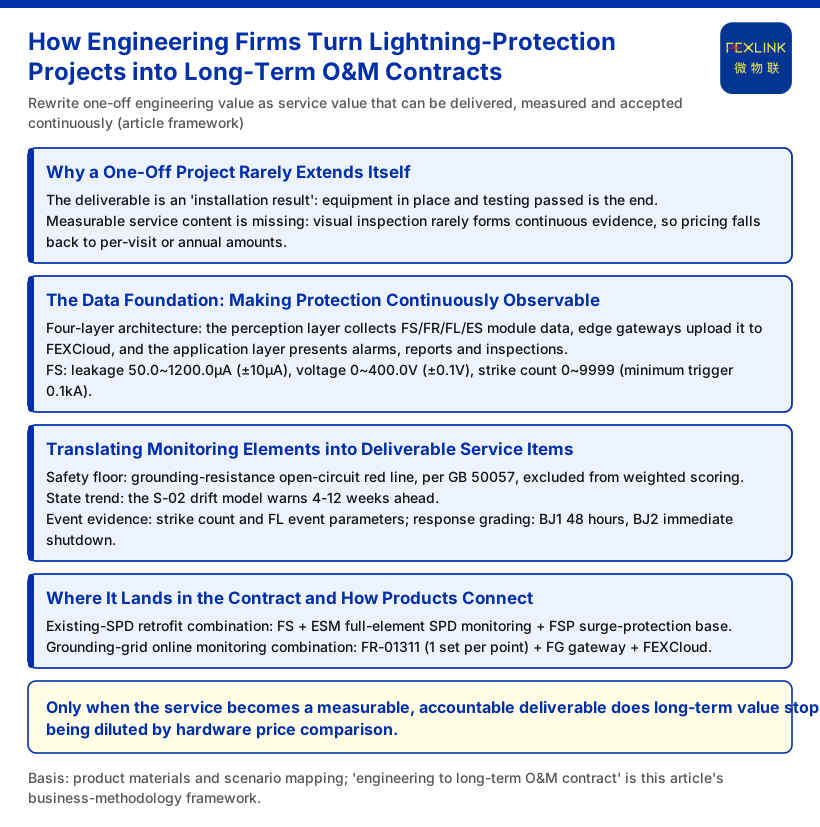
A lightning-protection project usually ends the moment it is handed over: the equipment is installed, acceptance testing passes, the warranty expires, and the relationship with the client simply closes. Turning such a project into a long-term operations and maintenance (O&M) contract is not a matter of selling the same hardware for a higher price. It requires rewriting one-off engineering value as service value that can be delivered, measured and accepted continuously: online monitoring supplies the data foundation, alarm response and event evidence form the service content, and contract clauses expand the deliverable from a bill of equipment into continuous state visibility plus agreed response responsibility.
Why a One-Off Lightning-Protection Project Rarely Extends Itself
Lightning-protection work is project-shaped by nature, which works against contract renewal. First, the deliverable is an installation result: once the equipment is in place and the test passes, the job is complete and no further service action is obligatory. Second, the problem is remembered only when it occurs: lightning protection is a low-frequency, high-consequence, event-driven need, and without a continuously visible state the client cannot tell whether service is actually happening. Third, there is little measurable service content: periodic visual inspection rarely yields continuous evidence, so pricing collapses to a per-visit or per-year figure that is easily negotiated down. All three point to the same gap: the service lacks a carrier that generates data continuously. Once monitoring turns "is it safe?" into a state that can be seen every day, renewal has something to attach to.
The Data Foundation: From "Installed and Finished" to Continuously Observable
Monitoring is defined in the knowledge base as a four-layer architecture of perception, edge, platform and application layers: the perception layer collects data from FS/FR/FL/ES series monitoring modules and sensors, the edge layer gateway uploads it to the FEXCloud platform, and the application layer presents alarms, reports and inspections. That sense-it, transmit-it, see-it path is precisely the carrier on which daily service delivery depends.
The perception layer's capability is verifiable. Take the FS surge protective device monitor: it lists monitoring elements covering remote signalling, air-switch status, grounding status, lightning-strike count, leakage current, temperature, voltage and lifetime estimation, with key parameters of leakage current 50.0~1200.0 μA (±10 μA), voltage 0~400.0 V (±0.1 V), and lightning-strike count 0~9999 (minimum trigger 0.1 kA). The ESM intelligent lightning-protection monitoring terminal extends to full elements including humidity, with a choice of DC5V or AC220V supply. The grounding side is handled by the FR grounding resistance monitor; the FR-01311 uses the three-electrode method, is DC12V-powered and rated for outdoor installation, with RS485/Zigbee/Ethernet communications. Lightning and transient events are monitored by FL: the FL-01222 (indoor) and FL-01212 (outdoor) cover a peak range of 1 kA~120 kA and support energy monitoring, while the FL-11122 (indoor) covers 0.1 kA~1 kA. Data is aggregated and uplinked by the FG lightning-protection intelligent gateway, defined as a protocol-conversion type with RS485/Zigbee downlink, Ethernet uplink and DC12V supply, in models FG-0221-ER and FG-0221-EZ. These devices are not isolated selection items; they are the source of the bill of what the service must deliver every day.
Translating Monitoring Elements into Deliverable Service Items
To be contractable, monitoring quantities must be translated into service actions the customer can accept. The knowledge base already supplies a usable semantic layering.
One, safety red lines. Grounding status maps to the non-bypassable red line (abnormal open circuit of the grounding resistance, per GB 50057); a red-line trigger emits the highest-level alarm directly and takes no part in weighted scoring. Such a quantity lends itself to a clause stating that the red line is never relaxed for team convenience.
Two, state trends. The Tianyan engine's S-02 residual-current trend drift (CUSUM) model can detect a weak mean shift while leakage is still within the safe range; the knowledge base states it can give 4-12 weeks' advance warning. This lends itself to a predictive-warning-plus-planned-maintenance clause.
Three, event evidence. Lightning-strike counts and FL event-parameter records answer what actually happened recently, which suits an event-reporting-and-traceability clause.
Four, response grading. In the knowledge base's six-level alarm scheme, BJ1 (20-39 points) requires action within 48 hours and BJ2 (0-19 points) requires immediate shutdown; these map directly to tiered response-time commitments.
Writing which quantities, which thresholds, how fast a response, and what evidence is retained into contractual language turns the service from a vague inspection-plus-warranty arrangement into measurable, accountable deliverables. This step is the article's methodological proposal; it is not a knowledge-base statement about an existing business model.
From Monitoring to Contract: Where It Lands
The knowledge base provides ready-made combination anchors. For lightning-protection device condition monitoring (retrofit of existing SPDs), the recommended combination is the FS surge protective device monitor, ESM full-element SPD monitoring and the FSP lightning-protection base. For online monitoring of substation and traction substation grounding grids, it is FR-01311 (one set per point) plus an FG gateway plus FEXCloud. These two mappings show that the technical foundation of a long-term service can be built on existing SPDs and grounding grids rather than waiting for a new-build project. Where specific models and names are used, the terminology locked in the knowledge base should be applied consistently: FS = surge protective device monitor, ESM = intelligent lightning-protection monitoring terminal (SPD monitor), FR = grounding resistance monitor, FL = lightning current / transient current monitor, FG = lightning-protection intelligent gateway, FSP = SPD lightning-protection base, FEXCloud = IoT cloud platform.
It is worth distinguishing equipment supply from service supply: equipment is only one subject matter of the contract, whereas service is the substance of a long-term contract. Monitoring answers whether data exists, while alarm grading and response deadlines answer how data becomes service action; neither works without the other. Engineering firms should also separate the two in quotations, because equipment is one-off and service renews by period, and bundling them lets the procurement logic of hardware dilute the long-term value.
Boundaries and Limitations: What This Article Does Not Claim
Second, the quantitative value indicators (for example an electrical-hazard identification rate of 95%+, an alarm compression ratio of 80%, 4-12 weeks' warning lead time, fault-localisation time from days to 2 hours, MTTR reduced by 60%, and a comprehensive energy-saving potential of 8-20%) are all vendor self-reports and have not been independently verified. They may be cited as vendor capability claims, but not as contractual commitments, pricing basis or external performance marketing.
Third, the knowledge base notes that the FR/FRP series has been applied to railway traction substation grounding-grid online monitoring and the Jinzhou Port tank farm (10 sets per tank), among other projects; this is an internal knowledge-base application reference and has not been independently verified. It is cited here only as a source note, not as performance evidence.
Fourth, this article provides no contract template, pricing model, return-on-investment (ROI) calculation or effect commitment for any specific project; it claims no model, parameter, certification or case not appearing in the knowledge base; all parameters cited are limited to those listed in the corresponding knowledge-base entries, with no extrapolation beyond that scope.
Conclusion
The route from a lightning-protection project to a long-term O&M contract is not to sell the hardware for a little more, but to make the service observable rather than subjective: first build a continuous data foundation through monitoring, then translate monitoring elements into four classes of acceptable service item — safety red lines, state trends, event evidence and response grading — and finally fix response deadlines and evidence-retention duties in the contract. For an engineering firm's leadership this means adjusting organisation and pricing logic, from project handover and acceptance to service that can be continuously evidenced; for the client's project owner it means the procurement subject expands from equipment to continuous state visibility. The method can be borrowed, but the specific clauses and effects still require project-level review.