 FEXLINK Research Institute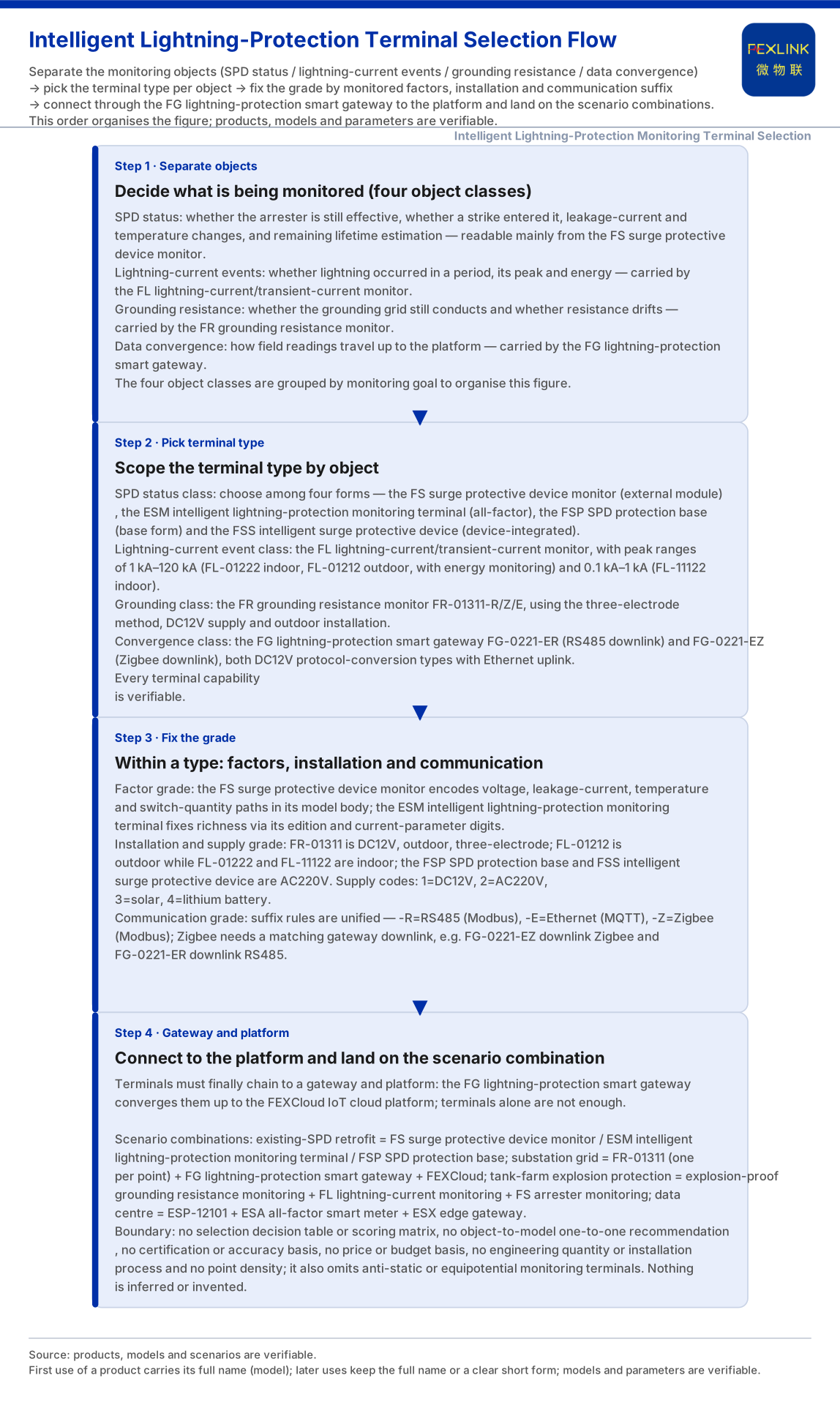
Choosing an intelligent lightning-protection monitoring terminal should not start with the model table. A more reliable first step is to classify the object to be monitored: SPD (surge protective device) status, lightning-current events, grounding resistance, or the gateway that aggregates data to the platform. The knowledge base gives four selectable terminal forms. The FS surge protective device monitor (e.g., FS-00011-R), ESM intelligent lightning-protection monitoring terminal (e.g., ESM-11312-R), FSS intelligent surge protective device (e.g., FSS-24100) and FSP SPD lightning-protection base (e.g., FSP-21100-R) belong to SPD-status monitoring; the FL lightning current / transient current monitor (e.g., FL-01212-R) covers lightning-current events; the FR grounding resistance monitor (FR-01311) covers grounding; the FG lightning-protection smart gateway (FG-0221-ER) covers aggregation. Once object and type are fixed, set the grade by model rule, monitored elements, installation environment and communication suffix, then land the combination with the scenario table.
1. Classify the Object First
The first question is not "which is cheaper" but "what must be seen". Monitoring objects fall into four classes.
SPD status: is the surge protector still effective, did a strike reach it, are leakage and temperature changing, how much lifetime remains. These quantities centre on the FS surge protective device monitor, covering remote signalling, air-switch status, grounding status, strike count, leakage current, temperature, voltage and lifetime estimation.
Lightning-current events: did a strike occur, how large was the peak, was there energy. The receiving terminal is the FL lightning current / transient current monitor.
Grounding resistance: is the grid still conducting, has the value drifted. The receiving terminal is the FR grounding resistance monitor.
Aggregation: how readings travel from site to platform. The receiving device is the FG lightning-protection smart gateway.
The knowledge base gives no unified definition for the "intelligent lightning-protection monitoring terminal". Its value is turning "choosing a terminal" into "match first, compare parameters second".
2. Choose the Terminal Type by Object
Once the object is fixed, the type largely converges.
For SPD status, choose among four forms: the FS monitor is an external arrester-monitoring module; the ESM terminal (SPD monitor) is full-element; the FSP base builds monitoring into a base; the FSS device integrates monitoring with the protective device. They share an object but differ in form, developed in section 3.
For lightning-current events, choose the FL monitor; its peak ranges split into 1 kA~120 kA (FL-01222 indoor, FL-01212 outdoor, with energy monitoring) and 0.1 kA~1 kA (FL-11122 indoor). The range decides whether it captures strong strikes or small transients — the first number to check.
For grounding, choose FR-01311-R/Z/E, three-electrode, DC12V, outdoor. For aggregation, choose the FG gateway; FG-0221-ER and FG-0221-EZ are DC12V protocol converters with RS485 and Zigbee downlink respectively and Ethernet uplink.
3. Within SPD Status, How Do the Four Forms Differ?
All four target SPD status; their differences matter.
The FS monitor is modular, distinguishing models by channel configuration. Its model rule is FS – [voltage channels][leakage channels][temperature channels][digital inputs][grounding/strike] – [communication]; examples run from FS-00011-R/Z/E (remote signalling, air-switch status, grounding status, strike counting) to FS-03211 adding leakage and temperature channels, to FS-33211 adding voltage channels and lifetime estimation. Key parameters: leakage 50.0~1200.0 μA (±10 μA), voltage 0~400.0 V (±0.1 V), temperature -20~100 °C (±1 °C), strike count 0~9999 (minimum trigger 0.1 kA), lifetime estimation 0~100%.
The ESM terminal is full-element; its model rule is ESM – [power][display][phases][current parameter][version] – [communication], version 1 being the basic edition and 2 the flagship. Its supply can be DC5V or AC220V, a difference not given for FS. Models include ESM-21001-R, ESM-11112-R, ESM-11312-R, ESM-21112-R, ESM-21312-R; elements cover digital inputs, grounding status, strike count, leakage, temperature, voltage, humidity and lifetime estimation.
The FSP base has few fixed elements: one remote-signalling input and one strike count; FSP-21000-R (no temperature) and FSP-21100-R (one temperature channel); AC220V, digital display, RS485.
The FSS device integrates device and monitoring; its model rule is FSS – [phases][varistor grade][leakage][reserved][reserved] – [communication], phases 1 = 2P and 2 = 4P, varistor grade Imax 20 kA to 80 kA, leakage 0 = none and 1 = full current. The series is AC220V, In/Imax 10 kA/20 kA to 40 kA/80 kA, Up 1.5 kV to 2.2 kV; leakage channels are one for 2P and three for 4P, with digital or OLED display.
Reminder: these differences are stated only from listed elements and parameters; the knowledge base gives no rule for "legacy retrofit vs new build".
4. Within a Type: Elements, Installation and Communication
After fixing the type, set the grade within it.
Element grade: for FS, voltage, leakage, temperature and digital-input channels are coded into the model body; for ESM, the version and current-parameter digits decide element richness. The third ESM digit is "phases", but the knowledge base gives no value table, so model digits cannot be wired one-to-one to the element columns (treated here as not expanded).
Installation and supply: FR-01311 is DC12V, outdoor, three-electrode; FL-01212 is outdoor, FL-01222 and FL-11122 indoor; FSP and FSS are AC220V. Supply codes: 1 = DC12V, 2 = AC220V, 3 = solar, 4 = lithium battery.
Communication: the suffix rule is unified — -R = RS485 (Modbus), -E = Ethernet (MQTT), -Z = Zigbee (Modbus). Zigbee needs matching gateway downlink, e.g. FG-0221-EZ downlinks Zigbee and FG-0221-ER downlinks RS485.
5. Landing the Combination with the Scenario Table
After choosing terminals, a project still needs a combination. The table can be used directly: legacy SPD retrofit recommends the FS monitor, ESM full-element SPD monitoring and the FSP base; substation / traction-substation grounding-grid online monitoring recommends FR-01311 (one per point) + FG gateway + FEXCloud; oil-tank farm / petrochemical explosion-proof protection recommends explosion-proof grounding monitoring (Ex d IIB) + FL lightning-current monitoring + FS arrester monitoring; data-centre neutral-to-ground voltage / distribution monitoring recommends ESP-12101 + ESA all-parameter smart meter + ESX edge gateway.
Two rules emerge: one scenario usually needs more than one terminal class, and terminals must chain with gateway and platform.
6. A Reusable Selection Order and Its Boundaries
The order: first fix the object (SPD status / lightning-current event / grounding resistance / aggregation); second bound the type by object (FS/ESM/FSP/FSS, FL, FR, FG); third set the grade by elements, installation and communication suffix; fourth connect through the FG gateway and land with the combinations.
Boundaries: the knowledge base gives no decision table or scoring matrix, no one-to-one object-to-model recommendation, no certification or accuracy basis, no price or budget basis, no quantities or workmanship, and no point density; it also omits anti-static or equipotential status monitoring terminals.
Conclusion
Choosing an intelligent lightning-protection monitoring terminal is not about comparing models first but about classifying objects first: SPD status, lightning-current events, grounding resistance and aggregation. For SPD status, choose by form among the FS monitor, ESM terminal, FSP base and FSS device; for lightning-current events, by the FL peak range; for grounding, by FR-01311's installation and measurement method; for aggregation, by the FG uplink/downlink interfaces. Then grade by elements, installation and communication suffix and land with the combinations.