 FEXLINK Research Institute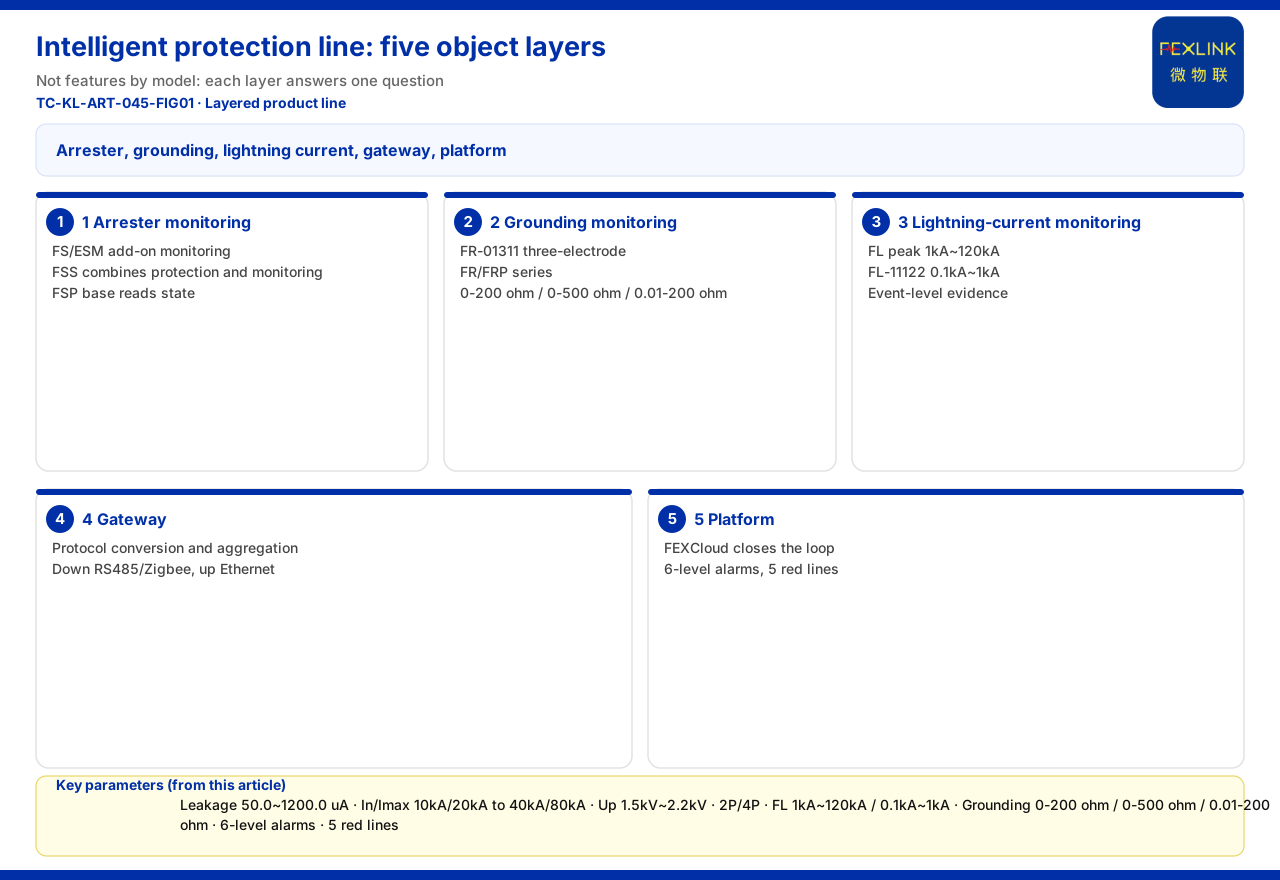
An intelligent lightning-protection product line is easily reduced to a list of surge protective devices with communications, or treated as complete once a module is added to a conventional arrester. This article takes a different view: rather than stacking features by device model, organise the line by five object layers — arrester monitoring, grounding monitoring, lightning-current monitoring, gateway and platform — so each layer answers one field question, and the hand-offs between categories form the product-family logic. Products, models, parameters and platform capabilities below are limited to the knowledge base entries.
Why Not Start from a "Device List"
A device list tends to produce three distortions. First, it treats "does it have a communications interface?" as the test of intelligence, ignoring what travels behind the interface. Second, it quotes single-point products while overlooking the gateway and platform, which must appear as a set. Third, models multiply while nobody can say which field question each answers.
The product-line panorama in the knowledge base defines the mainline scope: the FS surge protective device monitor, ESM intelligent lightning-protection monitoring terminal (SPD monitor), FSS intelligent surge protective device, FSP SPD lightning-protection base, FR grounding resistance monitor, FL lightning-current / transient-current monitor and FG lightning-protection intelligent gateway. This list is the skeleton for layered planning.
The Five-Layer Planning Framework: One Field Question per Layer
Layer 1: Arrester Monitoring — What State Is the Device In?
This layer maps to four families — FS, ESM, FSS and FSP — with different roles.
The FS surge protective device monitor is an arrester monitoring module. The knowledge base lists monitoring elements covering remote signalling, air-switch status, grounding status, lightning-strike count, leakage current, temperature, voltage and lifetime estimation; key parameters are leakage current 50.0~1200.0 μA (±10 μA), voltage 0~400.0 V (±0.1 V), temperature -20~100 °C (±1 °C), lightning-strike count 0~9999 (minimum trigger 0.1 kA) and lifetime estimation 0~100%.
The ESM terminal is positioned as a full-element SPD monitoring terminal. The knowledge base states its elements include humidity, with DC5V or AC220V supply; it covers more than FS and suits points needing a complete state profile.
The FSS intelligent surge protective device combines protection and monitoring in one device. The knowledge base gives In/Imax from 10 kA/20 kA to 40 kA/80 kA, Up covering 1.5 kV to 2.2 kV, 2P/4P, leakage-current versions with one or three channels, and an AC220V series supporting RS485/Zigbee/Ethernet suffixes.
The FSP SPD lightning-protection base provides base-side remote signalling and lightning-strike counting. The knowledge base lists FSP-21000-R and FSP-21100-R, both AC220V with RS485, the latter adding one temperature channel.
The Layer 1 question becomes: new points can use FSS to combine protection and monitoring.
Layer 2: Grounding Monitoring — Is the Path Reliable?
Grounding is the safety bottom line. The knowledge base describes the FR grounding resistance monitor's FR-01311 as using the three-electrode method, DC12V, outdoor installation, RS485/Zigbee/Ethernet, in a 204×202×72 mm aluminium enclosure. It also notes FR/FRP applications in railway traction substation grounding-grid monitoring and the Jinzhou Port tank farm; an internal reference. The knowledge base gives system-level reference parameters such as 0-200 Ω (±1%), 0-500 Ω (±0.5%) and an explosion-proof 0.01-200 Ω type.
Grounding monitoring is not a one-off test report but a long-term state variable.
Layer 3: Lightning-Current Monitoring — What Strike Event Occurred?
A strike is transient; only an event record supports review. The knowledge base lists three FL models: FL-01222 (indoor) and FL-01212 (outdoor) at 1 kA~120 kA with energy monitoring, and FL-11122 (indoor) at 0.1 kA~1 kA; all AC220V.
Layer 4: Gateway — How Do Dispersed Points Reach the Cloud Reliably?
The gateway handles aggregation and protocol adaptation. The knowledge base describes the FG lightning-protection intelligent gateway as transparent-transmission or protocol-conversion types; FG-0221-ER and FG-0221-EZ support RS485 or Zigbee downlink, Ethernet uplink and DC12V supply. The protocol matrix maps device downlink to Modbus RTU/Zigbee/LoRa, uplink to Modbus TCP/MQTT, with an optional gateway-level IEC 61850.
Layer 5: Platform — How Does State Become Judgement and Action?
The platform closes the line. The knowledge base defines a four-layer architecture of perception, edge, platform and application; the platform layer is FEXCloud, and the application layer provides visualisation, alarms, reports and mobile inspection. On diagnosis, records the Qianzhi engine's six-level alarm scheme (normal / attention / YJ1 / YJ2 / BJ1 / BJ2) and five non-bypassable red lines, (abnormal grounding open circuit) being based on GB 50057. The platform layer decides whether the line delivers "judgement" and not just "data".
Two Hand-Off Relationships Between Product Families
First, the vertical hand-off inside the mainline: Layer 1's arrester state, Layer 2's grounding state and Layer 3's lightning-current events are aggregated through the Layer 4 gateway and judged by the Layer 5 platform. Remove one layer and the data path breaks there.
Second, the horizontal relation between the mainline and its supporting arresters. The knowledge base lists "arresters (outsourced supporting, YSE series)" separately as Class E, distinct from the Class A mainline. The knowledge base covers power-supply arresters (DM series), Class D power arresters, signal/network arresters, lightning counters and a three-element SPD monitor (count + air-switch status + SPD status, RS485), noting outsourced production and cost-reference prices. The mainline handles "sensing and diagnosis", the supporting arresters "the protection body".
Where It Lands: Calibrating Coverage with the Selection Matrix
Completeness can be checked against the selection matrix. For "arrester condition monitoring (retrofit of existing SPDs)" the recommendation is FS monitor / ESM full-element SPD monitoring / FSP base. For "substation and traction substation grounding-grid online monitoring" it is FR-01311 (one set per point) + FG gateway + FEXCloud. For "tank farms / petrochemical lightning and explosion protection" it is explosion-proof grounding monitoring (Ex d IIB) + FL lightning-current monitoring + FS arrester monitoring. In typical scenarios the five layers need not all appear; they are trimmed to scenario risk and point conditions.
A Phased Roadmap
Phase one: cover arrester state and basic alarms at critical points with FS/ESM/FSP, making an invisible state visible. Phase two: add leakage current, temperature and the FG gateway, moving from "discover after failure" to "degradation trend visible". Phase three: introduce FR grounding and FL lightning-current monitoring, then use FEXCloud alarm grading and reports to make the state continuous O&M content. Phasing and priorities must be confirmed against project conditions.
Boundaries and Limitations: What This Article Does Not Claim
Second, no pricing, return on investment (ROI), market share or effect commitment is provided; supporting-arrester prices are cost references, not an external quotation basis.
Third, no model, parameter, certification or case absent from the knowledge base is claimed; the FR/FRP application notes are internal records, cited only as a source note, not as performance evidence.
Fourth, all parameters are limited to the corresponding knowledge base entries with no extrapolation.
Conclusion
Planning an intelligent lightning-protection product line is not mainly about adding communications modules to more arresters, but about layering by object: arrester monitoring (FS/ESM/FSS/FSP) answers "device state", grounding monitoring (FR/FRP) answers "is the path reliable", lightning-current monitoring (FL) answers "what event occurred", the gateway (FG) answers "how data reaches the cloud reliably", and the platform (FEXCloud) answers "how state becomes judgement and action". Clarify the relation with the supporting YSE arresters, and the line becomes a system that can be covered, trimmed and delivered continuously. Product facts are limited to the knowledge base.