 FEXLINK Research Institute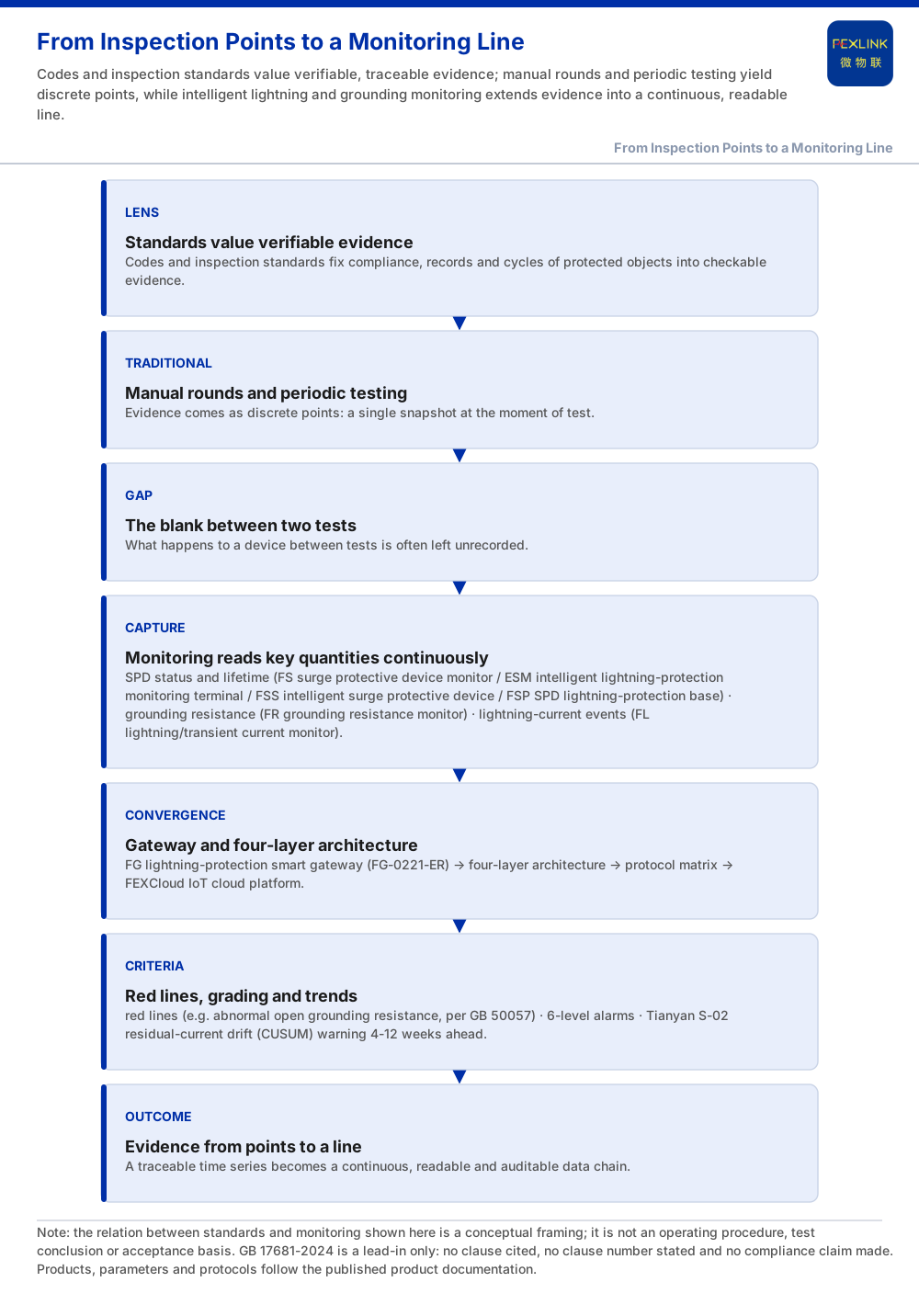
One-line answer: for standards and inspection-type codes such as GB 17681-2024, the real suggestion for intelligent lightning protection and grounding monitoring is not more devices, but that compliance rests on verifiable, traceable evidence. Intelligent monitoring turns evidence that once came only from manual inspection and periodic testing into a continuous, readable, traceable data record.
1. Standards Care About an Evidence Chain, Not Just Whether Something Is Installed
Standards and inspection-type codes share a trait: they fix the conformity, records and period of the protected object into checkable evidence. Traditionally that evidence comes from manual inspection and periodic testing — discrete points. A test captures a snapshot; what happened to the protective device between two tests is usually a blank in the record.
Intelligent monitoring fills that gap by reading the protection path's key quantities continuously, turning evidence from a point into a line.
2. Protection-Status Evidence Intelligent Lightning Protection Can Carry
The knowledge base's intelligent lightning-protection line gives a concrete bridge from protective devices to readable status.
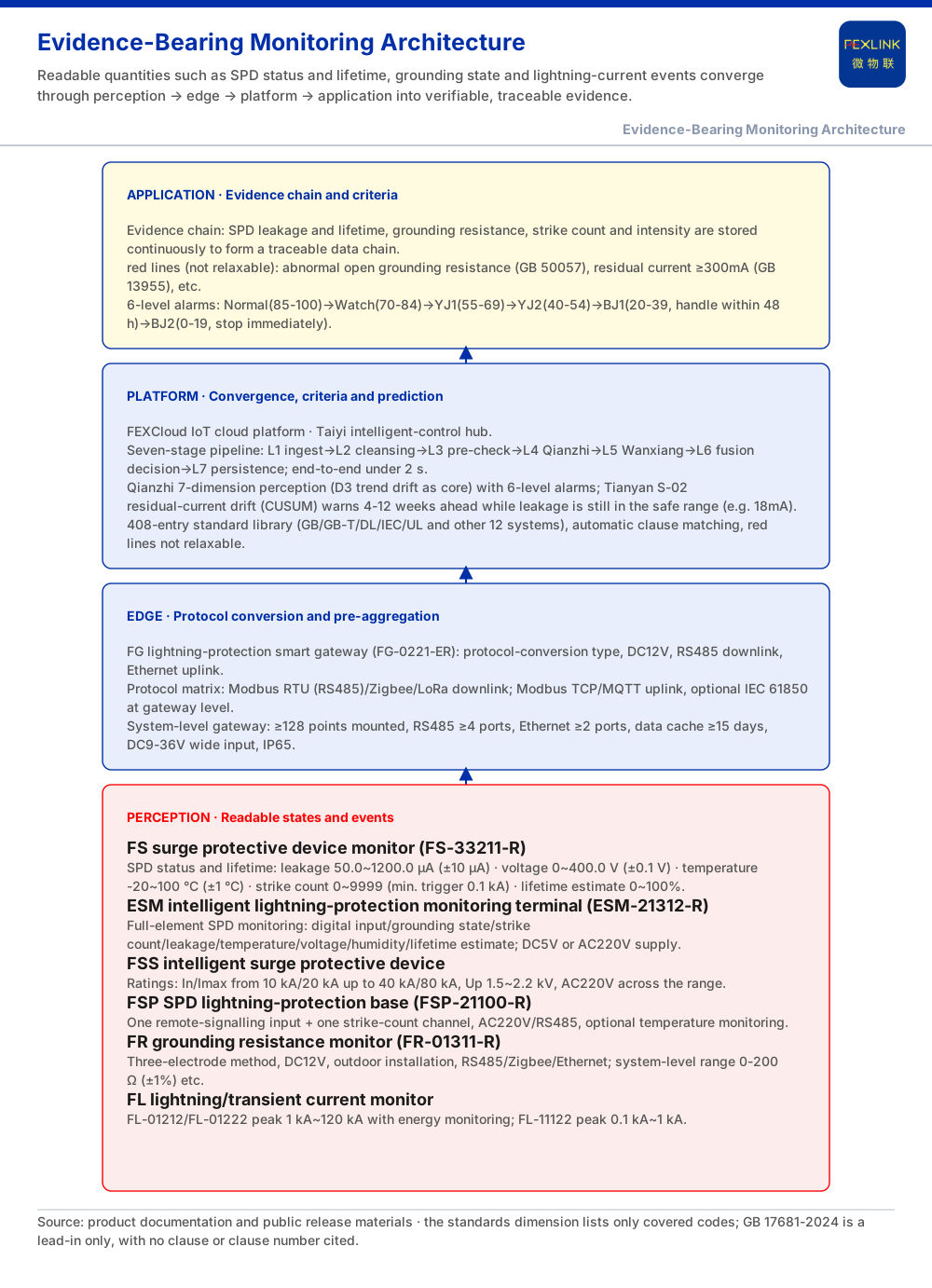
SPD status and lifetime: the FS surge protective device monitor (for example FS-33211-R) covers remote signalling, air-switch status, grounding status, lightning-strike count, leakage current, temperature, voltage and lifetime estimation, with key parameters of leakage current 50.0–1200.0 μA (±10 μA), voltage 0–400.0 V (±0.1 V), temperature -20–100 °C (±1 °C), lightning-strike count 0–9999 (minimum trigger 0.1 kA) and lifetime estimation 0–100%. The ESM intelligent lightning-protection monitoring terminal (SPD monitor, for example ESM-21312-R) is all-element: switching quantities, grounding status, lightning-strike count, leakage current, temperature, voltage, humidity and lifetime estimation. The FSS intelligent surge protective device offers In/Imax grades from 10 kA/20 kA to 40 kA/80 kA and Up of 1.5–2.2 kV, and the FSP SPD lightning-protection base (FSP-21100-R) provides a remote-signalling input and lightning-strike counting, with optional temperature monitoring.
Lightning-current events: among FL lightning-current/transient-current monitors, FL-01212 (outdoor) and FL-01222 (indoor) cover 1 kA–120 kA and support energy monitoring, while FL-11122 (indoor) covers 0.1 kA–1 kA — answering "how strong was this strike", not merely "did one happen". The FG lightning-protection gateway (FG-0221-ER) is a protocol-conversion type, DC12V powered, with RS485 downlink and Ethernet uplink, bringing these readings onto a single link.
3. Status Evidence Grounding Monitoring Can Carry
The FR grounding resistance monitor (FR-01311-R) uses the three-electrode method, is DC12V powered and installed outdoors, with RS485/Zigbee/Ethernet communication, turning grounding status that once waited for manual measurement into an online quantity. At system level, grounding monitoring units cover 0-200 Ω (standard, ±1%), 0-500 Ω (high-precision, ±0.5%) and 0.01-200 Ω explosion-proof (±2%), with IP65 protection and -20–70 °C operation; the smart gateway carries ≥128 points, ≥4 RS485 ports, ≥2 Ethernet ports and ≥15 days of data caching.
The distinction to keep: this article asks how grounding status is continuously recorded, not why grounding cannot rely on a single annual test — the latter is the territory of adjacent article (see "Boundaries").
4. From Records to Criteria: Red Lines, Grading and Trends
Readable data still needs a path and criteria. The knowledge base defines the monitoring system as a four-layer architecture — perception, edge, platform, application — where perception-layer data is uploaded via edge gateways to the FEXCloud IoT cloud platform and rendered as visualisation, alarms and reports. The protocol matrix gives device downlink as Modbus RTU (RS485)/Zigbee/LoRa and uplink as Modbus TCP/MQTT, with optional gateway-level IEC 61850.
There are two layers of criteria. The first is the safety red line that cannot be bypassed:, is abnormal grounding-resistance open circuit (per GB 50057), residual current ≥300 mA (GB 13955), three-phase voltage imbalance >15% (GB/T 15543), line temperature ≥110 °C (GB 16895), insulation resistance <0.5 MΩ (GB/T 16895); no one may raise the thresholds. The second is grading and trend: the six-level alarm system runs Normal (85-100), Watch (70-84), YJ1 (55-69), YJ2 (40-54), BJ1 (20-39, handle within 48 h) and BJ2 (0-19, stop immediately), each alarm carrying a standard-clause citation. The seven-dimensional perception matrix centres on D3 trend drift and outputs a 0–100 time-series risk score at D7. The Tianyan engine's S-02 residual-current trend drift (CUSUM) detects a weak mean shift while leakage is still safe (for example 18 mA) and warns 4–12 weeks earlier. The Taiyi control hub's seven-stage pipeline (L1 ingest → L2 cleaning → L3 red-line pre-check → L4 Qianzhi analysis → L5 Wanxiang assessment → L6 fusion decision → L7 persistence) runs end-to-end in under 2 seconds, and an L3 red-line trigger emits the top alarm directly.
Notably, records that the standards service embeds a 408-standard library (GB/GB-T/DL/IEC/UL and 12 systems) with automatic clause matching and non-relaxable red lines. On the platform side a standard is therefore a rule source that can take part in judgement, consistent with this article's "standards suggest monitoring" frame.
5. What This Means for Engineering and Records
The knowledge base lists "lightning-protection device condition monitoring (retrofit of existing SPDs)" as a standalone combination: FS surge protective device monitor / ESM intelligent lightning-protection monitoring terminal / FSP SPD lightning-protection base. The upgrade can add a monitoring layer on top of an existing protection system; machine rooms can reference the "data-centre zero-earth voltage / power-distribution monitoring" combination (ESP-12101 + ESA all-element smart meter + ESX edge gateway), and grounding grids FR-01311 + FG gateway + FEXCloud IoT cloud platform.
For records, the direct output is a time series: SPD leakage current and lifetime estimation, grounding resistance, strike count and intensity, and alarm and response records are stored continuously, extending the evidence chain from a single test report into a traceable data chain. The knowledge base gives only the scenario-to-product mapping and no retrofit procedure, construction sequence or quantity basis.
6. Boundaries: What This Article Does Not Claim
First, GB 17681-2024 is not in the knowledge base. This article cites no clause, infers no scope and makes no "meets/passes that standard" statement; the knowledge base lists GB 50057, GB 13955, GB/T 15543, GB 16895, GB/T 16895, GB/T 12325 and GB/T 14549 with the 408-standard library.
Third, on differentiation: this article does not repeat the blind-spot argument on periodic grounding testing or the SPD-after-installation discussion; its focus is what intelligent monitoring can provide from a standards/evidence perspective, spanning SPDs and grounding.
Fourth, the quantitative indicators in the knowledge base (electrical-hazard identification rate 95%+, alarm compression ratio 80%, warning lead time 4–12 weeks, MTTR reduced 60%, energy-saving potential 8–20%) are vendor statements, citable only as vendor capability claims, not as effect guarantees or procurement grounds.
Conclusion
The suggestion GB 17681-2024 carries for intelligent lightning protection and grounding monitoring comes down to one line: standards and inspection-type codes value verifiable, traceable evidence, and intelligent monitoring extends that evidence from the discrete points of periodic testing into a continuously readable line. The carrying capabilities are verifiable — FS, ESM, FSS and FSP for SPD status and lifetime, FL for lightning-current events and FR for grounding, converged through FG and the four-layer architecture and protocol matrix, with red lines and six-level alarms holding the floor and S-02 moving the warning earlier, landing through the "lightning-protection device condition monitoring (retrofit of existing SPDs)" combination. The standard's specific clauses are not claimed here.