 FEXLINK Research Institute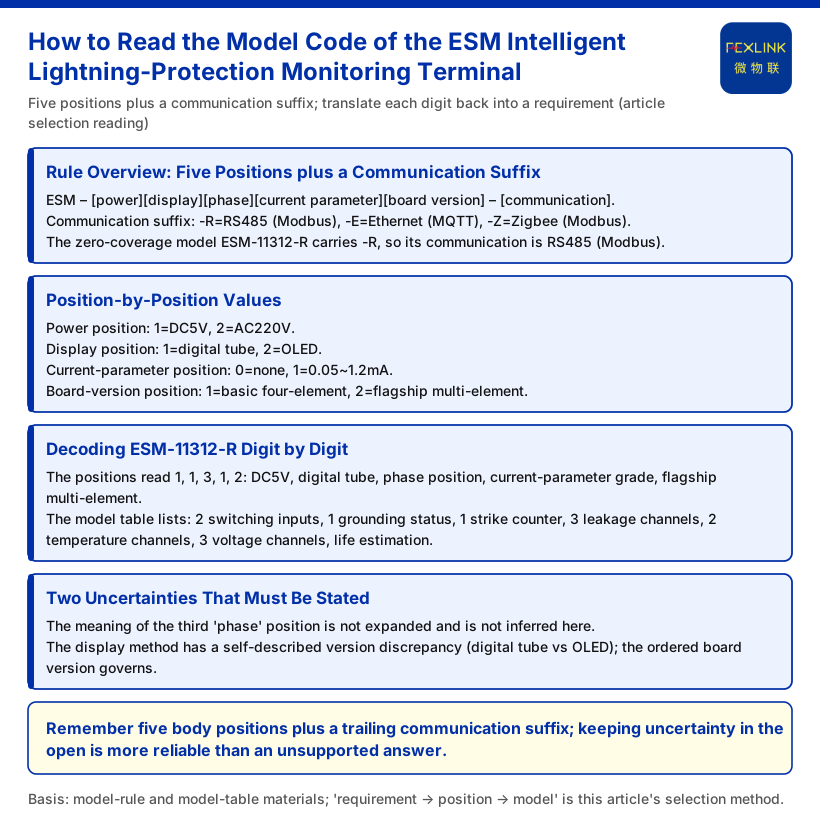
The ESM intelligent lightning-protection monitoring terminal (SPD monitor) uses a model code that is not a random serial number but a selection string encoded in fixed digit positions. The knowledge base gives the rule as ESM – [power][display][phase][current parameter][board version] – [communication]: five positions followed by a communication suffix. For the zero-coverage model ESM-11312-R the positions read 1, 1, 3, 1, 2, giving DC5V supply, digital-tube display, the phase position, a current-parameter grade and the flagship multi-element board version, with suffix -R meaning RS485 (Modbus). The correct reading is not to rank the serial by size but to translate each digit back into a requirement. The third "phase" position is not expanded by the knowledge base, and the display method carries a version discrepancy the knowledge base itself describes. Both are treated here as uncertain.
Rule Overview: Five Positions plus a Communication Suffix
The knowledge base writes the rule as ESM – [power][display][phase][current parameter][board version] – [communication]. It divides into a model body and a communication suffix. The body is five adjacent positions answering five selection questions from left to right: AC or DC supply, which display device, how many phases, whether a current-parameter grade is present, and basic or flagship version. The suffix reuses the knowledge base's common communication codes.
The suffix maps in the general suffix table: -R = RS485 (Modbus), -E = Ethernet (MQTT), -Z = Zigbee (Modbus). ESM-11312-R carries -R, so its communication interface is RS485 (Modbus) and it can join a Modbus-centric bus or gateway scheme directly. Separating model string, position meaning and communication suffix is the precondition for reading any ESM model.
Position-by-Position Values: Power, Display, Current Parameter, Board Version
The knowledge base defines four positions explicitly:
- Power: 1 = DC5V, 2 = AC220V. The same pair reappears (power 1: DC5V; 2: AC220V).
- Display: 1 = digital tube, 2 = OLED. The knowledge base gives the synonymous 1: digital tube (G), 2: OLED screen (O).
- Current parameter: 0 = none, 1 = 0.05–1.2 mA; the position only distinguishes "without" from "with the 0.05–1.2 mA grade".
- Board version: 1 = basic four-element version, 2 = flagship multi-element version, determining how rich the element set is.
The third position, "phase", deserves separate mention: the rule reserves a slot, but the knowledge base gives no value table for it. This article accepts only the structural fact that it is the phase position, does not infer how many phases 3 represents, and does not link it to the leakage-current or voltage channel counts. Where the knowledge base is silent, leaving a blank is better than filling it in.
Decoding ESM-11312-R Digit by Digit
Splitting ESM-11312-R gives 1, 1, 3, 1, 2, each checked against the table:
- Position 1 = 1: power DC5V;
- Position 2 = 1: display digital tube;
- Position 3 = 3: phase position, value to be confirmed;
- Position 4 = 1: current-parameter grade 0.05–1.2 mA;
- Position 5 = 2: flagship multi-element version;
- Suffix -R: RS485 (Modbus).
Only then should the reader consult the element row in the model table. The ESM-11312-R row reads: supply DC5V, display digital tube, digital inputs 2, grounding status 1, lightning-strike count 1, leakage current 3 channels, temperature 2 channels, voltage 3 channels, humidity none, lifetime estimation present. A caution: the table's "leakage current 3 channels, voltage 3 channels" are element facts; whether they share a numerical origin with the third "phase" position is not explained, and this article draws no such link. Stating the certain meaning of a position separately from the table's verifiable facts is what a reader is owed.
Where the Flagship Multi-Element Version Differs
The board-version position is the difference between 1 and 2. Two models share the same suffix and display: ESM-11112-R (positions 1, 1, 1, 1, 2) lists leakage current 1 channel, temperature 2 channels, voltage 1 channel and lifetime estimation; ESM-11312-R (positions 1, 1, 3, 1, 2) lists leakage current 3 channels, temperature 2 channels, voltage 3 channels and lifetime estimation. Both share board version 2; the difference appears in the third position and the channel counts. ESM-21001-R (positions 2, 1, 0, 0, 1) has power AC220V, current-parameter 0 (none) and board version 1 (basic four-element) — demonstrating how to read "current-parameter 0 = none" and "board version 1 = basic".
Selection can thus be read in two steps: fix the hard constraints such as supply and display, then judge which board version and current-parameter grade are needed. The table already lists each model's digital inputs, grounding status, lightning-strike count, leakage current, temperature, voltage and lifetime estimation, so once the position combination is fixed the reader can compare element coverage item by item.
Two Uncertainties That Must Be Stated: Display Method and the Phase Position
The first uncertainty is the display method. A note in the knowledge base records that in the 2025 selection manual ESM-21112/21312 are shown as OLED, whereas the model-rule document labels the same models as digital tube; the two are inconsistent, and the actual order version governs. This article does not draw a single conclusion about their display device and advises deferring to the specification of the ordered version. This explains why the display position reads 1 (digital tube) while a delivered version's table note may say OLED — a discrepancy the knowledge base itself declared, not something this article can adjudicate.
The second uncertainty is the third "phase" position: the rule gives it a name but no value table. This article therefore does not write "3 means three phases" nor "the third position equals the leakage-current or voltage channel count". Both are common extrapolations without knowledge-base support, and this article excludes them from its conclusions.
How to Read Requirement-Based Selection and Scenario Connections
On top of the knowledge-base facts, this article offers a reading for organising selection: first translate the monitoring elements a project needs into a combination of position values, then match that combination to a model, rather than picking a row by serial number or price.
On the scenario side, the mapping recommends, for "lightning-protection device condition monitoring (retrofit of existing SPDs)", the FS surge protective device monitor, ESM full-element SPD monitoring and the FSP lightning-protection base. ESM is thus one of the monitoring terminals in a retrofit scheme rather than an isolated selection item. Where naming is involved, the terminology locked in the knowledge base should be used consistently, for example ESM = intelligent lightning-protection monitoring terminal (SPD monitor) and FS = surge protective device monitor.
What This Article Does Not Claim
Second, this article does not infer the value of the third "phase" position, nor assert a digit-by-digit correspondence between model positions and the table's element columns.
Third, it does not decide between OLED and digital tube for ESM-21112/21312, only restating the knowledge base's version discrepancy and deferring to the ordered version.
Fourth, it claims no model, parameter, certification, accuracy or case absent from the knowledge base; listed parameters are limited to the corresponding entries, with no extrapolation.
Conclusion
To read an ESM model, remember the body is five positions and the end is a communication suffix. Four positions are already given: power 1/2 for DC5V/AC220V, display 1/2 for digital tube/OLED, current parameter 0/1 for none/0.05–1.2 mA, board version 1/2 for basic four-element/flagship multi-element. On that basis ESM-11312-R reads as DC5V, digital tube, current-parameter grade, flagship multi-element version and RS485 (Modbus), while the table separately lists digital inputs 2, grounding 1, lightning strikes 1, leakage current 3 channels, temperature 2 channels, voltage 3 channels and lifetime estimation. As for the third "phase" position and the display-method discrepancy, the knowledge base has not supplied a defensible position, and this article marks them as to be confirmed. Keeping uncertainty visible is more reliable than an answer that looks complete but has no basis.