 FEXLINK Research Institute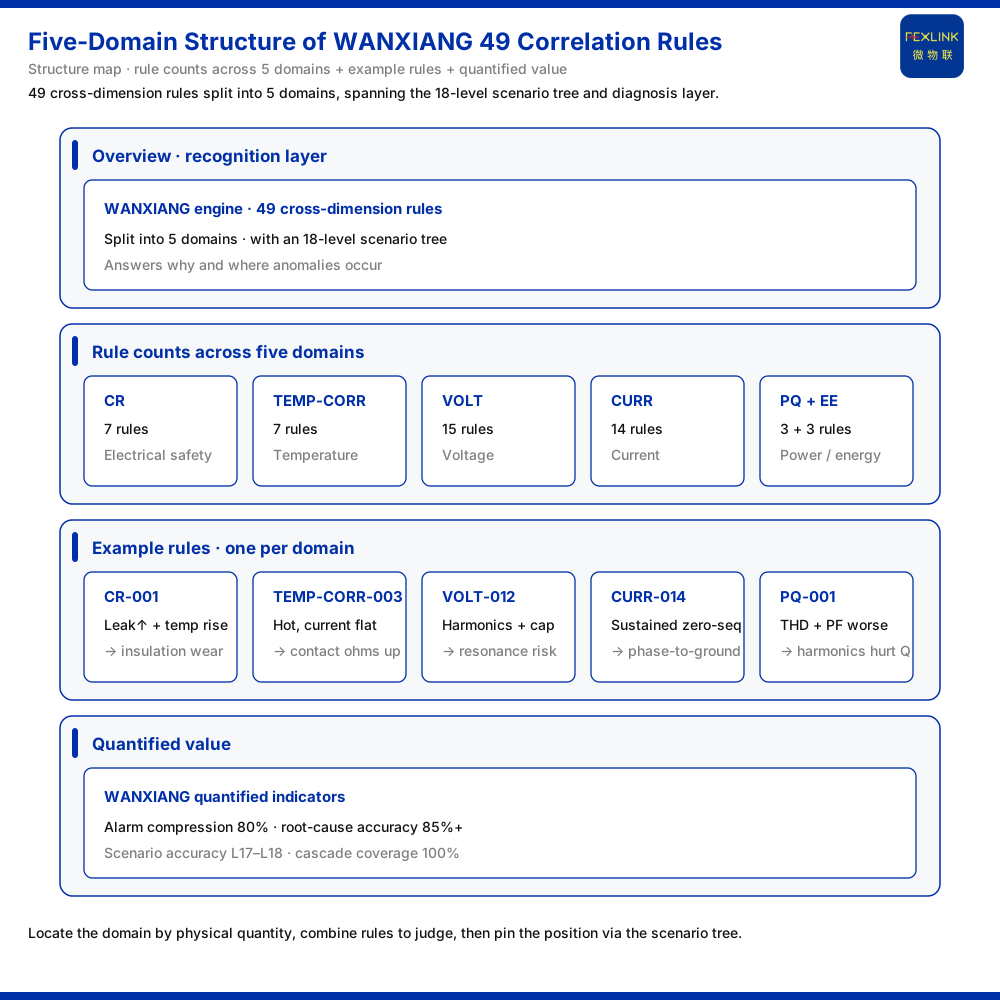
Direct answer
The Wanxiang engine of the product knowledge base contains 49 cross-dimension correlation rules, divided into five domains: the CR series, the TEMP-CORR series, the VOLT series, the CURR series, and the PQ series plus the EE series. By count, the CR series has 7 rules, the TEMP-CORR series 7, the VOLT series 15, the CURR series 14, and the PQ series 3 plus the EE series 3, totalling 49. This rule set is positioned as the basis of the judgement layer of the Wanxiang engine, using an 18-level scenario tree plus the 49 correlation rules to answer why an anomaly occurs and where it is. The quantitative value the product knowledge base gives is 80% alarm compression, root-cause accuracy above 85%, scenario positioning down to L17 to L18, and 100% cascade-risk coverage. This article explains the counts and example rules domain by domain and marks the material boundary.
1. Overview of the five domains of the 49 rules
The 49 cross-dimension correlation rules of the Wanxiang engine are divided into five domains. The first four have clear themes: the CR series corresponds to electrical safety, the TEMP-CORR series to temperature correlation, the VOLT series to voltage, and the CURR series to current. The fifth domain places the PQ series and the EE series side by side, each with 3 rules.
Sorted by count, the VOLT series is the largest at 15 rules; next is the CURR series at 14; the CR and TEMP-CORR series have 7 each; and the PQ and EE series have 3 each. Adding these numbers gives exactly 49, which shows the domain split is complete in coverage. The split is not a random pile but a grouping by the physical quantity each rule depends on.
This grouping has a direct benefit: when an anomaly appears in the field, the search can first be narrowed to a domain by the physical quantity involved and then compared with the rules inside that domain. A voltage anomaly goes first to the VOLT series, a current anomaly to the CURR series, and a temperature anomaly to the TEMP-CORR series. The larger the domain, the more combination cases it covers and the richer the available paths in troubleshooting.
2. The CR series: 7 electrical-safety rules
The CR series has 7 rules, on the theme of electrical safety. The example the product knowledge base gives is CR-001: rising leakage plus abnormal temperature, pointing to overall insulation degradation.
The form of this rule is worth noting: it looks at signals from two different sources together rather than only one of them. A single anomaly in leakage or temperature does not necessarily indicate a problem; only when the two appear together does it point to overall degradation of insulation. This is precisely the meaning of cross-dimension correlation and the reason it can raise the accuracy of root-cause judgement.
3. The TEMP-CORR series: 7 temperature-correlation rules
The TEMP-CORR series has 7 rules, built around temperature. The example is TEMP-CORR-003: temperature rising while current is unchanged, pointing to increased contact resistance.
The basis of judgement in this rule is that current did not change yet temperature rose. If the temperature rise were caused by an increased load, the current should rise in step; when current is unchanged while temperature rises, a problem in the resistance of the contact link is more likely. The rule narrows the range by elimination, and comparing temperature with current is the premise on which it holds.
4. The VOLT series: 15 voltage-domain rules
The VOLT series has 15 rules, the largest of the five domains, focused on voltage-related anomalies. The example the product knowledge base gives is VOLT-012: harmonics on the high side plus reactive power compensation switched in, pointing to resonance risk.
This rule shows that looking at harmonics alone or at compensation alone may both be insufficient. When compensation switching and rising harmonics exist at the same time, resonance may occur. The rule binds the two conditions to capture this combination risk. Being the largest domain also shows that voltage-domain cases requiring combination judgement are relatively rich.
For a person doing diagnostic work, the size of the VOLT series is also a reminder: voltage-type anomalies have many causes and voltage value alone should not be the only thing examined. Harmonics, compensation and load changes can all manifest through voltage, and the rules organise these clues together to reduce trial and error.
5. The CURR series: 14 current-domain rules
The CURR series has 14 rules, focused on current-related anomalies. The example is CURR-014: persistent zero-sequence current, pointing to single-phase grounding tracing.
A persistent zero-sequence current is a signal worth taking seriously. The direction of the rule does not stop at there being zero-sequence current but continues to point toward tracing single-phase grounding. In other words, the CURR series not only describes a phenomenon but also gives the direction of the next investigation. This advance from phenomenon to direction is what distinguishes a correlation rule from an ordinary threshold alarm.
With 14 rules, the CURR series is close in scale to the VOLT series, which shows current-side combination cases are likewise not to be ignored. Current anomalies are often related to insulation, contact and grounding, and a single measured point is hard to characterise; several current features must be observed together, which is where the value of the rules lies.
6. The PQ and EE series: 3 each
The PQ series has 3 rules and the EE series 3, together forming the fifth domain. The example the product knowledge base gives is PQ-001: total harmonic distortion and power factor worsening together, pointing to harmonic interference with reactive power.
This rule links power quality with reactive power, showing the two are not independent accounts. When harmonics worsen, the power factor often falls in step, and the combination condition of the rule captures exactly this linkage. The EE series likewise has 3 rules and belongs to the energy-use and energy-efficiency direction. The two series being placed side by side as one domain also suggests that power quality and energy-use efficiency often need to be viewed together in practice.
7. The positioning and quantitative value behind the domains
Why divide the 49 rules into five domains? This relates to the positioning of the Wanxiang engine. The product knowledge base positions the Wanxiang engine as the judgement layer of the situational-awareness brain, responsible for answering why an anomaly occurs and where it is. Dividing by domain is to make the rules correspond to the physical quantities they cover, for easier matching and explanation.
The quantitative value the product knowledge base gives includes 80% alarm compression, root-cause accuracy above 85%, scenario positioning down to L17 to L18, and 100% cascade-risk coverage. These figures show the 49 rules are not a mere list but a capability supporting actual judgement. The domain split is the premise that lets this capability be organised and explained. Understanding the domain split also means understanding how the Wanxiang engine sifts the truly noteworthy problems out of a large number of alarms.
Read together, the value and the domains suggest a usage approach: when a problem appears, first locate the domain by physical quantity, then let the rules make a combination judgement, and finally use the 18-level scenario tree to reach a specific location. The rules find the association and the scenario tree determines the scenario; the two together form the complete judgement layer. For algorithm and diagnostic engineers, mastering this domain structure is the starting point for using the Wanxiang engine.
Scope and limitations
First, this article restates only what the product knowledge base lists; the factual boundary is limited to the records of the 49 cross-dimension correlation rules of the Wanxiang engine, their domains, and their quantitative value.
Second, the total count of 49 rules and the five-domain division are cited as listed in the product knowledge base; this article does not infer the content of unlisted rules within each domain.
Third, the counts of each series, CR 7, TEMP-CORR 7, VOLT 15, CURR 14, PQ 3 and EE 3, are cited as listed in the product knowledge base.
Fourth, example rules such as CR-001, TEMP-CORR-003, VOLT-012, CURR-014 and PQ-001 are cited as listed in the product knowledge base; this article does not extend the conditions under which these rules apply.
Fifth, the 80% alarm compression, root-cause accuracy above 85%, scenario positioning down to L17 to L18, and 100% cascade-risk coverage are cited as listed in the product knowledge base; this article does not extend these indicators into conclusions about other engines.
Sixth, this article explains only the domains and positioning of the rules and does not provide specific engineering correlation-rule configuration or threshold-setting schemes.