 FEXLINK Research Institute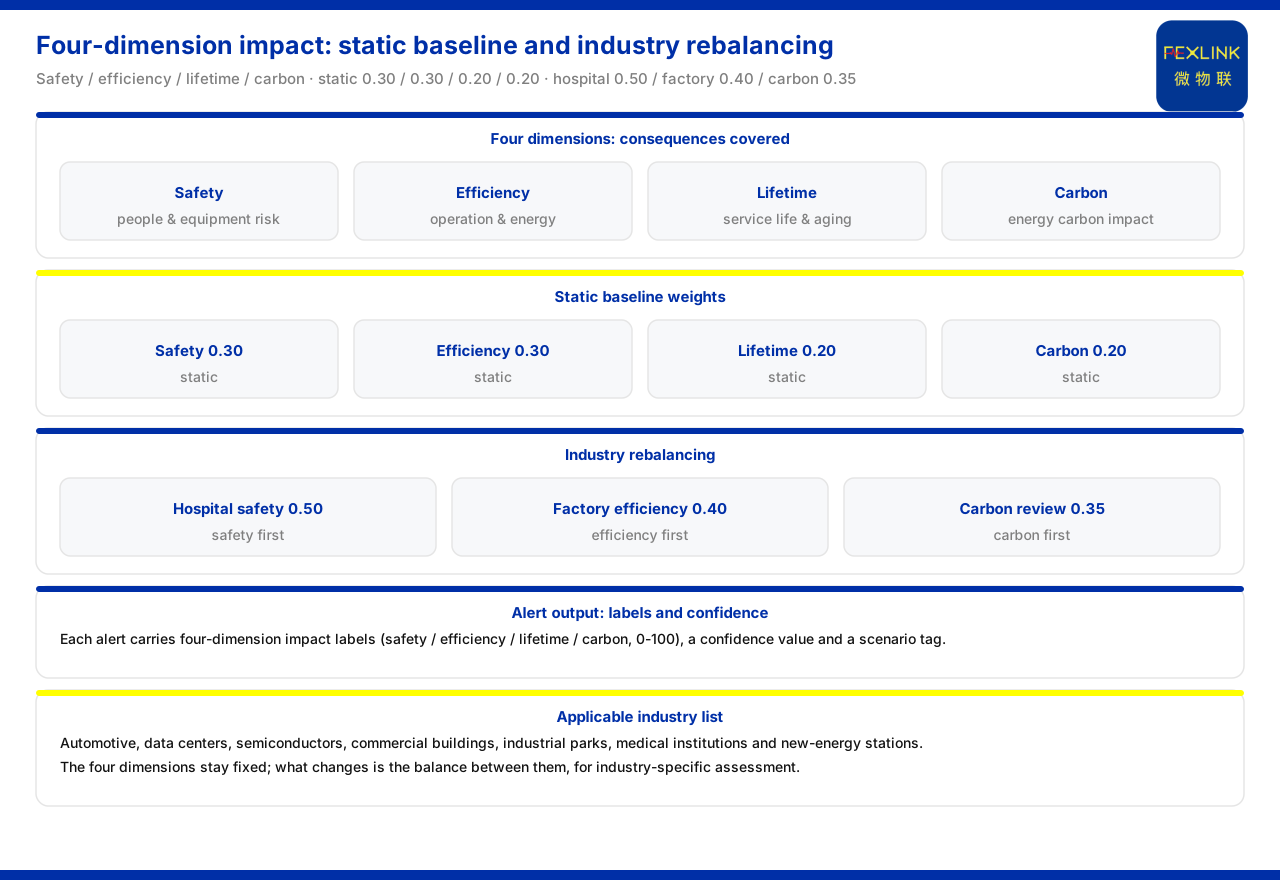
Direct answer
The four-dimension impact assessment of the Wanxiang engine is a framework that scores the impact of an electrical anomaly or a treatment action separately on the four dimensions of safety, efficiency, lifetime and carbon. Its base weights are 0.30 for safety, 0.30 for efficiency, 0.20 for lifetime and 0.20 for carbon, and it also allows adjustment by industry scenario: the hospital scenario raises the safety weight to 0.50, the factory scenario raises the efficiency weight to 0.40, and the carbon-assessment scenario raises the carbon weight to 0.35. That is, the four dimensions stay unchanged and what changes is the balance among them. The key to understanding this framework is to see first the fixed meaning of the four dimensions, then to understand why the dynamic weights can change by scenario, and finally to see how these scores enter the alarm output and serve industry-specific assessment.
1. The four dimensions of the four-dimension impact assessment
The four-dimension impact assessment in the product material contains four dimensions, safety, efficiency, lifetime and carbon. The four dimensions cover the main kinds of consequence of an electrical anomaly: safety corresponds to personal and equipment risk, efficiency to operation and energy-efficiency performance, lifetime to the usable years and ageing of equipment, and carbon to the carbon-emission impact of energy use. Assigning an anomaly to these four dimensions means the same event can be measured from different angles rather than expressed only by the single figure of "alarm or not". The value of listing the four side by side is that it gives each kind of consequence its own outlet, avoiding the use of one indicator to conceal the impact on the others.
2. Static base weights
The product material states that the base (static) weights of the four-dimension impact assessment are 0.30 for safety, 0.30 for efficiency, 0.20 for lifetime and 0.20 for carbon. These figures mean that, without industry-specific adjustment, safety and efficiency each take thirty percent while lifetime and carbon each take twenty percent. That safety and efficiency are tied at the highest weight shows that in the default state the framework values both risk and energy efficiency; that lifetime and carbon are set at twenty percent shows that, although these are important consequences, they are not the first balancing objects in the base reading. The static weights are the reference for understanding the dynamic weights: only by knowing the base can one see what a given scenario adjusts.
3. Dynamic weights: why they can be adjusted by industry
The several dynamic-weight examples given by the product material show that this framework is not fixed. A dynamic weight means reallocating the share of each dimension above the base weights according to industry or scenario. The reason such adjustment is allowed is that different industries have different sensitivity to the four kinds of consequence: some scenarios can least accept safety risk, some care most about energy efficiency, and some put carbon-emission assessment first. Giving the balancing authority to the scenario means that one set of assessment dimensions can fit different industries without having to build a separate indicator system for each. The three examples below correspond respectively to the three priority directions of safety, efficiency and carbon.
4. Hospital scenario: safety first
In the hospital-scenario dynamic-weight example of the product material, the safety weight is raised to 0.50. The direction of this adjustment is clear: in a scenario such as a hospital, which is highly sensitive to continuity of supply and personal safety, the safety dimension is given a higher share. Compared with the static base of 0.30, 0.50 means the weight of safety in the composite score rises markedly. Note that only the upward adjustment of safety is given here; how the other dimensions change accordingly is not developed within the range quoted by this article, so this article makes no inference about the specific values of the remaining dimensions.
5. Factory scenario: efficiency first
In the factory-scenario dynamic-weight example of the product material, the efficiency weight is raised to 0.40. Opposite to the hospital scenario, this adjustment places the emphasis on energy efficiency, suiting a scenario whose main management objective is equipment operating efficiency and energy consumption. Compared with the static base of 0.30, efficiency rising to 0.40 shows that in a factory context an improvement in energy-efficiency performance is valued more in the composite score. This example also shows that dynamic weights do not serve only risk preference; they can equally serve efficiency-oriented management objectives.
6. Carbon-assessment scenario: carbon first
In the carbon-assessment-scenario dynamic-weight example of the product material, the carbon weight is raised to 0.35. When the management objective turns to carbon-emission assessment, the share of the carbon dimension is raised, so that the same event or treatment action reflects carbon-emission impact more in the composite score. Taken together, the three examples, safety 0.50, efficiency 0.40 and carbon 0.35, represent three priority directions, and all of them are scenario-specific adjustments made on the basis of the static weights. This structure of "one set of dimensions, multiple balances" is why the framework can be used across industries.
7. How the four-dimension score enters the alarm
The four-dimension impact assessment does not stop at the assessment itself; it also enters the output stage. The six-level alarm system of the Qianzhi engine in the product material specifies that each alarm carries four-dimension impact tags, expressed on the four dimensions of safety, efficiency, lifetime and carbon on a scale of zero to one hundred, and also carries a confidence level and a scenario tag. That is, an alarm is not only "an anomaly occurred" but carries dimension-by-dimension scores, a degree of credibility and a statement of the scenario it is in. Putting the four-dimension score into the alarm lets the assessment result flow with the alarm, making it convenient to compare and dispose by dimension afterwards. This article makes no further inference about the scoring algorithm or the method of calculating the confidence level.
8. Relationship with the scenario-level assessment system
The four-dimension impact assessment in the product material sits under the scenario-level assessment system of the Wanxiang engine and, with location awareness and the scenario location tree, belongs to the scenario-based assessment mechanism. Location awareness involves five electrical topology position types, and the scenario location uses an eighteen-level scenario location tree. Understanding the four-dimension assessment under this system shows that it is not an isolated score but a link in the scenario-assessment chain: first locate the scenario the event is in through the scenario tree, then let the four-dimension assessment give the multi-dimensional impact, and finally output it together with the alarm system. The scenario information and the four-dimension score work together, so that a score on the same dimension has a comparable premise across scenarios.
9. List of applicable industries
In the product material, the applicable industries listed by the Taiyi intelligent control hub system include automobile manufacturing, data centres, semiconductors, commercial buildings, industrial parks, medical institutions and new-energy stations. This industry list provides a scenario reference for the industry-specific adjustment of the four-dimension weights: the hospital scenario corresponds to medical institutions, the factory scenario may correspond to automobile manufacturing, semiconductors or industrial parks, and the carbon-assessment scenario may correspond to stations and buildings whose objective is carbon-emission management. It should be noted that the industry list and the dynamic-weight examples belong to different sections of the product material; this article only quotes the two side by side and does not prescribe which set of weights an industry should adopt.
Scope and limitations
- This article is limited to the existing statements of the product material on the four-dimension impact assessment, the static and dynamic weight examples, the six-level alarm system, the scenario-level assessment system and the list of applicable industries; it makes no inference about unlisted algorithms, full weight-coverage conclusions or deployment conclusions.
- The weights (safety 0.30, efficiency 0.30, lifetime 0.20, carbon 0.20, hospital safety 0.50, factory efficiency 0.40, carbon-assessment carbon 0.35) and the score range (zero to one hundred) in this article are all figures listed in the product material and do not constitute a commitment to the results of a specific project.
- The dynamic-weight examples state only the dimension that is raised; this article does not infer the corresponding values of the remaining dimensions.
- The five electrical topology position types of location awareness and the eighteen-level scenario location tree are limited to the figures listed in the product material; this article does not make further inference about their internal structure.
- This article does not constitute a commitment to any unlisted capability; actual capability is subject to the latest product material and project scheme.