 微物联研究院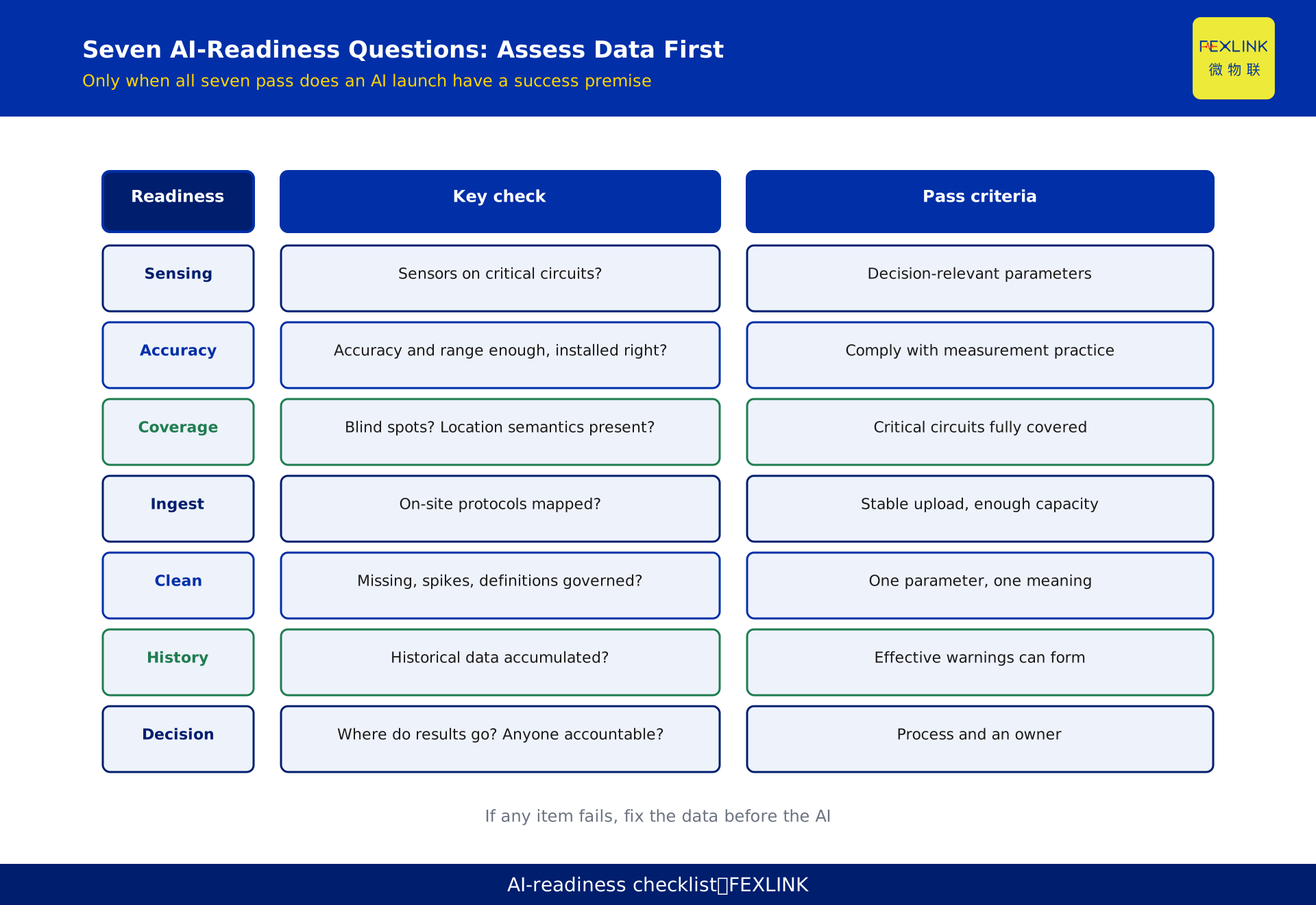
Direct Answer
Many executives, hearing "AI-based electrical diagnosis," assume: buy a large-model account, feed it data, and conclusions appear. That is wrong. The performance of AI hazard diagnosis is decided by the accuracy and coverage of sensing data; the model is only the analysis layer—without high-quality edge sensing data, the strongest model has nothing to work with. AI is not software you buy; it is an engineering chain of sense–ingest–clean–analyze–decide. Data is the foundation; the model is the building. The correct order: fix sensing first, then talk about AI.
1. Why "AI Equals Buying a Model" Is a Dangerous Misconception
Equating AI with "buying a large model" rests on two misunderstandings: that AI is standalone software, and that data is ready-made.
AI is not standalone software. AI for electrical hazard diagnosis is an analysis system tightly coupled to the site: ingesting on-site data, understanding topology, comparing standards, outputting executable decisions. Without site data, the model is an empty shell.
Data is not ready-made. Most enterprises' data foundations fall far short: no sensors, or sensors without upload, or uploads of uneven quality. Until the foundation is fixed, an AI project is on the wrong path from day one.
The cost is high: a company thinks buying a model means having AI, then discovers "the model is here, the data is not"—the system idles or outputs unreliable conclusions.
2. The Full AI Diagnostic Chain: Sense → Ingest → Clean → Analyze
To see why data comes first, look at the full chain. A mature end-to-end AI hub has seven stages:
L1 Ingest: bring on-site data in—"can the data get in." L2 Clean: missing, out-of-order, duplicate and spiky data are handled here; quality decides downstream credibility. L3 Standard check: compare data against standards—"compliant or approaching the red line"—the compliance baseline. L4 Parameter-level analysis: run trend and correlation analysis on voltage, current, temperature, leakage, identifying "which parameter is abnormal." L5 Contextual judgment: place findings into scenarios—the same anomaly means different things at different locations and loads. L6 Fused decision: combine all layers into a health score and recommendations. L7 Persistence and delivery: store, push, trigger predictions, deliver conclusions to decision-makers.
In this chain, L4 onward is "analysis"; L1–L3 is "data." No analysis layer can change input quality; sensing data is the only raw material.
3. How Sensing-Data Quality Decides AI Performance
Data quality has four dimensions, and each directly decides AI performance:
Accuracy. Sensor accuracy decides how credibly data reflects on-site state. Whether a temperature sensor is off by 2°C or 0.5°C changes reliability; with insufficient accuracy, deeper analysis only "works on noise."
Coverage. Which circuits and parameters are monitored decides what AI can "see." With inlet-only coverage, AI cannot locate the specific circuit; without temperature and leakage data, AI is blind to overheating and insulation degradation.
Frequency. Sampling frequency decides the time resolution of trend analysis. Hazards evolve gradually; too-low flattens trends, too-high explodes volume and cost.
Consistency. Whether data definitions, timestamps and units are uniform. One parameter with two definitions makes analysis unreliable.
If any dimension fails, AI performance degrades; if several fail, conclusions are simply unreliable. A large model cannot cure the data's "birth defects"—it can only find patterns in given data. Wrong data, wrong patterns.
4. Insufficient Accuracy: Even the Strongest Model Computes Wrong
A typical accuracy failure: a factory deployed an AI diagnostic system with mediocre sensors and casual installation. AI repeatedly reported "temperature anomaly"; operators checked and found normal temperatures. After several rounds, AI alarms were ignored.
The problem is in the data layer: sensor accuracy read a normal 1°C fluctuation as a 3°C anomaly; poor installation let environmental factors contaminate readings. A model doing trend analysis on such data cries wolf.
By contrast, an accurate system uses location awareness: the same 65°C reading is normal on a transformer winding, medium risk on a main busbar, high risk at an outgoing terminal, dangerous on cable sheath. Without accuracy and location semantics, AI cannot say what a temperature means—only that it is high.
5. Insufficient Coverage: Accurate but Half-Blind
Insufficient coverage shows up as "blind spots." AI conclusions are always limited by the data it sees:
Parameter blind spots: monitoring only voltage and current—no temperature, leakage or harmonics—leaves AI blind to overheating, insulation degradation and power-quality problems. A parameter or two finds only part of the problem.
Circuit blind spots: points only at the main inlet, no branch monitoring. AI can say "overall state is degrading" but not "which circuit"—decision value collapses.
Location blind spots: the same data means different things at different locations. Without location semantics, AI can only say "value abnormal," not "terminal overheating needs repair."
Coverage determines whether AI conclusions have "spatial resolution"—not just "is there a problem," but "where and how severe." That depends on sensing depth and breadth; without coverage, accuracy sees only part of the picture.
6. Three Typical Failures When Bad Data Feeds AI
Bad data into AI guarantees failure. Three forms:
False-alarm failure: poor accuracy and spiky data make AI treat noise as trend, flooding alarms and creating fatigue—when a real hazard arrives, nobody believes it.
Missed-alarm failure: gaps in coverage put hazards in blind spots; AI has no data and quietly "sees nothing." This is the most dangerous: the system runs, managers believe they are protected, while hazards are fully exposed.
Misjudgment failure: inconsistent definitions or missing location semantics make AI call normal data abnormal, or attribute circuit A's anomaly to circuit B—conclusions cannot be acted on, or mislead response.
All three share a root cause in the data layer. Any claim that "the model is not strong enough" should trigger a check of the data foundation. A stronger model with bad data only computes wrong conclusions faster.
7. A Checklist to Judge Whether You Are "AI-Ready"
Before deploying AI, assess data readiness:
Sensing ready: Are sensors/monitoring modules installed on critical circuits? Do they measure decision-relevant parameters (voltage, current, temperature, leakage)? Accuracy ready: Do sensor accuracy and range meet requirements? Does installation comply with measurement practice? Coverage ready: Are critical circuits fully covered? Any parameter or circuit blind spots? Does data carry location semantics? Ingest ready: Are on-site protocols mapped? Can data upload reliably and within capacity? Clean ready: Are missing data, spikes and inconsistent definitions governed? Does one parameter have two meanings? History ready: Trend analysis needs history—how soon can effective warnings form? Is historical data sufficient? Decision ready: Where do AI conclusions flow? Is there a response process and an accountable owner?
If any item fails, fix the data before the AI. Only when all pass does a launch have a success premise.
8. The Correct Order: Fix Sensing First, Then AI
The correct order for AI deployment: make the data foundation solid first, then the analysis layer:
Step one, fix sensing. Configure monitoring points on critical circuits by management needs and risk tiers—the data foundation and AI's only raw material.
Step two, connect ingestion. Map on-site protocols, get data uploading stably and completely, and size capacity to the point plan.
Step three, govern data. Establish cleaning and definition governance so data entering analysis is clean, consistent and location-tagged.
Step four, deploy analysis. On that foundation, deploy AI capabilities—parameter-level recognition, contextual judgment, fused decisions.
The order cannot be skipped: AI without sensing is a castle in the air; analysis without ingestion and cleaning is garbage in, garbage out. Mature systems are built this way: sensing supplies data, the edge handles ingestion and preprocessing, and the platform runs the seven-stage pipeline—one runnable loop of "data–analysis–decision."
9. The Real Increment: From Sensing to a Decision Loop
With the data foundation solid, AI's real increment is a decision loop:
From alarm to prediction: sensing data supports trend analysis, so the system warns early, leaving a response window instead of alarming only when limits trip.
From symptom to cause: multi-dimensional data supports correlation analysis—reporting not just "temperature anomaly" but "increased contact resistance is causing overheating."
From location to forecast: with accumulated history, the system predicts degradation trends and estimates remaining life, moving from "emergency repair" toward "predictive maintenance."
From people reading data to data supporting decisions: dashboards, digital twins and mobile push let data support decisions.
Every increment stands on the sensing-data foundation. The foundation sets the ceiling—without sensing data, AI promises are a picture.
Scope and Limitations
The conclusion "fix sensing data first, then AI" applies to planning and implementation of enterprise electrical hazard AI diagnosis projects, for owners, managers and integrators. Data foundations, equipment status and goals vary; readiness assessment combines site surveys and data-governance status. The checklist is a general framework, not an exact acceptance standard. The AI system described (seven-stage pipeline, parameter-level sensing, location awareness, health-score fusion) and effect metrics (recognition rate, alarm compression, etc.) are public descriptions from the FEXLINK product knowledge base for the Taiyi Intelligent Control Hub and its AI engine family; effect metrics are vendor-disclosed, not contractual commitments, and actual performance varies by project. All cases are anonymized (a factory, a park).