 FEXLINK Research Institute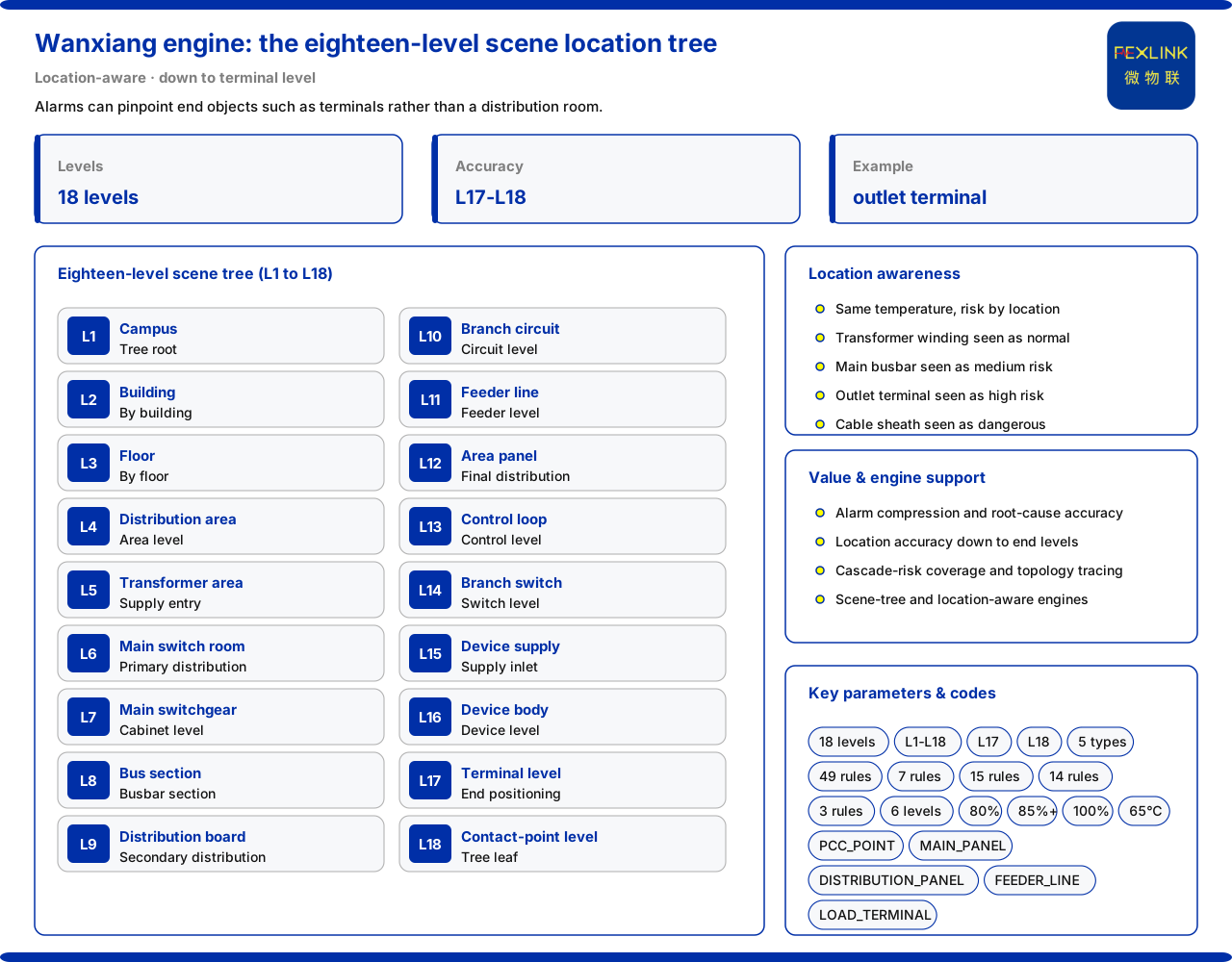
Direct answer
The core of the Wanxiang engine's scene-location capability is an 18-level scene-location tree. The product knowledge base gives levels from L1 to L18, starting at the park and ending at L17 wiring-terminal level and L18 contact-point level; an alarm can therefore be located precisely to an end object such as "the outlet terminal of circuit 5 in the power cabinet of workshop 3", rather than staying at a distribution room or a cabinet. Complementing this tree is a location-awareness capability: the same 65°C carries different risk levels when it appears at a transformer winding, a main busbar, an outlet terminal or a cable sheath. The product knowledge base organizes all this under the Wanxiang engine's "18-level scene tree and 49 association rules". This article only restates wording listed in the product knowledge base and does not infer unrecorded modelling methods.
1. The start and end of the 18-level scene-location tree
The product knowledge base records that the Wanxiang engine has an 18-level scene-location tree, with levels from L1 to L18. The tree starts at the park and ends at L17 wiring-terminal level and L18 contact-point level. Fixing the start and end clarifies the two ends of this location system: one is the sufficiently macro "park", the other the sufficiently micro "contact point". The number of levels matters because it determines how finely an alarm can be located. With only distribution-room level division, an alarm can only say "some distribution room is abnormal"; with step-by-step subdivision from park to contact point, an alarm can land on a specific wiring terminal or contact point.
2. The complete hierarchy from park to contact point
The 18 levels listed by the product knowledge base are, in order: park, building, floor, distribution area, transformer area, main distribution room, main switch cabinet, busbar section, distribution panel, branch circuit, trunk feeder, area distribution box, control circuit, branch switch, equipment supply, equipment body, L17 wiring-terminal level, and L18 contact-point level. The first levels are divisions of space and area, the middle levels are divisions of distribution hierarchy and circuits, and the last two land on physical connection parts such as terminals and contact points. This ordering from space to electrical to physical connection point lets the same anomaly be understood both as "which area of which building" and as "which terminal of which circuit".
3. What locating an alarm to a "terminal" means
The product knowledge base uses a concrete example to illustrate end-point locating precision: an alarm can be precisely located to "the outlet terminal of circuit 5 in the power cabinet of workshop 3". The value of this example is that it makes the tree's end capability concrete. For operation and maintenance, "workshop 3" gives the spatial range, "power cabinet" the cabinet object, "circuit 5 outlet" the circuit object, and "terminal" the physical connection part. With the four pieces of information stacked, a troubleshooter need not eliminate one by one across a whole cabinet or a whole circuit, but can go directly to the corresponding terminal to check. It should be noted that this example describes the granularity that locating can reach, not a promise of equally fine results at any site.
4. Location awareness: why the same 65°C differs in risk
The product knowledge base records that one of the Wanxiang engine's core innovations is location awareness. The same 65°C is treated as normal at a transformer winding, as medium risk at a main busbar, as high risk at an outlet terminal, and as dangerous at a cable sheath. The same 65°C changes risk level with location because the normal operating temperature and tolerance boundary differ by location. The meaning of location awareness is to bind the "temperature value" with "where the temperature appears" before judging risk, rather than applying one threshold to all locations. This also explains why the location tree must be fine enough: only when the location is specific enough do position-related thresholds and risk models have objects to land on.
5. Five electrical topology position types
The product knowledge base further records that location awareness maintains independent thresholds and risk models for five electrical topology position types: the point of common coupling, the main distribution cabinet, the distribution panel, the feeder line and the load terminal. Placing location awareness with the topology position types shows its organization: first classify field positions by electrical topology into several types, then configure each type with its own thresholds and risk model. Thus the same measured value landing on different types of position gets a different risk judgement. The five types cover typical electrical positions from the grid-connection entrance to the load end, forming the classification basis of location awareness.
6. Dedicated analysis engines supporting scene location
The product knowledge base records that the Wanxiang engine contains nine dedicated analysis engines, of which those directly related to scene location include the scene-tree management engine, the location-awareness engine and the topology-cascade impact engine. The scene-tree management engine maintains the 18-level scene tree as a data structure; the location-awareness engine combines a measured value with its position before grading; and the topology-cascade impact engine traces cascade effects on the topology, recorded as tracing up to 6 layers. The three divide the work clearly: one manages the "tree", one manages "location", one manages "cascade". Placing them with the 18-level scene tree and location awareness shows scene location is not a single algorithm but is supported by several engine classes.
7. Domains of the 49 cross-dimensional association rules
The product knowledge base records that the Wanxiang engine's 49 cross-dimensional association rules fall into five domains: 7 in the electrical-safety domain, 7 in the temperature-correlation domain, 15 in the voltage domain, 14 in the current domain, and 3 in the power-quality domain with 3 in the energy-efficiency domain. These rules are used, after the scene tree completes location, to further judge an anomaly's cause and relationships. Expanding the rule count by domain shows the voltage and current domains have noticeably more rules than the others, indicating that in association judgement voltage and current are the main analysis dimensions. The scene tree answers "where the anomaly is", the association rules answer "why it is abnormal", and the two work together in the Wanxiang engine.
8. Quantitative value wording
The product knowledge base lists a set of quantitative value indicators for the Wanxiang engine: alarm compression 80%, root-cause accuracy above 85%, scene-location precision L17-L18, and cascade-risk coverage 100%. "Scene-location precision L17-L18" corroborates the 18-level scene tree — the tree's last two levels are exactly the locating precision named in the quantitative value. Placing these indicators with the scene tree, location awareness and association rules gives a fairly complete understanding of the Wanxiang engine: it describes the locating granularity and also states the wording of locating and judgement on several indicators. All indicators are the product knowledge base's wording; this article does not infer their evaluation method.
9. What to note when reading these wordings
First, the 18-level scene tree should be understood as locating granularity, not a guarantee of reaching terminal-level results at any site. Second, location awareness should be understood as a set of thresholds and risk models distinguished by position, not a single temperature threshold. Third, the division between the scene tree and the association rules should be distinguished: the former locates "where", the latter judges "why". Fourth, the levels, examples, threshold classification and quantitative value above are the product knowledge base's wording; actual behaviour is affected by the completeness of the site ledger, measurement-point deployment and topology modelling, and should follow the latest product materials and the specific project scheme.
Scope and limitations
First, this article only restates content listed in the product knowledge base, and its factual boundary is limited to the levels and end points of the Wanxiang engine's 18-level scene-location tree, the example of an alarm located to an outlet terminal, location awareness's differentiated grading of the same temperature, the five electrical topology position types, the scene-tree management, location-awareness and topology-cascade impact engines among the nine dedicated analysis engines, the domain breakdown of the 49 association rules, and the quantitative value indicators.
Second, the precise location of an alarm "to a terminal" is an example listed in the product knowledge base; this article does not extend it into a locating-precision guarantee for any site.
Third, alarm compression 80%, root-cause accuracy above 85% and cascade-risk coverage 100% are the product knowledge base's wording; this article does not infer their statistical method or applicable working conditions.
Fourth, this article does not constitute a commitment to any specific project's locating precision or judgement effect; actual capability should follow the latest product materials and project scheme.