 FEXLINK Research Institute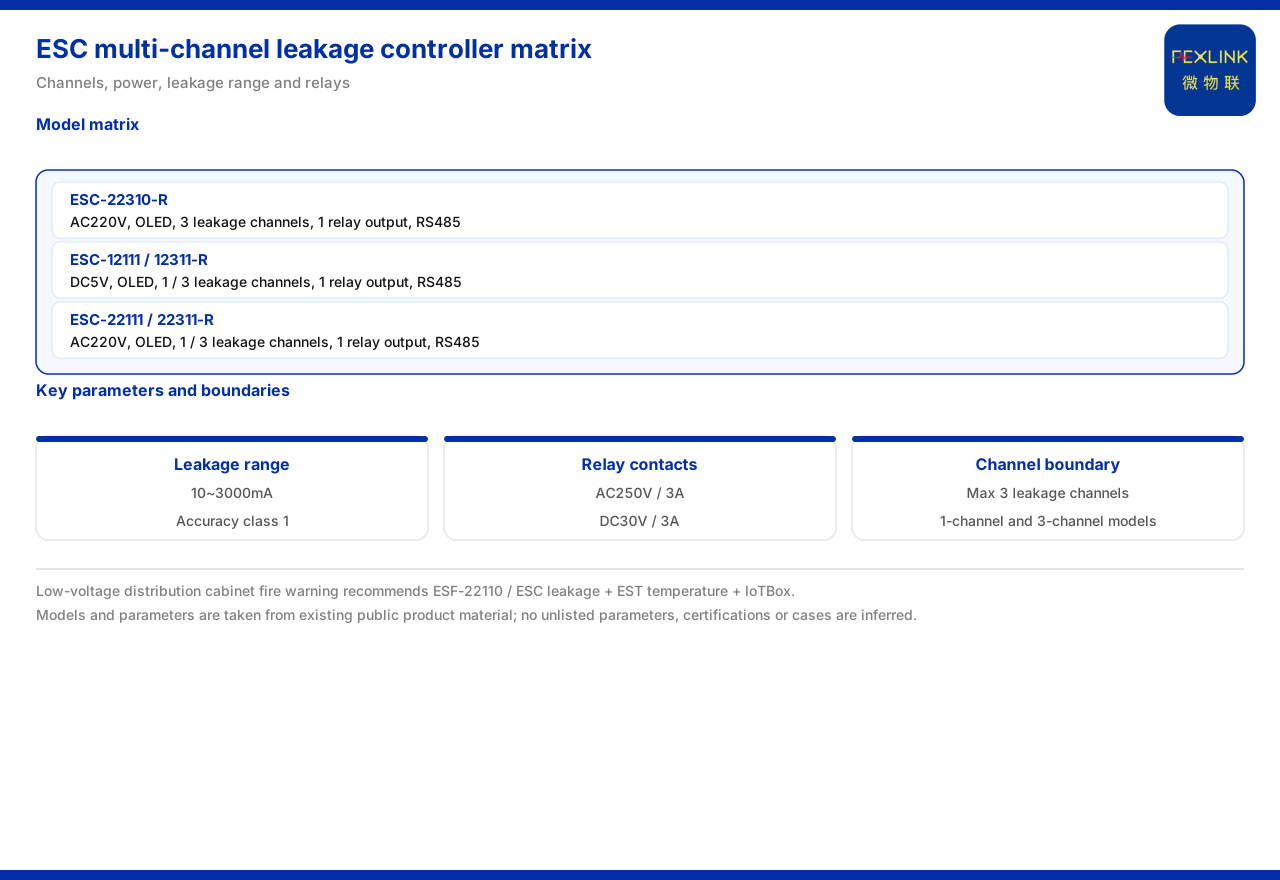
Direct answer
The multi-channel leakage-current monitoring and control device (ESC-22310-R) is a multi-channel product that the product documentation lists on the leakage side, and the product-model quick reference maps the ESC prefix to multi-channel leakage-current monitoring and control device. Its core specification is the number of leakage monitoring channels: the model matrix contains two grades, one channel and three channels, with a maximum of three; the leakage range is 10 to 3000mA with accuracy class one; and the relay contact is AC250V/3A and DC30V/3A. The model table further distinguishes by supply. AC220V: the multi-channel leakage-current monitoring and control device ESC-22310-R has an OLED display and three leakage channels, ESC-22111 has one channel, and ESC-22311-R has three. DC5V: the multi-channel leakage-current monitoring and control device ESC-12111 has one channel, and ESC-12311-R has three. Every model carries OLED, one relay output, and RS485.
Selection holds onto three points: channel count, supply, and range. Channel count determines how many circuits one device monitors in parallel, supply determines the power condition it connects to, and range and accuracy determine the reading wording. On this basis the article explains the listed specifications of the ESC and the selection order, and marks the parts the product documentation does not unfold.
1. The positioning of the ESC
The product-model quick reference maps the ESC prefix to multi-channel leakage-current monitoring and control device. This positioning shows that the ESC faces leakage cases where several circuits are monitored at the same time, rather than covering only a single measurement point. Compared with a single-channel product, a multi-channel product concentrates several channels inside one device.
This positioning also explains why channel count is a core variable. For a site, few circuits can use a single channel; several circuits monitored in parallel within one device call for three channels. The choice of channel count should follow the number of circuits to be measured, not the appearance or price of a model.
Multi-channel is a collective concept relative to single-channel, and it does not change the physical wording of leakage measurement. Whether one channel or three, the leakage range is 10 to 3000mA and the accuracy is class one. What a multi-channel product adds is the number of channels, not the measurement capability of each channel. Fix this point first, and channel count will not be confused with range when the models are read later.
2. Channel count: one and three, two grades
The model matrix lists the ESC's leakage monitoring channels as two grades, one channel and three channels, with a maximum of three. This is a hard boundary: only these two channel counts appear in the models, and no larger grade appears.
The model table maps them to specific models: ESC-22310-R has three channels, ESC-22111 one, ESC-22311-R three, ESC-12111 one, and ESC-12311-R three. One and three channels both have models under several supply conditions. In selection, fix the channel count first, then choose among models with the matching supply.
The choice corresponds directly to the site structure. A clear, simple circuit can use one channel; several circuits monitored in parallel within one device call for three. Because the largest grade is three channels, a larger circuit count must be covered by several devices and cannot be solved by a larger channel count on one device. Understanding this allows the total number of circuits and the channel count of one device to be planned separately.
3. Supply and display
The model table divides the ESC into two classes by supply. AC220V covers ESC-22310-R with three channels, ESC-22111 with one, and ESC-22311-R with three; DC5V covers ESC-12111 with one and ESC-12311-R with three. Both classes carry an OLED display.
The supply distinction shows that the ESC has models for both AC and DC conditions, not a single supply. The OLED display shows that every model has on-site reading capability. This article does not infer conditions beyond the two supply classes, nor the specific form of the displayed content.
4. Leakage range and accuracy
The product documentation records the ESC's key parameters as leakage 10 to 3000mA with accuracy class one. This range stays consistent between single-channel and multi-channel models, showing that a change in channel count does not change the wording of leakage measurement but only the number of channels.
Accuracy class one is the reading wording under this range. Read with the range, selection must confirm both that the range covers the on-site leakage level and that the accuracy meets interpretation needs. This article does not infer values outside the range, nor error behaviour beyond the accuracy class.
5. Relay output and communication
The model table records each ESC model's relay output as one channel and its communication as RS485. The key parameters give the relay contact capacity: AC250V/3A and DC30V/3A. The relay output shows the controller has contacts for external action, not merely acquisition; RS485 shows data is sent out over a wired serial link.
Read together, the ESC can both send data and give contacts. The former serves the upper-layer platform, the latter can connect to external control or interlocking. This article does not infer the relay output's control logic or setting values, nor communication methods beyond RS485.
6. Typical scenario: electrical fire early warning in a low-voltage distribution cabinet
A typical application scenario lists electrical fire early warning in low-voltage distribution cabinets as a landing point, recommending the electrical fire monitoring and control device (ESF-22110), the multi-channel leakage-current monitoring and control device, a temperature monitoring product, and an IoTBox. The ESC carries the multi-channel leakage acquisition.
This shows that leakage monitoring is usually not isolated but forms an early-warning chain with temperature monitoring and electrical fire monitoring and control. The value of the multi-channel leakage-current monitoring and control device lies in covering several circuits within a distribution cabinet at once, reducing device count and wiring complexity. This article states only the composition and does not infer interlocking logic or implementation quantities.
7. The role of the ESC in multi-channel scenarios
Put the ESC back into the scenario, and its role is one device covering several circuits. A low-voltage distribution cabinet often has more than one circuit, and using a single-channel device for each would raise both device count and wiring complexity. A multi-channel product covers more circuits with fewer devices.
But more channels is not always better. The more channels, the more concentrated the monitoring responsibility on one device, and the larger the affected scope once maintenance is needed. Channel count therefore involves a trade-off with reliability and maintenance convenience, a question to consider together with the operations arrangement. The product documentation lists only one and three channels, and this article does not infer a larger channel count.
8. Selection order
Taken together, ESC selection can advance in four steps. First determine the channel count according to the number of circuits, choosing between one and three; then choose the AC220V or DC5V model according to the on-site supply condition; then verify whether the leakage range of 10 to 3000mA and accuracy class one meet the requirement; and finally confirm whether the relay output and RS485 communication agree with the site.
Follow this order, and channel count, supply, and range are each independent yet jointly determine the model. Mixing the three and guessing from the model name tends to produce deviations such as enough channels but wrong supply, or right supply but wrong range. Checking item by item matches needs to a model.
Scope and limitations
First, this article restates only what the product documentation lists, bounded to the model matrix, the model table, and the key parameters of the multi-channel leakage-current monitoring and control device, the product-model quick reference entry, and the low-voltage distribution cabinet electrical fire early warning scenario.
Second, the leakage monitoring channel count and maximum value are cited as listed in the model matrix; this article does not infer a grade beyond three channels.
Third, each model's supply, display, channel count, relay output, and communication are cited as listed in the model table; this article does not infer the configuration of unlisted models.
Fourth, the leakage range, accuracy, and relay contact capacity are cited as listed in the key parameters; this article does not infer values outside the range or error behaviour beyond the accuracy.
Fifth, the typical scenario and recommended combination are cited as listed; this article does not infer its interlocking logic or implementation quantities.
Sixth, the relationship between channel count and range or accuracy is cited as listed in the model matrix and the key parameters; this article does not treat the channel count of a multi-channel product as an increase in single-channel measurement capability.