 FEXLINK Research Institute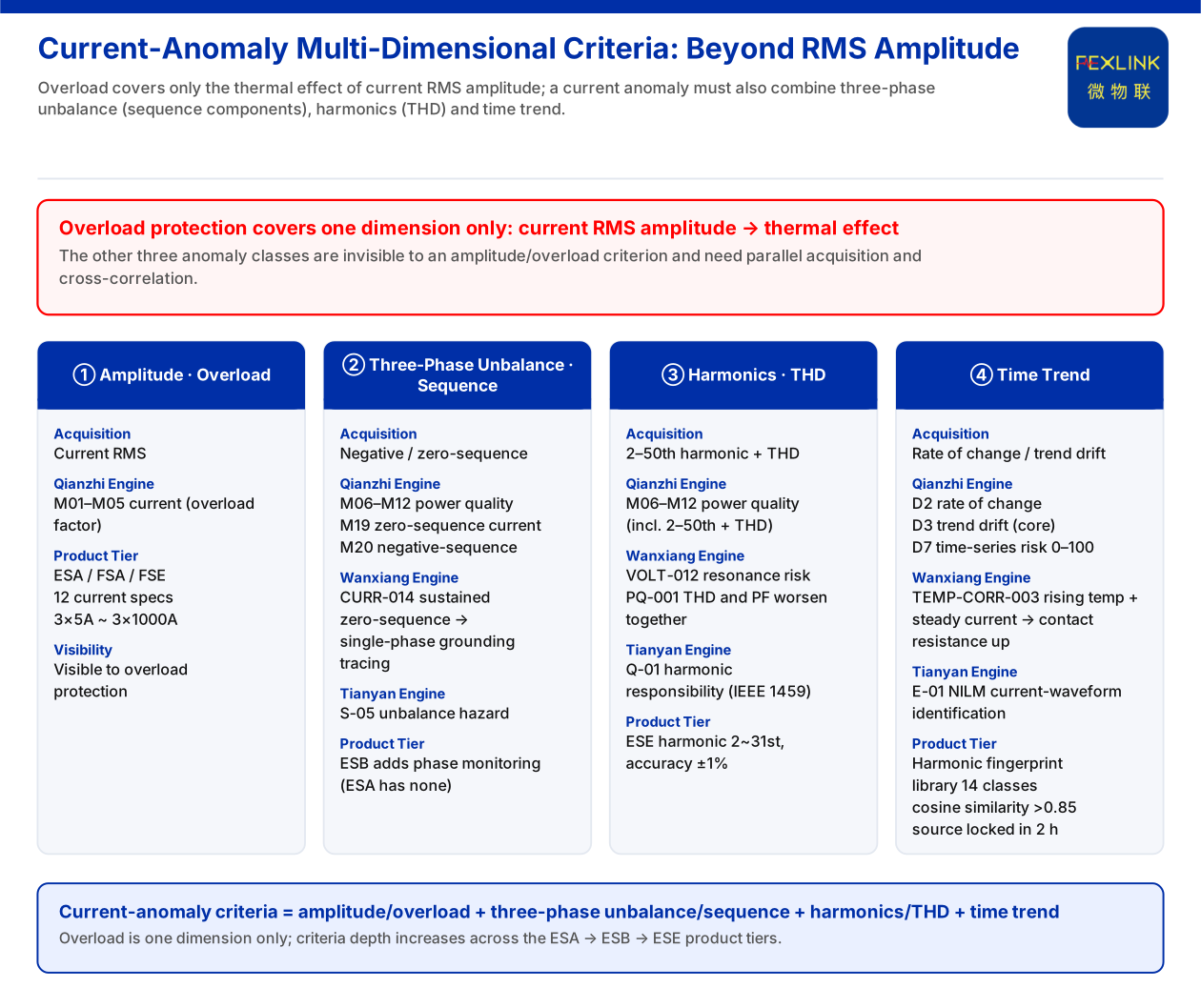
Judging current anomalies only by whether current exceeds rated value compresses them into a heating problem. Overload protection compares RMS magnitude; it answers whether conductors and insulation will overheat. Three-phase balance, harmonic content and slow drift over weeks are all invisible on that line. The knowledge base lists current (overload factor) among the Qianzhi engine's 20 specialist sub-models (M01-M05 basic vital signs), while current unbalance (sequence components) sits in M06-M12 power quality and zero/negative-sequence components in M13-M20 deep hazards. Overload is one node on that web, not the whole web. This article answers what else must be watched and what it maps to at product and platform level.
1. Overload Sees a Line; a Current Anomaly Is a Web
Overload judgement assumes a broadly symmetrical load, a near-sinusoidal waveform and a stable state. While that holds, one RMS threshold suffices; in the field it often does not. The seven-dimensional perception matrix splits "current" into directions: D1 magnitude, D2 rate of change, D3 trend drift (core), D4 anomaly density, D5 fluctuation amplitude, D6 correlation validation, D7 time-series risk score (0-100 composite decision). An overload threshold covers only part of D1; treating D1 as everything discards the information in D2, D3, D4, D5, D6 and the composite score.
Many current anomalies do not exceed limits in magnitude. When three-phase currents are unequal, their RMS values may all sit below rated, yet negative-sequence components already heat motors and transformers. When the waveform is rich in harmonics, the fundamental RMS may look normal while heating and insulation stress come from harmonics. When contact resistance grows, current may not change while temperature climbs. None triggers overload first, yet all are current anomalies.
2. Three Kinds of Current That Are Already Abnormal Without Overload
The first is three-phase unbalance. Asymmetrical loads introduce negative- and zero-sequence components. The knowledge base places current unbalance (sequence components) in M06-M12 power quality and zero/negative-sequence components in M13-M20 deep-hazard mining. Of the Wanxiang engine's 49 cross-dimensional correlation rules, 14 are in the CURR series, which uses "persistent zero-sequence current" as a clue for single-phase-to-ground tracing. Among the knowledge base's red lines is "three-phase voltage unbalance >15% (GB/T 15543)" — a voltage quantity, not a current quantity. The knowledge base gives no red-line threshold for "current unbalance," so this article states only that current unbalance must be watched.
The second is harmonics. The harmonic sub-model covers the 2nd-50th harmonics and THD and places resonance risk and harmonic intermodulation in M13-M20. Harmonics need not raise current magnitude: distortion can occur within rated current. The knowledge base also records a harmonic fingerprint library — 14 device fingerprints (three-phase rectifiers, 6-pulse inverters, UPS, charging piles, PV inverters) matched by cosine similarity above 0.85 to locate a pollution source within 2 hours. Among the Wanxiang engine's rules, a VOLT-series rule describes "high harmonics + reactive compensation switched in → resonance risk," and a PQ-series rule describes "THD + power factor worsening together → harmonics disturbing reactive power". The Tianyan engine's Q-01 model allocates harmonic responsibility per IEEE 1459.
The third is trend. An unchanged current reading does not mean the equipment is unchanged. Among the seven TEMP-CORR series rules of the Wanxiang engine, the TEMP-CORR-series criterion is "temperature rise + unchanged current → increasing contact resistance" — watch overload alone and this clue never triggers. Qianzhi's seven-dimensional perception sets D3 trend drift at the core and has D7 output a 0-100 time-series risk score; the Tianyan engine lists "three-phase unbalance hazard" as the S-05 launch model in the S safety-analysis board. Trend is not a new sensor but a way of organising the same current over time.
3. Why the Product Line Splits into ESA, ESB and ESE
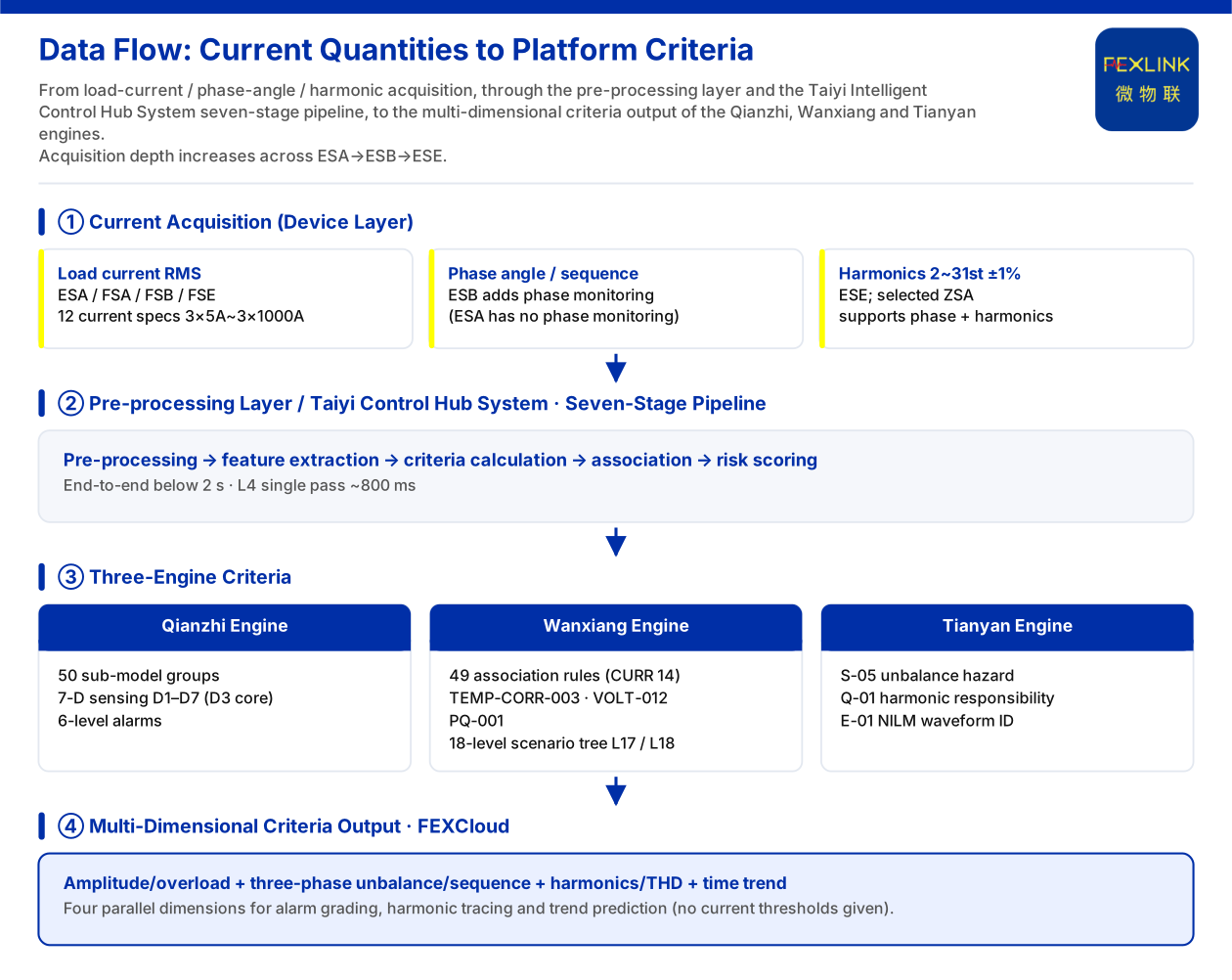
The product tiers map onto these three needs. The ESA all-element smart meter offers 6 current ratings (3×5 A to 3×1000 A), 3×220/380 V and meter monitoring, but explicitly has no phase or harmonic monitoring (choose ESB/ESE if needed). The ESB three-phase unbalance monitor shares the ESA architecture, adds phase monitoring and has no harmonic monitoring. The ESE power-quality monitor shares the ESB architecture and adds harmonic monitoring to phase monitoring (2nd-31st harmonics, ±1% accuracy). The FSA/FSB/FSE multi-element electrical intelligent controllers split into three models: FSA (meter) has no phase or harmonics, FSB (three-phase balance) adds phase monitoring, FSE (power quality) adds harmonic monitoring, across 12 current ratings (3×5 A, 3×100 A, 3×200 A, 3×400 A, 3×600 A, 3×1000 A) × 2 networking options. In the ZSA embedded multi-function smart meter, ZSA-22240-R and ZSA-22243-R also support phase and harmonics.
This distinction is the answer: to merely "keep current from exceeding limits," an ESA with meter monitoring suffices; to answer "is the three-phase supply offset, where do harmonics come from, why is temperature rising," ESB/ESE with phase or harmonic monitoring are needed. Leaving current anomalies to overload protection is like using ESA to answer an ESE question.
4. From "Reading" to "Judging": It Is Not Just More Thresholds
Collecting unbalance, harmonics and trend does not by itself make a judgement. The seven-stage pipeline gives the path: L1 ingest → L2 cleansing → L3 standard validation (red-line pre-check) → L4 Qianzhi analysis (50 sub-models in parallel, about 800 ms per round) → L5 Wanxiang assessment → L6 fusion decision → L7 persistence, under 2 seconds end to end. An L3 red-line trigger emits the highest-level alarm directly; L4's six-level alarm scheme splits urgency from normal (85-100) to BJ2 (0-19, immediate shutdown). L5's Wanxiang engine uses an 18-level scenario tree and correlation rules to view current with temperature, harmonics and leakage, and can localise an alarm to L17 terminal-block or L18 contact-point level. After L6, Tianyan models such as S-05 and Q-01 are triggered for prediction and responsibility allocation.
Unbalance (sequence components), harmonics (THD and order) and trend (drift) are not resolved by a single threshold but by three layers: multiple quantities, correlation and time. Data must pass through the four-layer architecture — perception, edge, platform, application — before entering that pipeline. Without continuous collection and uplink, a judgement such as "current unchanged but the trend is moving" has no basis.
5. Boundaries: What This Article Does Not Claim
It is not a selection conclusion or operating procedure.
Second, the quantitative value indicators in the knowledge base (electrical-hazard identification 95%+, alarm compression 80%, 4-12 weeks' warning lead, fault localisation from days to 2 hours, MTTR reduced 60%, comprehensive energy-saving potential 8-20%) are vendor self-reports. Cite them only as vendor capability claims, never as effect guarantees or procurement grounds.
Third, it gives no alarm thresholds, unbalance criteria, harmonic limits or wiring schemes for any current quantity; it cites only the knowledge base's standard numbers — GB/T 15543, GB/T 14549 and GB/T 12325 — without inferring their content, and invents no model, parameter or standard absent from the knowledge base.
Fourth, division of labour with adjacent topics: the voltage article covers voltage only; the leakage/residual-current article covers residual current only; this article covers what lies beyond load-current magnitude; the fault-arc article covers arcs only.
Conclusion
Overload is only one dimension of a current anomaly: whether magnitude will overheat a conductor. Judging whether current is truly abnormal needs three-phase balance (sequence components), waveform distortion (harmonics and THD), and drift over time. The knowledge base puts current (overload factor) in Qianzhi M01-M05, yet places current unbalance, zero/negative-sequence components and harmonics in M06-M12 and M13-M20; the product line carries these through ESB's phase monitoring and ESE's 2nd-31st harmonic monitoring; Wanxiang's CR, CURR, TEMP-CORR and VOLT rule families correlate them, and Tianyan's S-05 and Q-01 extend them toward prediction and responsibility allocation.