 FEXLINK Research Institute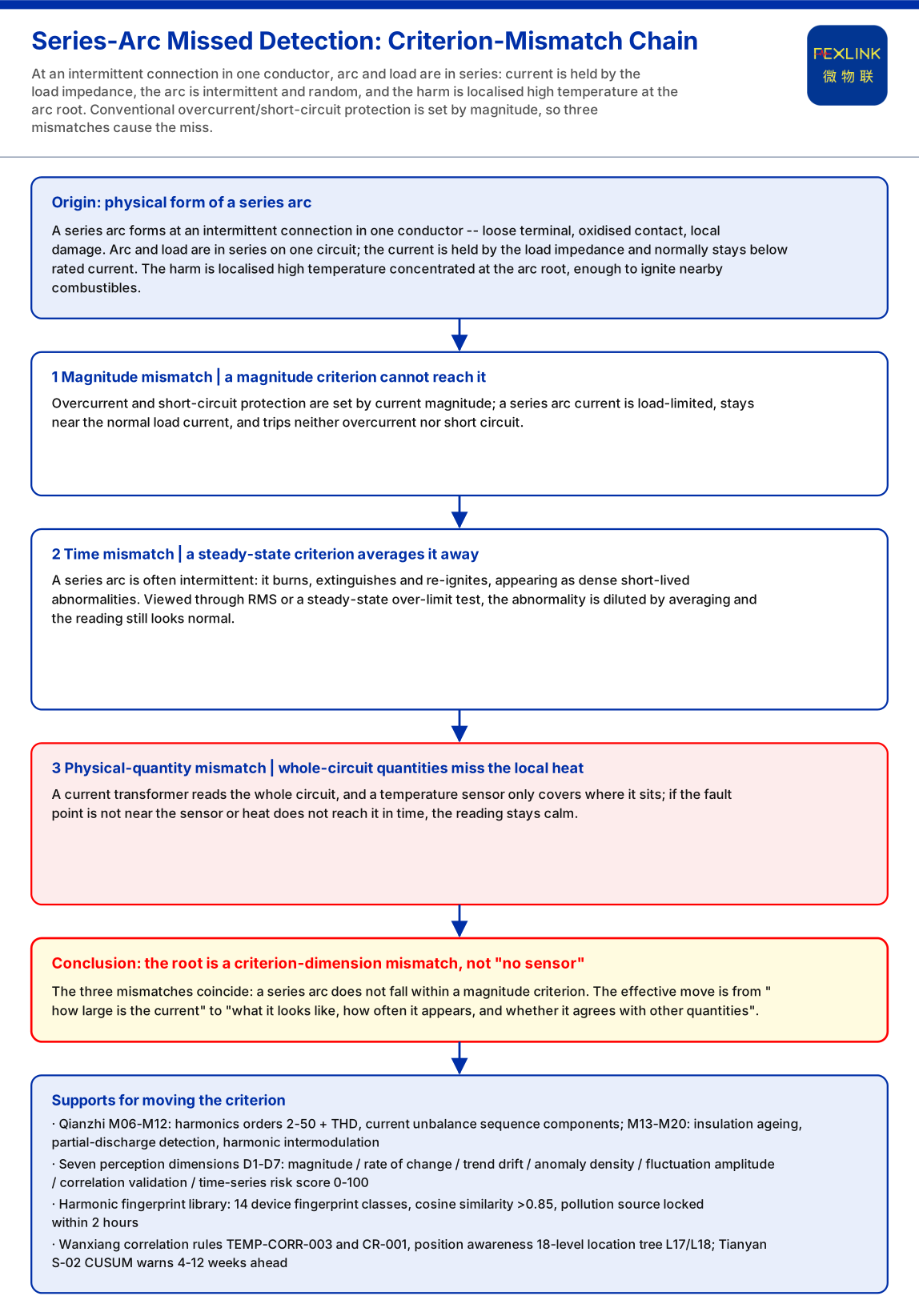
Why Series Arc Faults Are More Easily Missed
A series arc and a parallel arc are not the same class of fault. A series arc occurs at an intermittent connection within a single conductor — a loose terminal, an oxidized contact point, a locally damaged wire. The arc sits in series with the load on the same loop, so the loop current is bounded by the load impedance and normally does not rise above the rated current. Conventional overcurrent and short-circuit protection are set by current magnitude; this current neither trips the overcurrent threshold nor constitutes a short circuit. The root cause of the missed detection is therefore not a missing sensor but a misapplied criterion dimension: the signature of an arc falls mostly in the high-frequency content of the current wave-shape and the distortion near the zero crossing, not in the magnitude of the loop current. The mismatch is explained below across amplitude, time, and physical quantity. Product names, models, and parameters in this article follow current product information.
1. Amplitude Mismatch: Load-Limited Current That Overcurrent Protection Cannot See
Overcurrent protection works on the principle of "act when the current rises to a set value." A series arc's loop current is limited by the load and typically stays near the normal load current, so in magnitude it is not an anomaly overcurrent protection can recognize. This also explains why arc monitoring products output an "arc count" rather than a "current over-limit" flag. The FA fault arc monitoring module provides arc counts on one current channel, with DC12V supply and RS485 communication. It counts how many arc events occurred, not whether the current exceeds a limit — counting and over-limit are two different criteria, and the former does not depend on magnitude.
The product information describes the FA module only as a "fault arc monitoring module / arc count," without a terminological distinction between series and parallel. The series/parallel classification is general electrical engineering understanding and is used here to explain which class of arc is more easily missed.
2. Timing Mismatch: Intermittent, Random Traces Averaged Out by Steady-State Criteria
Even when the loop current is disturbed, a series arc is often intermittent: it burns for a while, extinguishes, and reignites repeatedly, appearing on the time axis as dense short-lived anomalies rather than a stable over-limit curve. Viewed through RMS or a "steady-state over-limit" test, the anomaly is diluted by time averaging and the reading still looks normal.
The Qianzhi engine expresses this difference: among seven perception dimensions, amplitude is only one. It is followed by rate of change, trend drift (core), anomaly density, fluctuation amplitude, correlation verification, and a time-series risk score output on a 0–100 scale. An anomaly such as an arc — modest in amplitude but dense in occurrence — should not be carried by the amplitude dimension alone. In the charging-safety scenario, the core technologies also include low-frequency wavelet / high-frequency surge capture (microsecond-level abnormal current capture) and a multi-parameter fusion intelligent algorithm. These capabilities observe at the microsecond and wave-shape scale, not at the steady-state RMS scale.
3. Physical-Quantity Mismatch: Localized Heat That the Circuit May Not Show
The danger of a series arc lies not in how large the loop current is but in the arc root concentrating energy into localized high temperature, sufficient to ignite nearby combustible material. A loop current transformer reads the entire loop current, and a temperature measurement point can only cover its own location. If the fault point is not near the measurement point, or heat does not reach the sensor in time, the reading stays quiet — this is the physical-quantity mismatch: using a whole-loop quantity to find a highly localized heat event.
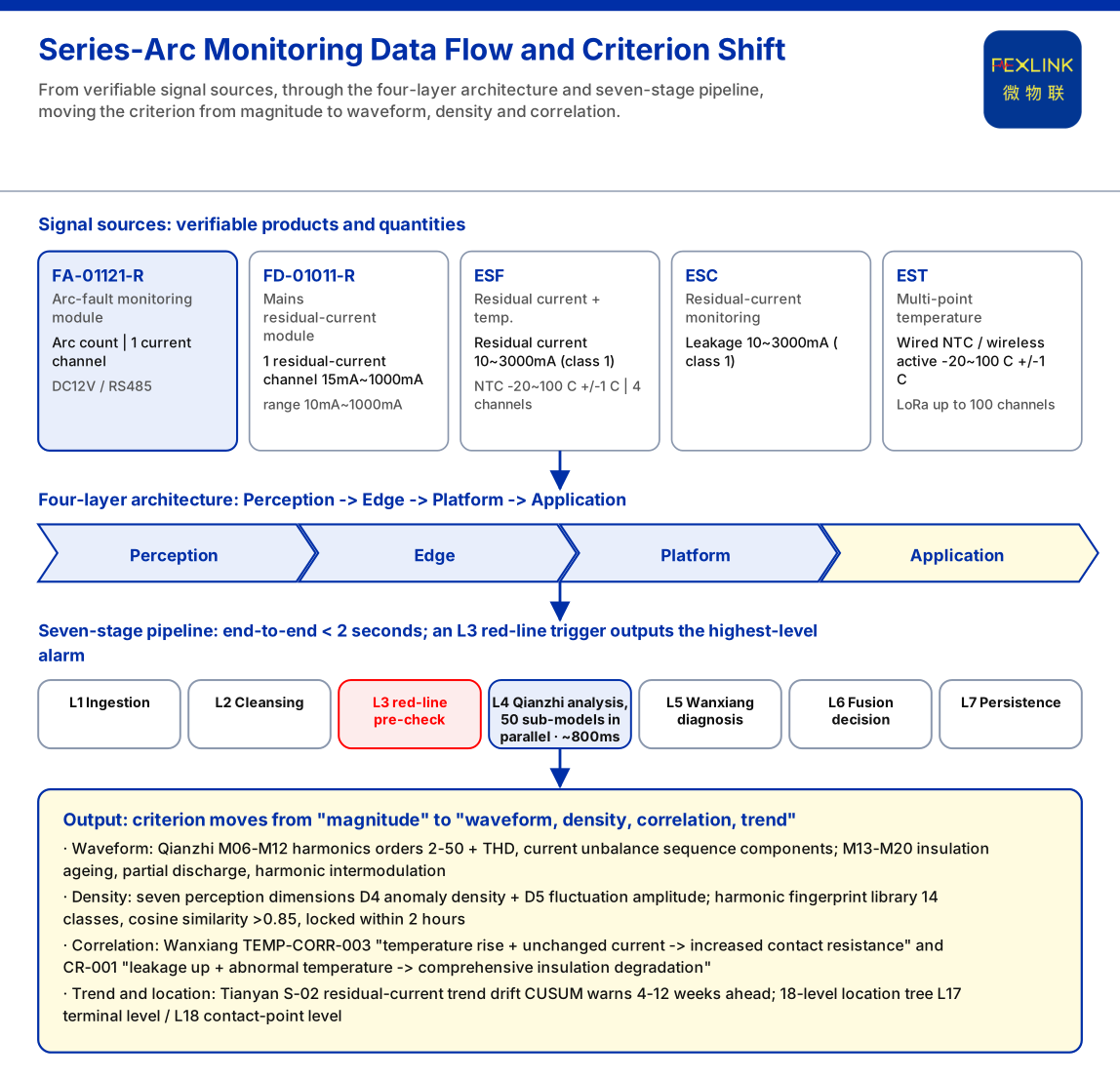
There is verifiable corroborating direction here. The Wanxiang engine's association rule "temperature rise + unchanged current → increased contact resistance" indicates that elevated contact resistance is one of the common causes of a series arc, and that it first shows as local heating while the current may stay unchanged. On the temperature side, ESF provides 4 channels of NTC temperature measurement from −20 to 100 °C at ±1 °C, and EST provides wired NTC and wireless active temperature from −20 to 100 °C at ±1 °C. The insulation-resistance red line of <0.5 MΩ (GB/T 16895) fixes insulation degradation — a risk sharing the same origin as arcing — as a baseline ahead of the algorithm.
4. Shifting the Criterion from Amplitude to Wave-Shape and Multi-Dimensional Features
Combining the three mismatches, the conclusion is clear: it is not that a series arc has no signal, but that it does not fall within the amplitude criterion. The effective approach is to shift the criterion from "how large the current is" to "what the current looks like, how densely it occurs, and whether it agrees with other quantities."
The Qianzhi sub-model groups provide this dimension. The power-quality screening group includes harmonics (orders 2–50 plus THD) and current imbalance (sequence components). The deep hidden-hazard mining group includes insulation state (aging model), partial discharge detection, and harmonic intermodulation. Harmonics and high-frequency content, together with wave-shape distortion, are precisely the traces an arc-type anomaly leaves in the frequency and wave-shape domains. The three dimensions of anomaly density, fluctuation amplitude, and correlation verification correspond to the arc's characteristics of being intermittent, random, and requiring corroboration. On the system side, a harmonic fingerprint library supports device-level tracing — 14 device fingerprints with cosine similarity matching above 0.85, locking a pollution source within 2 hours.
5. One Criterion Is Not Enough: Residual Current, Temperature, and Insulation Corroboration
The causes of a series arc are often related to poor contact and insulation degradation, so beyond statistics on the arc events themselves, other quantities that reflect the same degradation are needed. The verifiable combination is: FA collects arc counts; the FD mains (residual current) monitoring module provides one residual-current channel of 15 mA–1000 mA (positioned in the 10 mA–1000 mA range); ESF provides residual current of 10–3000 mA (accuracy class 1) and temperature; ESC provides leakage current of 10–3000 mA; and EST provides multi-point temperature. The Wanxiang engine's association rule "leakage ↑ + temperature anomaly → comprehensive insulation degradation" gives the direction for reading these signals jointly. Location awareness, with an 18-level scenario location tree, drills down to the wiring-terminal level and the contact-point level to answer which location is involved.
These quantities travel to the cloud through a four-layer architecture — perception, edge, platform, and application — and are then processed by a seven-stage pipeline: access, cleaning, red-line pre-check, Qianzhi analysis (50 sub-models in parallel, roughly 800 ms per round), Wanxiang assessment, fusion decision, and persistence. End to end this is under 2 seconds, and a red-line trigger directly outputs the highest-level alert. At the trend level, the Tianyan engine's theoretical basis (Arrhenius, exponential leakage growth, nonlinear contact-resistance growth) indicates that such degradation is gradual at first and then steep. Residual-current trend drift (CUSUM) can give advance warning 4–12 weeks while leakage is still within the safe range. Only by linking these quantities into a time series is it possible to read out the arc before it actually ignites.
6. Boundaries: What This Article Does Not Claim
First, this article gives no arc detection algorithm, wave-shape feature parameters, half-cycle or cycle-level criteria, or arc-count alert threshold, and no AFCI/AFDD terminology or certification information appears. These must not be fabricated here.
Second, the statement that "90% of charging fires originate from undetected hidden hazards" and the KSDSFE3250220001 case (third-harmonic level exceeding the limit by a factor of 18.7, comprehensive risk 75.5%) serve only as background, not as definitive conclusions.
Third, quantified value indicators — such as an electrical hazard identification rate above 95%, warning lead time of 4–12 weeks, and a 60% reduction in MTTR — are vendor self-reported claims that may be cited only as capability assertions and do not constitute a performance guarantee or procurement basis.
Fourth, only the GB 13955, GB/T 15543, GB 16895, and GB/T 16895 designations are cited; no clause content is inferred, and no protective action, customer case, or remediation effect is claimed.
Conclusion
A series arc is more easily missed because it is misaligned with conventional overcurrent protection across three criteria: the current is bounded by the load, so the amplitude criterion cannot reach it; the arc is intermittent and random, so the steady-state criterion averages it away; and the danger is localized heat, so whole-loop quantities may not read it. Closing the gap is not simply adding a sensor but shifting the criterion from "how large the current is" to the dimensions of wave-shape, density, and correlation. FA counts arc events; Qianzhi carries wave-shape and density through harmonics, partial discharge, and insulation sub-models together with seven-dimensional perception; Wanxiang provides corroborating direction through association rules and location awareness; and Tianyan moves the judgment forward through trend and lead time, all landed through the four-layer architecture and the seven-stage pipeline. Terminology and models are written in line with current product information.