 微物联研究院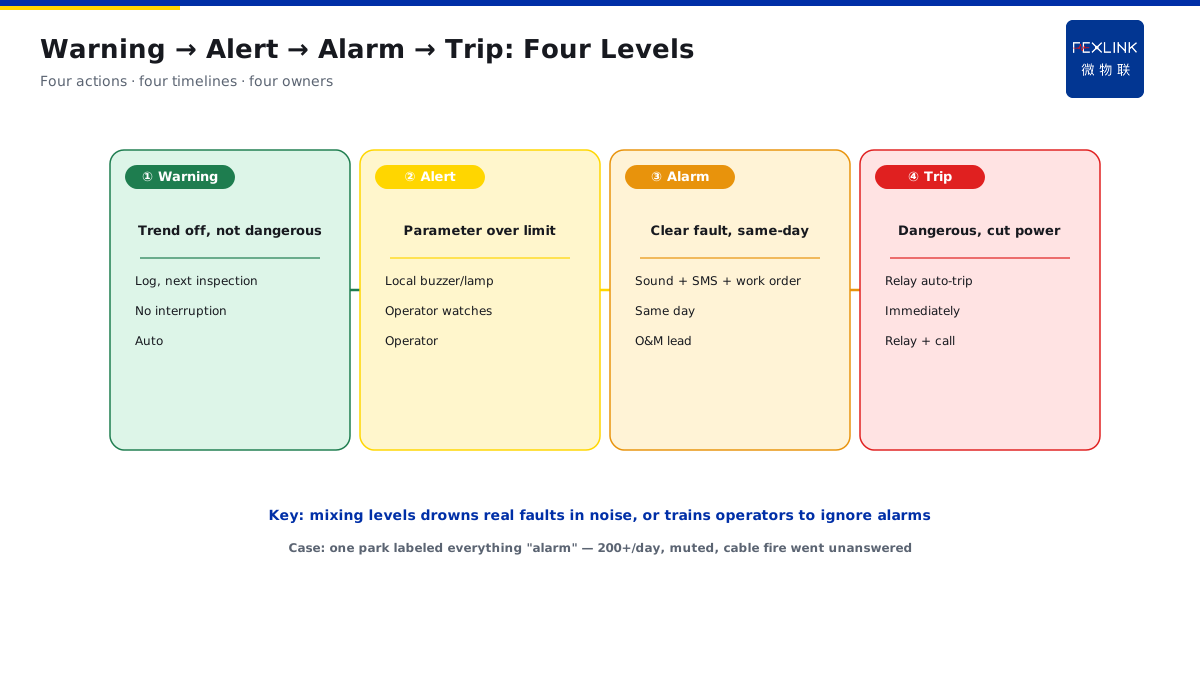
Direct Answer
Warning, Alarm, Alert, Trip — these four words appear on monitoring platforms all the time, but they are not synonyms. They are four response levels:
- Warning: trend anomaly, not dangerous yet — check at next patrol, do not bother anyone;
- Alarm: parameter exceeds threshold, needs attention — on-site sound/light, operator watches screen;
- Alert: clear anomaly, needs same-day action — sound + SMS, work order;
- Trip: dangerous state, must cut power immediately — protection device acts automatically, phone call notification.
Key insight: four levels, four timeframes, four responsible persons. Mix them up, and you either drown real incidents in warnings, or train operators to ignore alarms because there are too many.
At one industrial park, every anomaly on the monitoring platform was called "Alert" — a small temperature rise was an alert, residual current exceeding threshold was an alert, even a tiny voltage fluctuation was an alert. Operators received over 200 alerts a day, and eventually muted the sound. Then one day, a cable actually caught fire — the platform popped up an "Alert," but nobody looked. By the time fire trucks arrived, half the switchroom had burned through.
Post-incident review: if levels had been correct — slow temperature rise is Warning (on-site log, no SMS), residual current exceeding threshold is Alert (sound + SMS, same-day fix), insulation breakdown before cable fire is Trip (auto disconnect + phone call) — this fire could have been completely avoided.
1. Definitions of the Four Actions
Many people mix these four words up, but engineering-wise their boundaries are very clear:
Warning
- Trigger: parameter deviates from normal trend, but still within safe range;
- Response time: next patrol (daily);
- Responsible: operator (glances at screen);
- Action: on-site log, no push.
Alarm
- Trigger: parameter exceeds set threshold, but not urgent;
- Response time: within this shift (hourly);
- Responsible: operator;
- Action: on-site sound/light, no SMS.
Alert (Critical)
- Trigger: parameter clearly exceeds limit, at risk;
- Response time: same day;
- Responsible: operator + electrician;
- Action: sound + SMS, work order.
Trip
- Trigger: dangerous state, may cause incident;
- Response time: immediately (milliseconds);
- Responsible: protection device (automatic);
- Action: auto disconnect + sound/light/phone/SMS.
Simple rule: Warning means "notice," Alarm means "check," Alert means "act," Trip means "save life."
2. Why Platforms Only Go Up to "Alert," Trip Is Hardwired
Owners often ask: if the platform can monitor, why can't it directly control the trip?
Because software and hardware reliability are not in the same league:
- The monitoring platform may crash, may disconnect, may be misoperated;
- Protection devices (breakers, fuses) are hardwired, do not depend on any software.
If you rely on software to decide whether to trip — the moment the platform crashes, is the moment equipment burns.
Correct division:
- Platform does Warning, Alarm, Alert — these have time for human confirmation, slow is OK;
- Hard protection does Trip — millisecond action, no software dependency.
FEXLINK is designed exactly this way: the ESF electrical fire controller monitors and does warning/alarm, but the actual trip is performed by the upstream breaker or fuse. The platform gives "recommendations," hard protection gives "action."
3. Severity × Urgency: Two Dimensions, Four Levels
Not all anomalies fit neatly into one level. Engineering uses two dimensions:
Severity (how bad is the consequence):
- Low: does not affect operation;
- Medium: may affect operation;
- High: may cause incident.
Urgency (how fast must it be fixed):
- Low: can wait for planned shutdown;
- Medium: fix this shift;
- High: fix immediately.
Two dimensions combined give four levels:
- Low severity × Low urgency = Warning (next patrol);
- Medium severity × Medium urgency = Alarm (on-site, this shift);
- High severity × High urgency = Alert (same day, work order);
- Extreme severity × Extreme urgency = Trip (cut power now).
The benefit of this two-dimensional matrix: it does not treat "serious but not urgent" matters (like slowly rising temperature) as "alerts" that spam operators, and it does not miss "urgent but not serious" matters (like a single voltage fluctuation).
4. Escalation Rules: What If No One Acknowledges
The worst thing a grading system can do: alert is sent, nobody looks.
So you need automatic escalation rules:
- Warning: no escalation (it is meant for "noticing");
- Alarm: no acknowledgment in 30 min → escalate to Alert, send SMS;
- Alert: no acknowledgment in 1 hour → escalate to critical alert, call manager;
- Trip: auto-acknowledge (power is already cut, no need for human acknowledgment).
The point of escalation is not to "punish operators," but to ensure every alert gets answered.
FEXLINK TaiYi ZhiKong platform does exactly this: after an alert is sent, if the operator does not acknowledge within 15 minutes, it auto-escalates to the electrician; if the electrician does not acknowledge within 30 minutes, it auto-escalates to the manager. The whole chain is closed-loop.
5. Responsibility Matrix: Who Owns Which Level
Four actions, four responsible persons, no mixing:
| Level | First Owner | Second Owner | Escalate To |
|---|---|---|---|
| Warning | Operator (log) | — | — |
| Alarm | Operator (confirm) | Electrician | Manager |
| Alert | Electrician (fix) | Manager | Plant Director |
| Trip | Protection device (auto) | Operator (on-site) | Dispatch |
Post this table on the duty room wall. New staff memorize it first — know which level maps to whom.
6. A Real Case
A data center, originally all anomalies were "Alert":
- Busbar temperature 45°C → 55°C → Alert;
- Residual current 30mA → 80mA → Alert;
- Voltage fluctuation ±5% → Alert.
Operators received 150 alerts a day, and eventually mastered the skill of "muting the sound in three seconds."
After redesign:
- Busbar temp 45→55°C (trend rising) → Warning, on-site log, no SMS;
- Residual current 30→80mA (above threshold but not dangerous) → Alarm, on-site sound/light, operator checks this shift;
- Residual current 80→200mA (clearly above limit) → Alert, sound + SMS, work order;
- Busbar temp >120°C (dangerous) → Trip, auto disconnect.
After redesign:
- Operator SMS per day dropped from 50 to 3;
- Real anomalies no longer drowned out;
- One residual current event rising from 80 to 200mA was handled at "Alert" level in time, never reaching trip.
7. Three Common On-Site Mistakes
Mistake 1: calling everything "Alert." This is the most common mistake. No levels, one SMS sent, operators quickly go numb. The whole point of grading is to make important signals stand out.
Mistake 2: Warning also sends SMS. Warning is trend anomaly, not dangerous yet. If Warning also sends SMS, operators get 50 warnings a day, and real alerts get drowned out. Warning should only be logged on-site; operators glance at it when watching the screen.
Mistake 3: Alert does not escalate. Alert is sent, nobody looks, done. No escalation = no alert. You must have timeout escalation — 15 min no ack → escalate to electrician, 30 min no ack → escalate to manager.
8. One Sentence to Remember
Warning, Alarm, Alert, Trip — not synonyms, four response levels. Different level, different action, different channel, different owner.
That is the correct way to design an alert system.
9. Common Questions
Q: Can I set my own grading standards? A: Yes, but suggest following industry practice (e.g., residual current 100/300/500mA three tiers), then adjust after 3 months of operation. Do not set them in stone on day one.
Q: Does the ESF electrical fire controller support grading? A: Yes. ESF supports three thresholds (Warning / Alert / Trip): Warning logs on-site, Alert triggers sound + SMS, Trip outputs dry contact to upstream breaker. Fully consistent with the grading logic in this article.
10. Why This Matters
Alert grading is one of those topics that sounds bureaucratic but has a very practical bottom line: keeping operators effective. Most facilities install a monitoring platform, configure every threshold to "alert," then wonder why operators mute the sound after a week.
The problem is not the equipment. The problem is the grading. When every anomaly is an alert, no anomaly is an alert. When operators receive 200 alerts a day, they learn to ignore all of them — including the one that would have prevented a fire.
That is why grading matters. That is why escalation matters. That is why the responsibility matrix matters.
A well-designed alert system does not generate more noise. It generates clearer signals. It helps operators focus on what matters, and sleep through what does not.
This article gave you the fundamentals. Apply them to your next platform review. Teach them to your duty team. Share them with your electrical engineer.
Stay safe. Stay professional. Stay curious.
Start today. Review your last alarm report. Stay safe.
Final Thoughts
Alert grading is not just about software. It is about human factors. It is about trust. It is about making sure the next time something goes wrong, someone actually looks.
Good luck, and stay safe.