 微物联研究院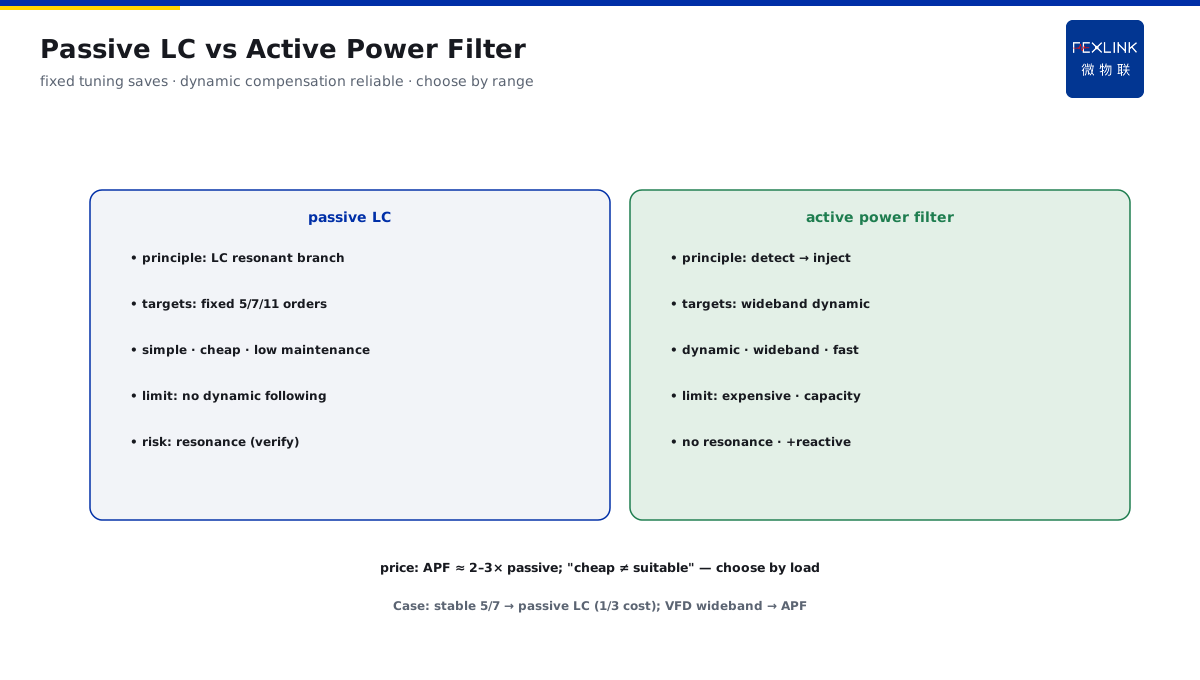
Direct Answer
An enterprise with harmonic over-limit is torn between APF and capacitor-compensation cabinets — the price gap is large. How to choose? The answer: choose by load characteristics — if the harmonic source is stable, dominated by a few orders, and the budget is limited, passive LC can suffice; if the harmonic source fluctuates, dynamic compensation is needed, or the system already has resonance risk, choose APF. The decision's key is to measure the harmonic spectrum and load fluctuation first, then compare the applicable ranges of the two equipment types, avoiding a blind purchase of an expensive APF.
At one plant's injection-molding machine group (harmonics mainly 5th/7th order, relatively stable load) with harmonic over-limit: the spectrum was measured first — 5th 12%, 7th 6% (voltage distortion over limit); load fluctuation small. Plan: passive LC filter branches (5th/7th tuned) + capacitor bank, at one-third the cost of an APF; after treatment, voltage distortion dropped to 3.5%, within limits. Decision logic: measure the spectrum and fluctuation first, then choose the equipment — passive for stable harmonic sources (saves money), APF for fluctuating sources (reliable), avoiding a blind purchase of expensive equipment.
Because:
- Passive LC is "fixed tuning": filters specific orders, simple structure and cheap;
- APF is "dynamic compensation": follows harmonic changes in real time, wideband, expensive;
- Applicable conditions differ: stable loads use passive, fluctuating loads use APF;
- Resonance risk: passive can resonate with system impedance and must be checked.
Key insight: "measure first, choose later" is the first principle of harmonic treatment. Spectrum + fluctuation determine the selection — passive for stable, APF for fluctuating; money spent where it counts.
At one plant, an APF was installed directly (without measuring harmonics first): high investment but the result did not match expectations. Review found the plant's harmonics were mainly 5th/7th and stable — passive LC would have sufficed; the APF's capability was excessive. The plan was later changed to passive LC: cost down 60%, treatment within limits. Lesson: choosing without measuring leads to over-investment — measure the spectrum and fluctuation first, then decide the equipment route.
1. Principles and Characteristics of the Two Equipment Types
Step one: how each works.
Passive LC compensation:
- Principle: LC resonant branch (low impedance at specific frequencies);
- Targets: fixed harmonic orders (5th/7th/11th);
- Characteristics: simple structure, low cost, low maintenance;
- Limits: filters only fixed orders, cannot follow dynamically;
- Risk: resonance with system impedance (needs verification).
Active power filter (APF):
- Principle: detects harmonics in real time → outputs reverse compensation current;
- Targets: wideband harmonics (dynamic changes);
- Characteristics: dynamic compensation, wideband coverage, fast response;
- Limits: high cost, capacity-limited (large capacity is expensive);
- Advantage: can also provide reactive compensation (optional).
Core differences:
- Fixed vs dynamic: passive fixed tuning, APF real-time following;
- Cost: passive low, APF high;
- Coverage: passive narrow (fixed orders), APF wide (wideband);
- Resonance: passive has risk, APF has none.
Key insight: passive = fixed filtering, cost-saving; APF = dynamic compensation, reliable. Applicable conditions determine value for money.
2. Applicable Load-Characteristic Comparison
Step two: which load uses which.
Passive LC applicable:
- Stable harmonic source (small load fluctuation);
- Harmonics dominated by a few orders (5th/7th concentrated);
- Limited budget (low-cost priority);
- Low system resonance risk (verification passed).
APF applicable:
- Highly fluctuating harmonic source (frequent load changes);
- Scattered harmonic orders (wideband over-limit);
- Dynamic-compensation need (real-time response);
- High system resonance risk (passive not advisable);
- Expansion margin (harmonics will grow).
Judgment basis:
- Harmonic spectrum: concentrated vs scattered;
- Load fluctuation: stable vs fluctuating;
- Resonance risk: low vs high;
- Budget: limited vs sufficient.
Example comparison:
- Injection-molding group (5th/7th stable): passive LC suffices;
- VFD group (wideband fluctuating): APF suitable;
- Arc furnace/rolling mill (impact fluctuation): APF required.
Key insight: load characteristics determine the selection. Stable concentrated → passive; fluctuating scattered → APF — compare against the applicable ranges before deciding.
3. Considering Resonance Risk
Step three: can passive cause problems.
Resonance principle:
- The LC branch and system impedance form a resonant circuit;
- Amplification when the resonant frequency coincides with system harmonic frequencies;
- Resonance overvoltage possible at light load or during switching;
- Capacitor banks and harmonic sources can also resonate.
Risk scenarios:
- Large background harmonics (resonance amplification);
- Reactive compensation mixed with filtering (multiple resonances);
- Switching operations (transient resonance);
- Load changes (resonant frequency drift).
Verification methods:
- System-impedance scan (resonant-frequency calculation);
- Switching simulation (transient verification);
- Field verification (monitor harmonics after commissioning);
- Reserve margin (tuning points away from system resonant frequencies).
Mitigation measures:
- Tuned branches away from system resonant points;
- Series reactors (limit inrush and harmonic amplification);
- Staged switching (control transients);
- Switch to APF when resonance risk is high.
Key insight: resonance is the enemy of passive. Verify and avoid — tuning points away from system resonant frequencies; when necessary, abandon passive for APF.
4. Cost-Magnitude Differences
Step four: how much money differs.
Passive LC cost:
- Component cost: reactors + capacitor banks;
- Per-branch price: by capacity (kvar);
- Characteristics: one-off investment, low maintenance;
- Magnitude: about 1/3–1/2 of an APF.
APF cost:
- Component cost: IGBT modules + control + cooling;
- Per-unit price: by capacity (A);
- Characteristics: high investment, some maintenance (module life);
- Magnitude: about 2–3 times passive.
Total-cost comparison:
- Same capacity: APF price is about 2–3 times passive LC;
- Operations: passive low, APF medium (module replacement);
- Effect: passive fixed, APF dynamic (as needed);
- Decision: choose by need, avoid over- or under-capability.
Cost-effectiveness trade-off:
- Stable harmonics: passive saves money with enough effect;
- Fluctuating harmonics: APF expensive but necessary;
- Resonance risk: APF avoids verification (total cost may be lower).
Key insight: the price gap is 2–3 times, but "cheap ≠ suitable." Choose by applicable range — passive saves for stable, APF is necessary for fluctuating; include resonance risk in total cost.
5. Decision Steps
Step five: how to choose step by step.
Decision steps:
- Step 1: harmonic measurement (spectrum + amplitude + trend);
- Step 2: load-characteristic analysis (fluctuation judgment);
- Step 3: resonance-risk verification (system impedance + switching);
- Step 4: plan comparison (passive/APF/hybrid);
- Step 5: commissioning verification (treatment effect + trend monitoring).
Measurement points:
- Harmonic spectrum: per-order content (concentrated vs scattered);
- Load fluctuation: current changes (stable vs fluctuating);
- Background harmonics: grid-side contribution (resonance risk);
- Trend: harmonic growth (expansion margin).
Selection comparison:
- Concentrated spectrum + stable + no resonance: passive LC;
- Scattered spectrum + fluctuating: APF;
- High resonance risk: APF (or verified passive);
- Budget-sensitive + stable: passive first;
- Important load + dynamic need: APF.
Verification:
- Re-measure harmonics after commissioning (compliance confirmation);
- Trend monitoring (tracking harmonic changes);
- Resonance monitoring (switching/light-load verification);
- Effect assessment (before/after comparison).
Hybrid-plan notes:
- Passive + APF combination: passive filters the main steady-state orders (5th/7th), APF supplements dynamic fluctuation;
- Applicable: mainly stable + partially fluctuating loads (balancing cost and effect);
- Configuration: passive by steady-state capacity, APF by fluctuation capacity (small capacity may suffice);
- Note: the hybrid also needs resonance verification (the passive part's risk does not decrease).
Key insight: the five decision steps: measure → analyze → verify → select → validate. Measure spectrum and fluctuation, verify resonance, then compare — data speaks, no blindness.
6. Product Landing: Power-Quality Monitoring
FEXLINK products land the harmonic-treatment decision:
- ESE Power-Quality Monitor / FSE Power-Quality Metering-Controller: harmonic-spectrum measurement (first-step data for the decision);
- Load-fluctuation analysis: fluctuation judgment (selection basis);
- Treatment-effect verification: re-measurement after commissioning (compliance confirmation);
- Long-term monitoring: harmonic trends (expansion/new-load warning).
Design principle in one sentence: "measure first, choose later — data speaks." Spectrum + fluctuation + resonance — the harmonic-treatment decision has a basis.
7. Common Decision Misconceptions
- Blindly buying APF: buying the expensive one without measuring. Consequence: excessive capability, wasted investment. Correct: measure spectrum and fluctuation first.
- Passive installed and forgotten: no resonance verification. Consequence: resonance amplifies harmonics/overvoltage. Correct: impedance verification + switching validation.
- Price only: using passive because it is cheap. Consequence: fluctuating harmonics not filtered (treatment fails). Correct: choose by load characteristics.
- No effect verification: installed and ignored. Consequence: treatment failure unknown. Correct: re-measure after commissioning + trend monitoring.
- Ignoring harmonic growth: configured per the current state. Consequence: over-limit again after load growth. Correct: reserve margin + long-term monitoring.
Scope and Limitations
This article provides a selection framework for APF active power filters vs passive LC compensation (principles/characteristics, applicable load characteristics, resonance risk, cost differences, decision steps) for selecting treatment equipment and designing plans for enterprises with harmonic over-limit. Specific equipment capacity must be calculated from on-site harmonic-measurement data and load characteristics; passive LC plans require system-impedance verification and switching simulation; treatment-plan design and construction must be performed by qualified personnel per codes. All cases are anonymized (a certain plant) and do not refer to any specific customer.