 FEXLINK Research Institute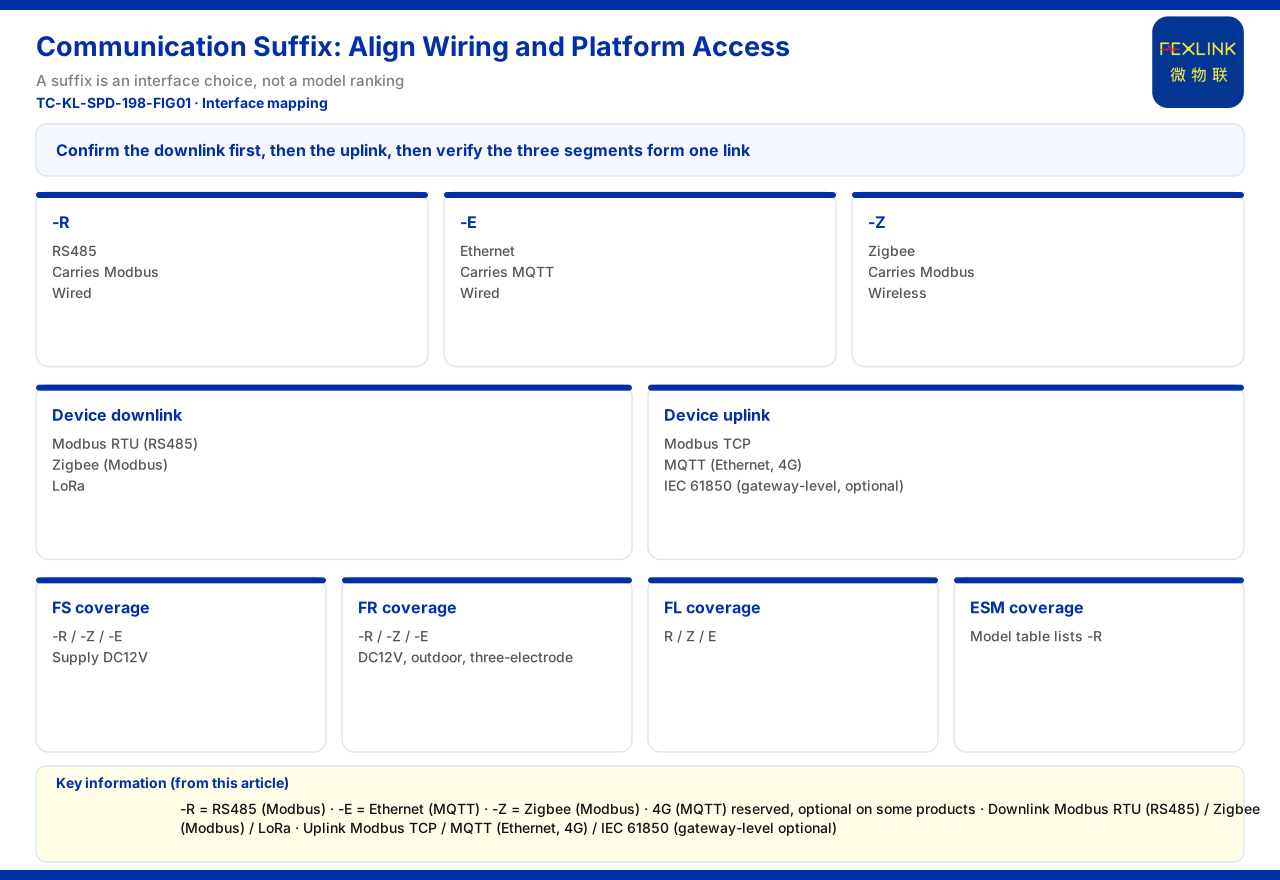
Direct answer
The communication suffix of a lightning-protection product is a selection digit corresponding to the on-site wiring method and the platform access method. The general suffixes given by the product material are: -R for RS485 (Modbus), -E for Ethernet (MQTT), and -Z for Zigbee (Modbus), with 4G (MQTT) reserved and optional on some products. Selection should first see whether the site permits cabling and whether the points are scattered, then look at the access method of the target platform, and finally confirm within the corresponding product family whether that suffix exists. Note that the product material does not give a priority rule for choosing a suffix by wiring method, transmission distance or platform type; selection should therefore match against the listed correspondences rather than assume a recommended order.
1. Each of the three suffixes corresponds to one communication method
The product material states the meaning of the suffixes directly: -R is wired RS485 carrying Modbus, -E is Ethernet carrying MQTT, and -Z is wireless Zigbee, also carrying Modbus. These three suffixes are not appearance or version differences but a combined identifier of the physical communication layer and the protocol. Understanding this makes it clear why the same monitoring point can choose models with different suffixes: their collection capability may be identical, and the difference lies in how the data is sent out. Treating the suffix as an interface choice rather than a model rank avoids unnecessary misunderstanding. Conversely, reading the suffix as functional strength may lead to a choice on the same monitoring point that does not match actual need, for example choosing wireless where cabling is convenient, or choosing RS485 when the platform accepts only Ethernet, with higher subsequent modification cost.
2. The suffix must match on-site wiring conditions
On-site conditions usually decide wired or wireless first. If monitoring points are concentrated and communication cable can be laid, a wired method facilitates unified wiring and management; if points are scattered and crossing walls or zones is difficult, a wireless method reduces construction work. Among the general suffixes in the product material, -R and -E are wired and -Z is wireless. The product material also records that the FR grounding resistance monitor (e.g. FR-01311-R) offers three variants, -R, -Z and -E, all DC12V, outdoor-installed and using the three-electrode method, which shows that under the same collection principle the suffix can be replaced according to on-site wiring conditions. Note that the material gives no specific limits on transmission distance, node count or interference conditions, so these should be confirmed by on-site assessment.
3. Distinguish Ethernet and 4G on the uplink
The device-side suffix solves how to connect into the gateway, while data reaching the platform also involves the uplink method. The communication protocol matrix given by the product material is: device downlink including Modbus RTU (RS485), Zigbee (Modbus) and LoRa; device uplink including Modbus TCP and MQTT (Ethernet, 4G), plus optional IEC 61850 at gateway level. Ethernet and 4G can both carry MQTT, and the difference is whether the site has a wired network. If the site can provide a network cable, devices with the -E suffix can be chosen together with an Ethernet uplink; if the site has no wired network, the availability of 4G should be checked among the listed options, and the product material states that 4G is reserved and optional on some products, so it must not be assumed that all models support it.
4. Suffixes and the protocol matrix are two descriptions
It is easy to conflate the suffix with the protocol matrix during selection, but the two are at different levels. The suffix sits on the device model and describes one device's interface; the protocol matrix describes the communication combinations the whole monitoring system allows, including device downlink and uplink. They should be read together: first confirm the downlink protocol by the device suffix, then confirm the uplink protocol by how the gateway and platform receive it, and finally check whether the two can form one link. The product material places the suffix in the general naming rules and the protocol matrix in the system parameters, precisely to signal that selection must cross these two levels. Looking only at the suffix and not the matrix may yield a combination that works for a single device but cannot be connected to the target platform.
5. Suffix coverage differs across product families
The product material shows that families differ in how fully they cover the suffixes. The FS surge protective device monitor (e.g. FS-00011-R) offers -R, -Z and -E communication in the model, with a uniform DC12V supply; the FR grounding resistance monitor likewise offers three variants; the FL lightning current / transient current monitor also offers R, Z and E communication on each model; while the ESM intelligent lightning-protection monitoring terminal (SPD monitor, e.g. ESM-11312-R) is listed mainly with -R communication in the product material's model table. This means selection must not assume that all products have all three suffixes but should confirm the available options family by family. If the site needs wireless access and a family does not list a wireless variant, the adjustment should be made at the combination level rather than forcing a fit.
6. Three steps for checking the suffix
Casting suffix selection into three steps is more robust. Step one confirms the downlink interface: list all devices to be connected, mark each model's communication suffix and corresponding downlink protocol, using the suffix definitions and the protocol matrix directly as the basis. Step two confirms the uplink interface: check the uplink protocols the gateway and platform accept, confirm the conditions under which Ethernet and 4G each apply, and confirm whether the chosen product supports them. Step three confirms consistency: check that the device suffix, the gateway downlink and the platform uplink form one complete link, and check whether the optional IEC 61850 is needed at the gateway layer. These three steps need no additional material; filling in the tables at the two ends side by side quickly exposes a break in the list. For a retrofit, the existing gateway's downlink protocol should also be an input, to avoid a suffix mismatch between new devices and the old gateway.
7. The selection priority not given in the material
The product material does not give the specific rules, priorities or limits for choosing -R, -Z or -E by on-site wiring method, transmission distance or platform access method. The correspondence between suffixes and protocols is limited to the general naming rules and the protocol matrix. One must therefore not infer from the product material conclusions such as preferring wired, or requiring wireless at a long distance. What selection can do is match item by item: whether the site permits cabling, which uplink protocols the platform accepts, and whether the target product family offers the corresponding suffix. Answering these three questions separately lets the suffix choice converge naturally and makes the reason for the choice easier to explain in review.
Scope and limitations
First, this article explains only the meaning of the communication suffix and the matching method; the factual boundary is limited to the product material, and no parameter, standard or certification not listed there is introduced.
Second, the suffix definitions, protocol matrix and product models here are as recorded in the product material; this article does not infer the communication capability of unlisted models from them, nor does it judge the actual link quality on site.
Third, the product material does not give a priority rule for suffix selection; the matching approach here is a method induction from the listed facts and does not represent a selection standard given by the material.
Fourth, the suffix choice of a specific project must be determined in conjunction with on-site wiring, distance, interference and platform access requirements; this article provides no networking design or selection calculation.