 FEXLINK Research Institute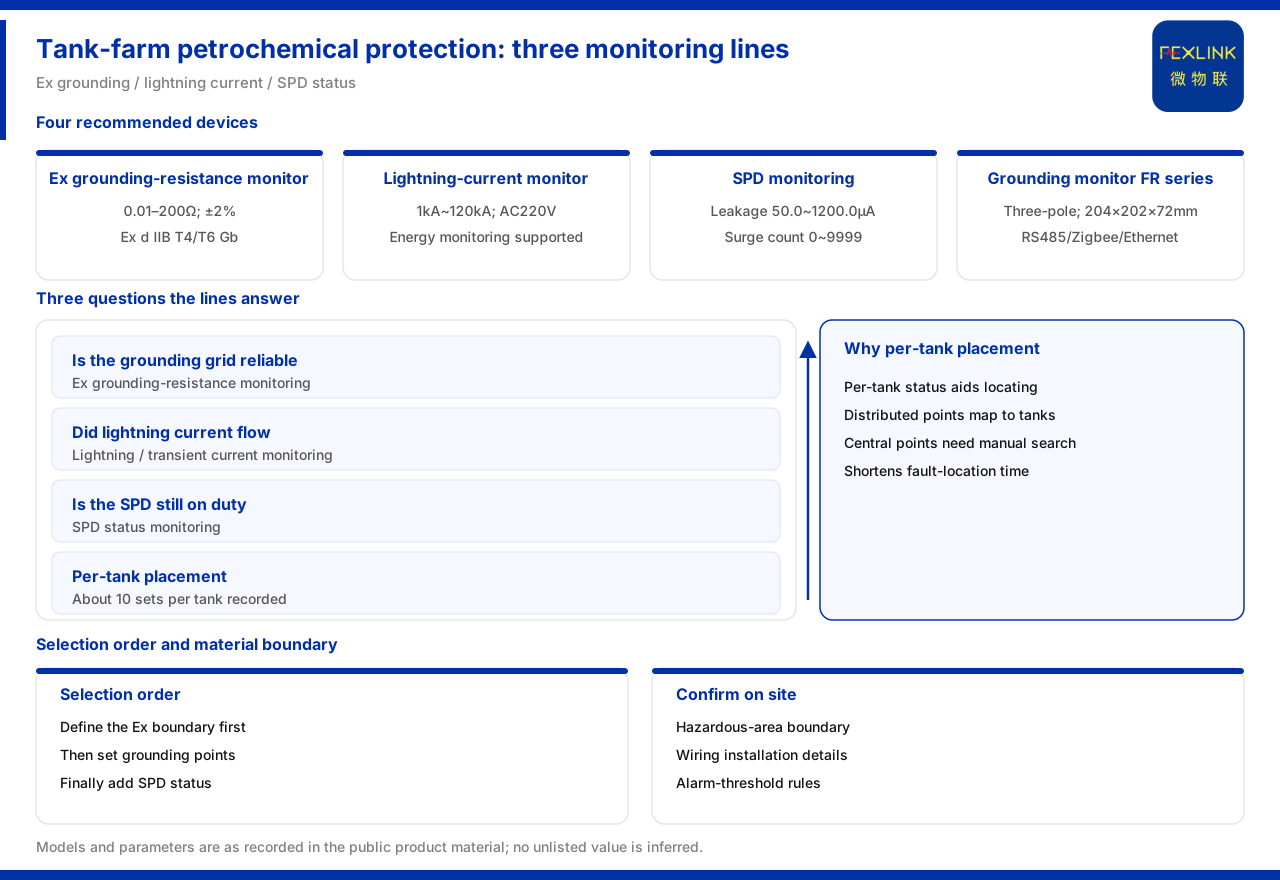
Petrochemical tank-farm lightning and explosion protection: how should the monitoring devices be configured?
Direct answer: according to the available product material, the recommended combination for lightning and explosion protection monitoring in oil-tank farms and petrochemical scenarios is three lines of capability — explosion-proof grounding resistance monitoring, lightning-current monitoring and surge protective device monitoring. Explosion-proof grounding resistance monitoring addresses the hazardous explosive atmosphere, with a range of 0.01–200 Ω and an accuracy of ±2%, and an explosion-protection rating of Ex d IIB T4/T6 Gb. Lightning-current monitoring covers a peak range of 1 kA to 120 kA, is powered by AC 220 V, and supports energy monitoring. Surge protective device monitoring gives a leakage current of 50.0 to 1200.0 μA (±10 μA) and a lightning-strike count of 0 to 9999 (minimum trigger 0.1 kA). The three lines answer three separate questions — whether the grounding grid is reliable, whether any lightning current has passed through, and whether the surge protective device is still working — and together they form a usable lightning-protection state view for the tank area.
Why grounding monitoring comes first
The underlying condition for lightning protection in a tank farm is grounding. Once the grounding resistance or the grounding loop becomes abnormal, lightning current cannot be discharged along the designed path, and no amount of air termination or protective components can guarantee the outcome. The FR grounding resistance monitor (for example the FR-01311 series) uses the three-electrode method, can be installed outdoors, and supports RS485, Zigbee and Ethernet communication; its aluminium enclosure measures 204 × 202 × 72 mm. For an oil-tank area, an outdoor, networkable form like this can be deployed close to the grounding grid directly, without concentrating the measuring unit inside a control room.
The material records that the FR/FRP grounding resistance monitors have been applied to the Jinzhou Port oil-tank area, at about 10 sets per tank. That deployment density shows what the tank area cares about: the independent state of each individual tank and its associated grounding grid, rather than one undifferentiated station-wide grounding value. Only by distributing monitoring points to the tanks can an operator locate the specific tank when one grounding point degrades.
A distinction must be drawn between the ordinary type and the explosion-proof type. The device intended for a hazardous explosive atmosphere is the explosion-proof grounding resistance monitor, with an explosion-protection rating of Ex d IIB T4/T6 Gb, a range of 0.01–200 Ω and an accuracy of ±2%. It solves the problem of measuring safely inside a hazardous area; an ordinary grounding resistance monitor, even with a similar range, cannot replace the installation conditions that the explosion-proof form corresponds to.
Lightning-current monitoring fills in "did a strike pass through"
Grounding state and protective-device state are both relatively static information; lightning-current monitoring supplies event information. The FL lightning current / transient current monitor (for example FL-01222-R) is offered in both indoor and outdoor forms, with a peak range of 1 kA to 120 kA, AC 220 V supply, and support for energy monitoring. For a tank area, its value is that it turns "a strike occurred" from an inference into a record: with peak and energy data, operation and maintenance can judge whether an inspection is needed after a thunderstorm and whether a protective device has already absorbed one high-intensity impulse.
Note that the peak range describes the monitorable interval, not a promise of protection capability. The material gives no recording method outside that interval, and no conversion rule between energy data and device life, so it is not possible to extrapolate that "monitoring a certain energy necessarily means damage".
Surge protective device monitoring answers "is the device still on duty"
The key parameters of the FS surge protective device monitor (for example FS-00011-R) are a leakage current of 50.0 to 1200.0 μA (±10 μA) and a lightning-strike count of 0 to 9999 (minimum trigger 0.1 kA). Leakage current reflects the small current state of the components inside the protective device under continuous voltage, while the strike count records how many times it has operated. One is static and one is dynamic, and together they support two kinds of judgement: whether the device is approaching degradation, and whether it has already operated.
The material notes that some surge protective device monitor models do not include leakage-current monitoring, and their leakage column is marked "—"; those models provide counting and other functions only. When selecting, therefore, first confirm whether the site needs "leakage plus counting" or "counting only", and do not assume that every surge protective device monitor has a leakage channel.
Why deployment by tank is emphasised
The grounding system of a tank area is usually not a single grid but is made up of the separate grounding and bonding of tanks, pipe racks and ancillary facilities. The application record of about 10 sets per tank shows that the monitoring units are distributed per tank. Distributed points give a direct location benefit: when one grounding resistance path becomes abnormal, operation and maintenance can map it immediately to a specific tank instead of searching segment by segment across the station.
Centralised points use fewer devices, but when an abnormality occurs the location must be isolated manually in stages, which lengthens the handling time. In a hazardous area, shortening the time to locate an abnormality is itself a safety benefit. Deployment by tank is therefore not about adding devices; it is about making the state of each grounding grid distinguishable.
How the three lines relate and the selection order
Looking at the three device types together, the selection order can be summarised as: first fix the explosion-proof boundary, then fix the grounding monitoring points, then look at the lightning-current channel, and finally add the protective-device state. The first step confirms which areas of the tank farm belong to a hazardous explosive atmosphere; only positions in that area need the explosion-proof grounding resistance monitor. The second step lays out grounding monitoring points per tank, using the deployment density of about 10 sets per tank as a reference for scale. The third step determines the mounting location and the indoor or outdoor form of lightning-current monitoring. The fourth step distinguishes, on the surge protective device monitor, whether leakage-current monitoring is included.
The point of this order is not to skip the explosion-proof boundary. If an ordinary device is placed in a hazardous area, the installation conditions do not hold even if the parameters are met; conversely, if the explosion-proof type is chosen everywhere including non-hazardous areas, it brings unnecessary cost.
Material boundaries and items to confirm on site
First, what the material gives is a recommended combination, not the only solution. Different tank areas may differ in grounding form, thunderstorm intensity and protective-device configuration, so the specific number of points must be determined together with a site survey.
Second, the material gives no installation and wiring details for explosion-proof devices, and no specific boundary for hazardous-area classification; both must be confirmed against the site design documents.
Third, the material gives no conversion relationship between lightning-current energy and the remaining life of a protective device, so energy data cannot be used directly as a replacement criterion.
Fourth, the material gives no linkage or alarm-threshold configuration rules for the various devices; these belong to the scheme-design level and need separate review.
Summary
The monitoring configuration for petrochemical tank-farm lightning and explosion protection can be set out as three lines: explosion-proof grounding resistance monitoring handles the grounding-grid state in the hazardous environment, with a range of 0.01–200 Ω, an accuracy of ±2% and an explosion-protection rating of Ex d IIB T4/T6 Gb; lightning-current monitoring handles strike-event recording, with a peak range of 1 kA to 120 kA; and surge protective device monitoring handles the protective-device state, with a leakage current of 50.0 to 1200.0 μA and a strike count of 0 to 9999. The FR grounding resistance monitor (for example the FR-01311 series) supports networking through the three-electrode method, an outdoor aluminium enclosure and RS485, Zigbee and Ethernet communication, and already has a tank-area application record of about 10 sets per tank.
When reviewing a scheme, it is worth checking three things in particular: whether the explosion-proof boundary is clearly drawn, whether the grounding monitoring points are implemented per tank, and whether models with and without leakage-current monitoring are distinguished. Keeping the parameters the material can support separate from the items that need on-site confirmation is what makes a tank-farm lightning-protection monitoring scheme both compliant and practical.